
The Cross Tie That Holds Firm and Releases When It Matters
Your horse is 1,200 pounds of flight instinct. The tie keeping him safe during grooming shouldn't be a liability — it should be the one piece of equipment you never think twice about.

Every Grooming Session Starts With a Silent Prayer That Your Ties Will Hold
The panic is over in seconds, but the aftermath lingers. A broken snap leaves you with a loose horse in a barn aisle, gates open, stall doors unlatched, and your stomach in your throat. A tie that doesn't release — that holds when it shouldn't — means a horse fighting against solid nylon, scrambling, potentially going down. Both failures happen in barns every day, not because horse owners are careless, but because most cross ties on the market aren't engineered for either scenario.
Riders who've been in the industry long enough have stories. The mare who flipped trying to get away from a tie that wouldn't give. The gelding who broke free, cantered through the parking lot, and spent an hour eating ornamental shrubbery while his owner called for help. These aren't freak accidents. They're the predictable result of using general-purpose hardware in a situation that demands specific, thoughtful engineering.
The frustrating part is that cross ties don't announce their weakness before it matters. They look fine hanging on the barn wall. They hold through a hundred easy grooming sessions. It's only when something goes wrong — when your horse actually needs the tie to perform — that you discover whether you bought a cross tie or a liability.

One Snap. One Frayed Ply. One Moment Where the Hardware You Chose Changes Everything.
The category gets confusing because products that appear similar can differ in construction, usable length, hardware, and package quantity. A fixed or limited adjustment range may work in your wash stall but leave your horse too close to a wall in another aisle. A tie sold individually can be mistaken for a pair. A snap configuration that was not considered before purchase may be less convenient once you are standing beside an anxious horse and need to manage the setup quickly.
Those small mismatches create a frustrating cycle. You shorten one side to compensate for uneven ring placement, borrow another tie at a show, or keep using a worn setup because replacing it means comparing measurements and hardware all over again. Meanwhile, your horse may be asked to stand in a space that feels more restricted than necessary. If your horse steps sideways, raises his head, or reacts to sudden barn noise, you do not want excess slack, an awkward angle, or unfamiliar hardware adding another complication.
That is the trap: buying by appearance instead of by construction and fit. Many nylon cross ties share the same basic silhouette, but that does not mean they offer the same ply count, adjustment range, snap types, or quantity. Until those details are checked, you are left hoping the tie will suit both your horse and the space where you actually groom.

Double the Ply. Nickel the Snap. Adjust for Every Aisle. That's the Formula That Works.
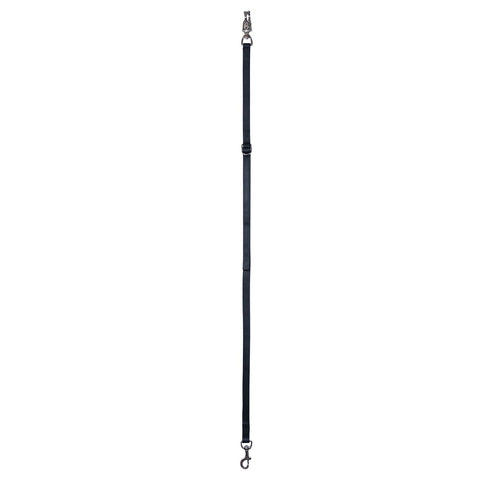
You can choose between two published adjustment ranges: 24 to 72 inches or 48 to 96 inches. The shorter option covers compact setups while still extending to six feet; the longer option reaches up to eight feet for wider aisles or higher and farther-spaced attachment points. Because the ranges overlap, you can select the version that best matches your barn rather than trying to make one fixed measurement work everywhere.
At one end, a nickel-plated quick-release panic snap provides an emergency-release option. The product is designed for cross-tie use while grooming or tacking up and is described as fitting most aisles, wash stalls, and grooming stalls. For your horse, the practical benefit is a setup that can be adjusted to the available space, helping you avoid relying on a tie that is plainly too short or leaving unnecessary length hanging in the aisle. As with any tying equipment, appropriate placement, supervision, and regular inspection remain part of responsible barn use.
For you, the payoff is straightforward: the construction, length choices, adjustment method, and package quantity are stated before you buy. Each cross tie is sold individually, so you can order the number your setup requires or replace one side without assuming a pair is included. It is a practical, horse-first approach to a basic piece of barn equipment—backed by equine expertise from a family-owned company trusted since 1948.
Break-Resistant Build
Double-ply heavyweight nylon distributes tension across twice the material, dramatically reducing the risk of snapping under a pulling horse.
Emergency Release
The nickel-plated quick-release panic snap is engineered to release under tension — exactly when and how you need it most.
Compare the Construction Before You Clip In
These adjustable nylon cross ties share a similar purpose, but their published construction, length ranges, hardware, and package quantities differ. “Not listed” means the cited product page does not publish that specification.
| Feature | Schneiders Dura-Tech® Double Ply Adjustable Nylon Cross Tie | Tough1 Adjustable Nylon Cross Tie | Weaver Equine Nylon Cross Ties, 1" |
|---|---|---|---|
| Published nylon construction | Heavyweight double-ply nylon | Doubled nylon | Quality nylon; ply count not listed |
| Published webbing width | 1 inch | 1 inch | 1 inch |
| Published adjustable length | Choice of 24–72 inches or 48–96 inches | 36–72 inches | 36–72 inches |
| Panic-snap description | Nickel-plated quick-release panic snap on one end | Heavy-duty brass-plated quick-release panic snap on one end | Panic snap on one end; plating or finish not listed |
| Hardware on opposite end | Not listed on cited product page | Easy-open Triggerbull snap | Swivel snap |
| Published adjustment design | Two-piece strap connected with adjustable slide hardware | Fully adjustable with slide buckle | Adjustable slide |
| Published package quantity | Sold individually | Package quantity: 1 | Sold per pair |
Double-Ply Nylon Built for Real Barn Use
- ✓1" double-ply nylon construction — heavy-duty strength throughout the full length of the tie
- ✓Nickel-plated quick-release panic snap for reliable emergency release under tension
- ✓Two adjustable length options: 24"–72" and 48"–96" to fit virtually any aisle or stall
- ✓Two-piece slide hardware design allows quick, tool-free length adjustment in seconds
- ✓Fits most barn aisles, wash stalls, and grooming areas — sold individually
Strength, Safety, and Adjustability — Everything Your Cross Tie Should Be.
Get the Cross Tie That Actually Releases When Your Horse Needs It To
The Dura-Tech® Double Ply Adjustable Nylon Cross Tie pairs a heavy-duty double-ply build with a nickel-plated panic snap rated for real emergency use — and adjusts to fit wherever your horse gets groomed. Schneiders has supplied working barns for 78 years and we stand behind every piece of hardware we carry. Don't settle for ties you can't trust — order yours today.