
One Rose-Pink Block, Hung Where He Can Reach It
Your horse knows when he needs salt — if you give him a source he can get to. Himalayan rock salt, mined from ancient deposits, hung in the stall and available free choice.

Fourteen Hours in a Stall and Nothing to Do With His Mouth
Salt is the other half of it. Horses need minerals daily, and a horse who wants them and can't reach them has no way to tell you except behavior. If the block lives in a holder on the ground under the water bucket, or the last one crumbled into the shavings, or he's in a different stall this week than last, he isn't getting to it reliably.
A hard block hung at head height solves both at once. He can lick it whenever he wants, and it gives him something worth going back to.
One honest caveat: if chewing, coat changes, weight loss, or hoof quality persist, that's a conversation for your veterinarian, not a block of salt.

A Block Only Helps If Your Horse Can Reach It
A scoop in the morning bucket only works if he cleans up his grain. Skip a feeding, turn him out early, or stall him beside a horse who bolts his own and helps himself to the rest, and what you paid for goes into the muck cart. A block sitting loose on the stall floor collects shavings and gets nudged into a corner. A holder solves that and puts one more piece of hardware into a stall, which some horses treat as a project.
Then there's the block itself. One that crumbles apart in a month gets replaced, kicked around, and half-wasted before he ever finishes it.
Free choice is the whole idea: your horse takes what he wants, when he wants it, and you're not guessing at grams. That only holds up if the block is hard enough to last and hung somewhere he actually goes.

Ancient Rock Salt, Mined Where the Ocean Once Was
It's a source of the natural minerals your horse needs daily, and it assures a balanced intake of iron, potassium, and magnesium. Feed it free choice in the stall: hang it, and your horse takes what he wants, when he wants it. No scoop, no top-dressing, no depending on him finishing his grain.
Hung at head height, it's a genuinely good boredom reliever too — something to work on through the long gap between hay and breakfast.
Four sizes come on a rope: 2.2, 4.4, 7.5, and 12 pounds. If your stalls are set up with holders instead, the 4.4 lb brick fits a standard salt block holder and ships without the rope. Pick the size for how hard your horse goes at it, and the format for how his stall is built.
Mined Himalayan Rock Salt
Mined from ancient deposits in the Himalayan Mountains. The rose-pink color signals the mineral content — a balanced intake of iron, potassium, and magnesium, in a hard block your horse can lick free choice.
Free Choice, All Day
Hang it in the stall and your horse takes what he wants, when he wants it — no scoop, no top-dressing, and a good boredom reliever through the long hours.
Three Free-Choice Salt Licks, Compared by Published Details
Compare each product by its published salt source, mineral description, feeding directions, and available formats. This table reports observable manufacturer or retailer information only; it does not imply nutritional equivalence or replace guidance from your veterinarian or equine nutritionist.
| Feature | Schneiders Himalayan Horse Rock Salt Lick | Horsemen's Pride Jolly Salt Snack | Redmond Rock® - Mined Horse Salt Lick |
|---|---|---|---|
| Published salt source | Mined from deposits in the Himalayan Mountains | Mined in the Himalayan Mountains | Mined from an ancient deposit in Utah |
| Published product description | Himalayan salt containing naturally occurring minerals | Pure Himalayan, rose-colored rock salt | Unrefined mineral salt containing sea salt and naturally occurring trace minerals |
| Minerals explicitly named in published materials | Iron, potassium, and magnesium | Iron, potassium, and magnesium | Iron, potassium, and magnesium are listed in Redmond's published trace-mineral analysis |
| Free-choice feeding directions | Feed free choice in your horse's stall | Not listed on the cited product page | Offer free choice in your horse's pasture or stall; provide fresh water |
| Rope-hung option | Rope-hung versions are listed for hanging in your horse's stall | The published description says the 2.2-, 4.4-, and 7.5-lb sizes include a rope | A Rock on a Rope option with a hemp rope is listed |
| Published non-rope format | A 4.4-lb brick designed for a standard salt-block holder is listed | A 4-lb brick appears in the product selector | A Rock No Rope format is listed by Redmond |
| Published enrichment positioning | Described as a boredom reliever when hung in your horse's stall | Not listed on the cited product page | The rope version is described as stall enrichment and a boredom buster |
Mined Pure, Delivered Simple, Used Free Choice
- ✓Rose-pink color confirms high iron and trace mineral content — not a dye, pure ancient geology
- ✓Available in 2.2 lb, 4.4 lb, 7.5 lb, and 12 lb sizes to fit any stall or budget
- ✓Rope-hung versions keep the lick accessible and off the stall floor — no tools needed to install
- ✓4.4 lb brick fits standard salt block holders — no special hardware required
- ✓Feed free choice — hang it and let your horse self-regulate daily mineral intake naturally
Pure Ancient Salt. Nothing Processed, Nothing Added.
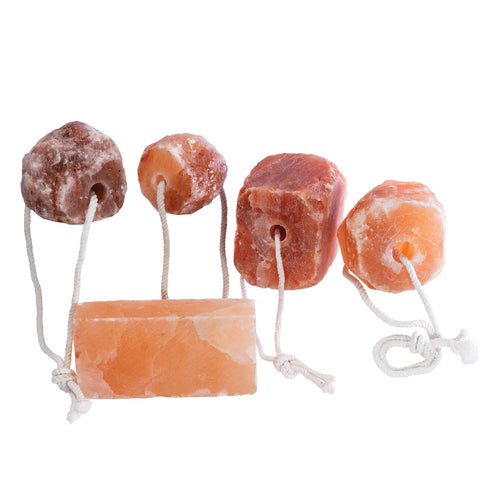
Hang One in Every Stall
The Himalayan Horse Rock Salt Lick gives your horse a free-choice salt source he can reach whenever he wants it — on a rope in 2.2, 4.4, 7.5, and 12 lb sizes, or as a 4.4 lb brick that fits a standard salt block holder. Family-owned since 1948, we don't stock products we wouldn't use in our own barn.