
Labeled for Small Strongyles — Including the Encysted Stages
Panacur® Paste 10% is 10% fenbendazole, labeled for large and small strongyles including the encysted stages, plus pinworms and ascarids. Where it fits your horse's year is a conversation for your veterinarian.

The Stage of the Cycle a Rotation Can Leave Behind
Here's what makes parasite management genuinely hard: the adult worms living in the large intestine are not the whole story. Small strongyle larvae can burrow into the intestinal wall and encyst there, and a dewormer's label tells you which stages it covers. A rotation built only around adults leaves that stage out of the plan.
That isn't a failure of effort. It's a gap in the plan, and the only way to close it is with your veterinarian, fecal testing, and a product whose label covers the stage you're worried about.

Not Every Active Reaches Every Stage
A horse grazes, takes in strongyle larvae from the pasture, and most of those larvae go on to mature into adults in the large intestine. Some of them don't. They burrow into the intestinal wall and encyst. Panacur's label covers large and small strongyles including those encysted stages, plus pinworms and ascarids — that's the reason it earns a place in the conversation.
And the conversation is the point. Encysted burden, fecal egg counts, your horse's age and turnout situation, what's already been used in your barn: those belong in front of your veterinarian before you change your program, not after. What we can tell you is what the label covers and how many syringes a given protocol takes. Your vet is who decides whether your horse needs it.

The Answer Lives in the Active Ingredient Your Rotation Has Been Missing
One 25-gram syringe deworms a horse up to 1,100 lbs at the standard dose. Set the dial ring to your horse's weight — determine the weight first, make sure his mouth is free of feed, and do not under-dose.
The five-day protocol is different arithmetic, and it's worth knowing before you order. For foals and weanlings under 18 months, where ascarids are a common problem, the label calls for 4.6 mg/lb (10 mg/kg) daily for five consecutive days — one syringe for each 550 lbs of body weight, per day. That's two syringes a day for an 1,100 lb horse, ten syringes across the full five days. Order the whole course rather than discovering it mid-week.
Panacur paste is labeled safe for use in foals and pregnant mares. Beyond that, the deworming decision belongs to you and your veterinarian: fecal testing, your pasture, your horse's history, and where fenbendazole fits your calendar. A published program runs December 1, February 1, April 1, June 1, August 1, and October 1. Bring it to your vet before you change what you're doing.
Schneiders has stocked trusted equine health products since 1948.
Labeled for Encysted Stages
Fenbendazole is labeled for large and small strongyles, including the encysted stages, plus pinworms and ascarids.
Labeled for Foals and Pregnant Mares
Panacur paste is labeled safe for use in foals and pregnant mares, with dosing published for foals and weanlings under 18 months. Your veterinarian is who decides which product and which protocol your horse needs.
Compare Equine Dewormer Labels Before You Dose
Each product uses different active ingredients and carries different parasite, age, and reproductive-safety labeling. Review the distinctions with your veterinarian using current body weight, diagnostic testing, breeding status, and your horse’s parasite-management history. “Not listed” means the cited label does not publish that indication or claim.
| Feature | Schneiders Panacur Paste 10% 25 g | ZIMECTERIN GOLD Paste | QUEST PLUS Gel |
|---|---|---|---|
| Active ingredient and labeled concentration | Fenbendazole paste, 10% (100 mg/g) | Ivermectin 1.55% plus praziquantel 7.75% paste | Moxidectin 2.0% plus praziquantel 12.5% oral gel |
| Syringe coverage at labeled doses | 25 g syringe treats up to 1,100 lb at 5 mg/kg; up to 550 lb per day at 10 mg/kg | 7.35 g syringe treats up to 1,250 lb at the labeled dose | 14.0 g SURE-DIAL syringe treats up to 1,500 lb at the labeled dose |
| Encysted or mucosal small-strongyle stages expressly listed | Encysted early L3 (hypobiotic), late L3, and L4 cyathostome larvae | Not listed as encysted or mucosal; the label lists fourth-stage small-strongyle larvae | Late L3 and L4 mucosal cyathostome larvae |
| Labeled regimen for the listed encysted or mucosal stages | 10 mg/kg daily for five consecutive days | Not listed for an expressly identified encysted or mucosal indication | One administration at the recommended dose |
| Tapeworm indication | Not listed | Anoplocephala perfoliata tapeworms listed | Adult Anoplocephala perfoliata tapeworms listed |
| Horse bot indication | Not listed | Oral and gastric Gasterophilus stages listed | Specified second- and third-instar Gasterophilus stages listed |
| Age information on label | No minimum age stated; label provides dosing for foals and weanlings under 18 months | For horses two months of age or older | For horses and ponies six months of age or older |
| Reproductive-safety labeling | Evaluated in pregnant mares and stallions; the five-day 10 mg/kg larval-control dose has not been evaluated in pregnant mares or stallions | Not tested in breeding, pregnant, or lactating mares or breeding stallions | Labeled safe for breeding, pregnant, and lactating mares; reproductive-safety studies in breeding stallions have not been conducted |
| Post-treatment strongyle egg-suppression claim | Not listed | Not listed | Suppression through 84 days following one oral administration |
Formulated to Reach Where Other Dewormers Can't
- ✓10% fenbendazole formula targets large strongyles, small strongyles (including encysted stages), pinworms, and ascarids
- ✓Apple-cinnamon flavor improves acceptance — even with reluctant horses
- ✓One 25g syringe treats horses up to 1,100 lbs
- ✓Dial-ring dosing mechanism for accurate, weight-based administration
- ✓Safe for foals, pregnant mares, and breeding stallions — broader approval than most dewormers
Targeted Parasite Control Your Rotation Has Been Missing
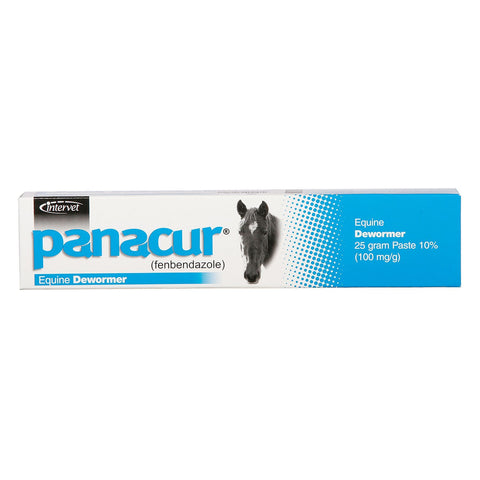
Talk to Your Vet, Then Order the Full Course
Panacur® Paste 10% is labeled for large and small strongyles — including the encysted stages — plus pinworms and ascarids. One 25-gram syringe covers a standard-dose treatment for a horse up to 1,100 lbs. The five-day protocol takes one syringe per 550 lbs of body weight per day, so count the whole course before you order. Talk to your veterinarian about where it fits your horse's year. Schneiders has stocked trusted equine health products since 1948.