
The Fly Sheet That Keeps Bugs Off Skin — Not Just On
Most fly sheets touch your horse's skin. That touch is why insects bite through. This one was engineered to be different from the first stitch.

Your Fly Sheet Is Touching Your Horse — And That's Exactly Why It's Failing
You've tried multiple brands. You've tried the lightweight ones that breathe well but billow and rotate by noon. You've tried the heavier ones that stay put but turn your horse into a greenhouse before 10 a.m. Every summer the pattern repeats: a few weeks of cautious optimism, then the first heat wave, then a horse who clearly hates wearing it. You start leaving it off on the worst days, which defeats the purpose entirely.
In high-gnat pressure zones — Florida panhandle, Gulf Coast, Eastern swamp country, Central Texas river bottoms — riders describe the same cycle. The soft mesh sheets that feel silky in the store compress flat against the coat within an hour of turnout. Fabric pressed against skin is, functionally, no barrier at all for a midge or no-see-um determined to feed. The insect doesn't need to penetrate the weave — it works the contact points.
By late summer, many horses develop rubbed patches at the withers, shoulders, and chest — not from insects, but from the sheet itself working against their skin in the heat. The belly, if the sheet doesn't have a proper band, gets hammered from below. And you've spent another season wishing there was something that actually worked the way the packaging promised.

The Soft Mesh Problem Nobody Talks About at the Feed Store
The air gap is everything. A window screen keeps insects out not because the mesh is impenetrable but because the space between screen and sill is a barrier insects won't cross in flight. The moment mesh fabric presses flat against your horse's coat — held there by warmth, sweat, and gravity — it becomes a contact surface. Gnats, midges, and no-see-ums are small enough to work those contact points, particularly at the shoulders and neck where a soft sheet naturally settles lowest.
Owners keep solving the wrong problem. They upgrade to a higher thread count. They apply extra fly spray under the sheet. They try compression clips and additional belly straps. None of it addresses the root issue: a fabric that drapes against skin cannot create the air gap required to actually keep biting insects off. The physics won't allow it, regardless of what the tag claims about insect resistance or UV protection.
The wither and neck fit issue compounds everything further. Most fly sheets are designed for a generic body type that doesn't account for the real range of horses in turnout. A sheet that pulls tight across high withers creates a pressure ridge, and that ridge becomes a rub zone within days. A sheet with an ill-fitting chest panel won't stay centered, and a sheet that drifts exposes exactly the areas you were trying to protect — leaving both horse and owner worse off than no sheet at all.

When Stiff Fabric Became the Kindest Thing You Could Put on Your Horse
That air gap changes the physics. Gnats and no-see-ums that exploit soft-mesh contact points can't reach skin when space exists between fabric and coat. The mesh weave blocks insects in flight; the material's stiffness helps ensure they never find the contact surface they need. In high-gnat pressure regions where riders have tried everything else, this principle is what produces the response owners keep describing the same way — in their own words — as 'finally.'
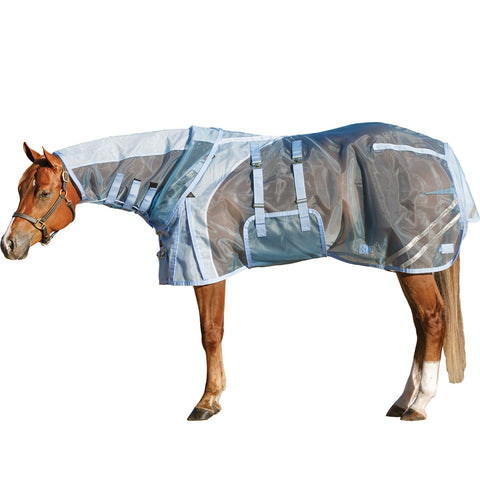
Designed with our V-Free® Wither Relief fit, this fly sheet is well suited for horses with a naturally sloped shoulder, moderately defined shorter wither, and strong, well-muscled topline. A stretch seam at the neck junction moves through grazing and drinking without creating a pressure ridge across the wither. The Adjusta-Fit® chest closure adjusts for actual shoulder width, not the shoulder width of an imaginary average horse. The elastic bellyband seals the underside and helps keep the whole system anchored through rolling and active movement.
SilverTek® antibacterial lining on the chest, shoulders, and tail flap addresses the rub zones where continuous contact breaks down skin. Reflective striping runs the body length for visibility at dawn and dusk turnout — precisely when biting insect pressure peaks. Forty percent UV protection helps prevent coat bleaching through sustained summer exposure. The 2-year warranty backs every stitch. Schneiders has been building horse clothing in Chagrin Falls, Ohio since 1948, and the Mosquito Mesh® II is the product our engineers kept returning to improve until the physics were right.
Air-Gap Protection
Stiff 350D nylon stands off the coat to maintain the air gap that keeps gnats and no-see-ums from ever reaching skin.
Wither-Relief Fit
V-Free® neck and Adjusta-Fit® chest move with your horse's conformation, eliminating the pressure ridges and rubs that end seasons early.
Full-Coverage Fly Sheets, Feature by Feature
Compare published construction, coverage, fit, and UV specifications for three fly sheets. This table reflects observable product-page information rather than performance rankings; where a specification was not published, it is marked “Not listed.”
| Feature | Schneiders Schneiders® Mosquito Mesh® II Attached Neck V-Free® Adjusta-Fit® Bellyband Fly Sheet | Rambo® Protector Plus Fly Sheet (No Fill + Hood) | WeatherBeeta ComFiTec Essential Mesh II Combo Neck |
|---|---|---|---|
| Main mesh material | 350D extra-fine “window screen” nylon mesh | Patented self-repairing polyester-and-nylon mesh; denier not listed | Soft, durable, breathable mesh outer; fiber and denier not listed |
| Neck coverage | Integrated attached neck; does not detach | Standard neckline with detachable close-contact hood included | Combo-neck design; detachable status not listed |
| Front closure | Adjusta-Fit® open front with double snaps and hook-and-loop adjustment | V-front closure | Twin adjustable buckle closure with touch tape |
| Underbelly coverage and closure | Snug bellyband with elastic inserts, T-post hardware, and locking bands | Extra-wide belly band with hook-and-loop fastening and three adjustable straight surcingles | Low cross surcingles; belly wrap not listed |
| Published UV protection | 40% UV protection | 65% UV protection | 75%+ UV block |
| Contact-area lining | 70D SilverTek® nylon lining at chest, shoulders, and tail flap | Silky lining at neck, shoulders, and extra-long tail flap | 210T nylon lining at shoulders, mane, and tail |
| Published size range | 70–86 inches | 60–87 inches | 66–84 inches |
| Rear stabilization listed | Detachable elastic leg straps adjustable from 20–38 inches | Adjustable tail strap | Adjustable, removable leg straps |
| Published warranty for this fly sheet | Two-year limited warranty covering straps, surcingles, assembly, and hardware | Two years | Not listed |
Engineering Built Around the Air Gap
- ✓Mosquito Mesh™ — Best dual airflow & insect protection
- ✓Best protection against gnats, stable flies & mosquitoes
- ✓Better protection against large flies (horse flies, greenheads)
- ✓0.4 UPF UV rating
- ✓2-year warranty
Full-Season Protection. Fit That Actually Fits.
Get the Air-Gap Protection Your Horse Has Been Waiting For
The Schneiders® Mosquito Mesh® II is built around the principle that fabric touching skin isn't protection — it's a contact point for every gnat in the pasture. With decades of horse clothing expertise behind every fit detail and a 2-year warranty backing the construction, this is the fly sheet designed to hold its air gap when others fail. Order yours today and give your horse a better fly season.