
Stop the Stomp: Four Boots, Knee to Coronet Band
Every stomp your horse throws at a fly is a tiny shockwave through the joints, tendons, and hooves. These boots were built to end that cycle — durably, affordably, and in a full set of four.

Your Horse Is Stomping All Day — and the Damage Goes Deeper Than Flies

Most Fly Boots Look Fine in the Tack Room — and Fail by 10 A.M.
- ✗Stomping all day drives concussion into your horse's joints, muscles, and hooves.
- ✗Short closures load up with chaff and mud, then let the boot slide down the leg.
- ✗A light mesh does not last a full season of sun, washing, and pasture play.
- ✗Gaps at the top and bottom are exactly where flies get inside the boot.

Dura-Mesh II: Built for the Horse Who Plays Hard
The full-length hook and loop closure runs the whole height of the boot instead of pinching everything down to one narrow band, and flexible stays hold the boot's shape against the leg through a full range of motion, so it does not collapse or bunch at the fetlock. The protection you fastened at morning turnout is still where you put it at evening check.
Fleece sits at the top and bottom of the boot. It gives your horse a soft contact surface at the knee and the coronet band, and it reduces the chance of flies working their way in at the edges. New, more comfortable elastic makes the boot easier on the leg than the version it replaces.
The non-fitted cut stands off the cannon so more air keeps moving, which matters in a hot climate where a boot that bakes gets rubbed off by lunchtime. The mesh also carries a 70% UV protection rating, which matters for horses in southern or high-altitude pastures and for anyone with white stockings and pink skin below the knee that the sun finds first. All four legs, one set, one decision.
Hard Play Durability
1000D heavy poly/vinyl coated mesh stands up to fence posts, gate hardware, and the pawing a fly-bothered horse does all day.
Non-Fitted Airflow
The non-fitted cut stands off the leg so more air moves through, built for warmer climates.
Fleece Top and Bottom
Fleece at the knee and the coronet band gives your horse a soft contact surface and reduces the chance of flies getting inside.
70% UV Protection
A published 70% UV rating over the lower leg, from the bottom of the knee to the coronet band.
Compare the Published Fly Boot Features
See how three non-fitted fly-protection options compare using specifications and design details published on the cited product pages. Unlisted specifications are identified rather than inferred.
| Feature | Schneiders Schneiders® Dura-Mesh II Non-Fitted Fly Boots - Set of 4 | Kensington 73% UV Bubble Fly Boots - Set of 4 | Cashel Crusader Fly Leg Guards - Set of 4 |
|---|---|---|---|
| Package quantity | Set of 4 | Set of 4 | Set of 4 |
| Published mesh construction | 1000D heavy poly/vinyl-coated mesh | USA-made 1000 x 2000 denier Textilene® fabric | Soft nylon-coated micro mesh |
| Closure design | Full-length hook-and-loop closure | Long vertical hook-and-loop closure | Adjustable hook-and-loop closures |
| Top and bottom trim | Fleece around the top and bottom | Light fleece trim around the top and bottom | Soft nylon trim |
| Shape-support design | Flexible stays help keep the non-fitted boots upright | Roomy bubble design intended to maximize airflow and minimize skin contact | Design described as inhibiting sagging and shifting |
| Published UV protection | 70% UV protection | 73% UV protection | Percentage not listed on the cited product pages |
| Listed size options | Pony (11 in.), Horse (14 in.), and Draft/Oversize (15.5 in.) | Medium/Small Horse (700–900 lb), Large/Average (900–1,200 lb), and XLarge/Large Horse (1,200–1,500 lb) | Mini, Small Pony, Large Pony, Arab, Horse, and Warmblood |
Heavy-Duty Mesh Engineered for Real Pasture Conditions
- ✓Dura-Mesh™ — Maximum durability for active horses
- ✓Best protection against deer flies, greenheads & horse flies
- ✓Better protection against gnats, stable flies & mosquitoes
- ✓0.7 UPF UV rating
- ✓Hard Play Durability — built for the most active horses
Complete Leg Coverage, Right Out of the Box
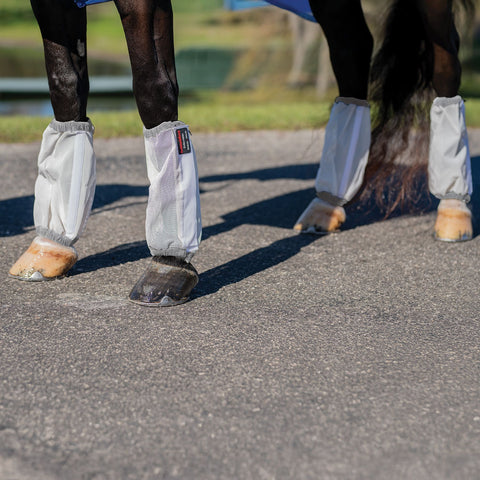
One Set. Four Boots. Knee to Coronet Band.
The Schneiders Dura-Mesh II Non-Fitted Fly Boots bring 1000D mesh, a full-length closure, flexible stays, and fleece-lined edges to all four legs in a single set. Hard play durability and 70% UV protection, from a family horse business that has been doing this since 1948. Order your set today and give your horse the protection he needs to rest and graze instead of stomp.