
Train Over Fences Without Lugging Heavy Jump Standards
You want to work on cavalettis and grid work, not spend half your session wrestling wooden standards into position. Lightweight, durable, and built to stack — these jump blocks give your ring the flexibility your training demands.

Your Jump Setup Is Eating Into Your Actual Riding Time
Every English rider who schools at home or works without a jump crew knows this tradeoff. A simple cavaletti exercise can require several trips across the ring, especially when standards, poles, and cups are stored separately. Then the exercise changes: lower one side, move the placing pole, widen the cross pole, or rebuild the line for a greener horse. Each adjustment interrupts the rhythm of the session and asks your horse to stand through another pause.
The cost isn’t only inconvenience. Limited arena time often has to fit around work, chores, lessons, weather, and daylight. When the setup feels larger than the ride, it becomes tempting to simplify the plan, leave out the second exercise, or choose flatwork again. None of those choices is wrong, but they may not match the training session you intended for your horse. Repeated often enough, the equipment begins deciding the program instead of supporting it.
What makes this frustrating is that the riding goal is usually modest: organize poles, adjust heights, and keep your horse focused without turning every change into a barn project. You don’t need a permanent show course for basic grid work. You need a setup that fits the way you actually train—often alone, on a schedule, with your horse’s attention as valuable as the remaining daylight.
Traditional Jump Equipment Was Never Designed for the Working Rider
That friction shows up in small choices. You set the first line but skip the second because the standards are at the far end of the barn. You leave a pole at one height instead of changing the question for your horse. You rush a reset while holding the reins, or you dismount again and let your horse wait while you move both sides. The equipment still works, but the process pulls attention away from pace, straightness, distances, and the quality of each pass—the details the exercise was meant to improve.
The stop-and-start pattern can be especially unhelpful with a young, fresh, or easily distracted horse. Long pauses give your horse time to look outside the ring, drift away from the task, or lose the steady rhythm you established in warm-up. Then you spend the next pass rebuilding focus instead of progressing through the grid. If daylight, weather, or a lesson schedule is closing in, the pressure to hurry increases, and careful course changes can start feeling like obstacles of their own.
That is the trap: riders often accept cumbersome setup as inseparable from useful fence work. So the planned gymnastic becomes one cross pole, the adjustable cavaletti stays at one setting, and the extra repetition gets postponed. Your horse may still have a productive ride, but the equipment has narrowed the options before the schooling question is fully answered. When every variation demands another haul across the arena, consistency depends less on your plan and more on how much setup you can tolerate that day.
- ✗Half your ride disappears into carrying standards back and forth across the ring.
- ✗Wooden standards are awkward to move alone, so the second exercise never gets built.
- ✗A rail that rolls off means another dismount and another pause for your horse.
- ✗Wood in an outdoor ring means painting, sealing, and replacing warped boards.

Lightweight Blocks That Set Up in One Trip and Stay Put
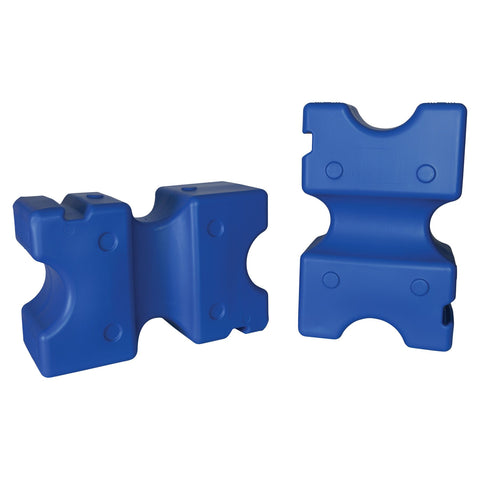
The blocks are heavy-duty, thick-walled plastic. They will not absorb moisture or warp the way wood does, which means no painting, no sealing, and no replacing swollen boards — and they take a knock from a hind foot and go back in the ring. Each block measures 22.5 by 9 by 14 inches, giving your pole a solid base that is not easily tipped.
Grip ridges on the stacking surfaces keep the upper block from sliding off the lower one when you stack for height. The indentations hold your rail in place instead of letting it roll off the moment the wind picks up or your horse brushes it on the way through. For cavalettis, cross poles, and grid work, that means you can change the question you are asking without rebuilding the whole exercise.
Schneiders has been equipping working barns and competitive riders since 1948, and these blocks carry the same idea: solve the real problem, not the theoretical one. Sold in pairs.
Set Up Fast
Light enough to carry both blocks at once and set them without a helper, so your ring is ready in minutes.
Built to Last
Heavy-duty, thick-walled plastic that will not absorb moisture or warp the way wooden standards do — no painting, no sealing, no replacing boards.
Stack for Height
Grip ridges on the stacking surfaces keep the upper block from sliding off the lower one when you stack for additional height.
Poles That Stay Put
Indentations let a pole or wooden rail sit down into the block instead of rolling off the side.
Choose the Jump Blocks That Fit Your Training Setup
Here’s how three real jump-block products compare using specifications and features published by their manufacturers or current product pages. “Not listed” means the cited source did not publish that detail; no missing specification has been inferred.
| Feature | Schneiders Schneiders® Jump Blocks - Pair | Horsemen’s Pride Jump Block | Burlingham Sports Riser Max Jump Block |
|---|---|---|---|
| Package quantity | Sold as a pair | Sold as a pair | Sold as a pair |
| Published dimensions | 22.5 in. x 9 in. x 14 in. | 20.25 in. x 15.25 in. x 9 in. | 8.5 in. x 13.5 in. x 16.75 in. per block |
| Published material | Heavy-duty, thick-walled plastic | Single-mold polyethylene | Not listed in the cited Riser Max entry |
| Stacking design | Stackable, with grip ridges designed to help keep stacked blocks from sliding | Can be stacked in two orientations: flat or upright | Uses a peg-in-hole stacking feature |
| Numeric heights published for one pair | No numeric height positions listed | 9 in., 15 in., or 24 in. | 10 in., 15 in., or 18 in. |
| Published pole accommodation | Indentations are provided for a pole or wooden rail | Poles are not included; maximum pole diameter is not listed | Designed to hold poles up to 4 in. |
| Listed training uses | Cavalettis, cross poles, grid work, and training jumps | Schooling and training exercises | Cavaletti, lunging, and jumping |
| Listed color options | Blue, red, and white | Blue, red, and white | Black, green, grey, purple, red, royal blue, and white |
Engineered for the Way Riders Actually Train
- ✓Sold in pairs — everything you need for a complete fence in one purchase
- ✓Grip ridges lock stacked blocks so rails don't send the whole stack sideways
- ✓Pole indentations hold rails securely in place throughout the exercise
- ✓22.5" x 9" x 14" footprint — stable on arena footing, compact to store
- ✓Stackable design provides adjustable fence height without extra equipment
One Pair. Every Jump Exercise You Need.
Spend Less Time Moving Standards and More Time Jumping
Schneiders Jump Blocks are lightweight, stackable, and made from heavy-duty thick-walled plastic that will not warp or need painting. Grip ridges hold the stack, indentations hold your rail, and one pair covers cavalettis, cross poles, and grid work. We have been equipping working barns since 1948. Order your pair today.