
Fine Enough for Gnats, Comfortable Enough to Wear All Summer
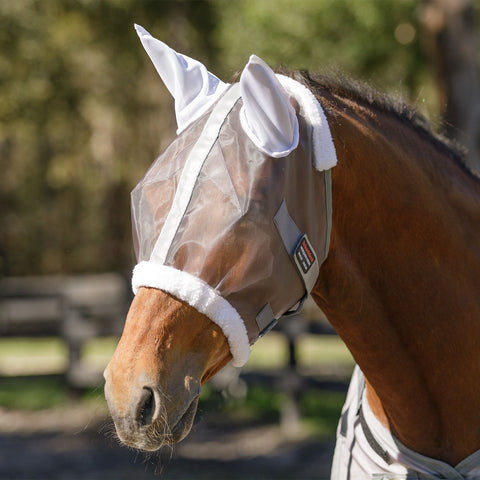
350D extra-fine window-screen mesh shields your horse from small to medium-sized biting insects, including tiny gnats, with our best airflow and a 40% UV protection rating.

Your Fly Mask Is Letting the Worst Bugs Through
Constant head shaking is not a small thing. A horse in that state is not resting, not settling, and not much fun to handle. Heat makes it worse. A thick, close mask on a hot afternoon traps warmth against your horse's face, and a horse who is too warm rubs the mask off. You come out at noon and find it halfway across the paddock, your horse squinting in the sun. You have tried different brands, different sizes, different closures. Something still gets through.

Standard Fly Mask Mesh Was Never Designed for Gnats
So riders layer. A bandana over the ears. Tape at the cheekbones. Another spray, another fan in the stall. None of it addresses the mesh, and the mesh is the whole argument.
There is also a stubborn belief that a finer weave has to mean less air and more heat. It sounds logical, but it depends entirely on the material. A coarse, heavy mesh can hold radiant heat despite its big openings; a fine mesh made from the right nylon can keep air moving because it is not carrying that weight in the first place.
And then fit. Riders who switch masks to solve the bug problem often trade it for a new one: loose at the ears so the midges walk in at the edge, or close enough to the eye to leave a rub mark, or a closure that gives up three weeks into field use. Options are not the same as a solution.
- ✗Tiny gnats and no-see-ums pass straight through ordinary fly mask mesh.
- ✗A hot, heavy mask gets rubbed off by noon and left in the paddock.
- ✗Loose ear pockets let midges in right at the edge.
- ✗A mask that sits too close to the eye leaves rub marks by the end of the week.

350D Window-Screen Mesh, Built for Hot and Buggy
The same fine weave is what gives this mask our best airflow. It stays cool in direct sunlight and carries a 40% UV protection rating over the sensitive skin around your horse's eyes and nose, which matters most in exactly the hot, humid places where heat buildup is what drives a horse to rub a mask off in the first place.
A reflective strip runs down the face and across the hook and loop closure, so your horse is easier to see at dusk, on a night check, or on a trail ride that runs late. And the fit is the one our team is proudest of: this is the most comfortable fit in our fly mask line, and comfort is what keeps a mask on a horse's face instead of in the dirt.
This mask carries the Schneiders name because Schneiders designed it. We have been a family-run horse business in Chagrin Falls, Ohio since 1948 — decades of listening to what riders actually need, changing what does not work, and standing behind what does.
Stops the Smallest Biters
350D extra-fine window-screen mesh is our best shield against small to medium-sized biting insects, tiny gnats included.
Best Airflow
The fine weave keeps air moving and stays cool in direct sunlight, built for horses living in hot, buggy climates.
Most Comfortable Fit
The most comfortable fit in our fly mask line, because a mask your horse tolerates is a mask that stays on his face.
Reflective Face Strip
A reflective strip down the face and on the hook and loop closure raises visibility in low light and at night turnout.
How Three Fine-Mesh Fly Masks Compare
Compare the manufacturers’ published details for mesh, ear coverage, UV protection, closures, and other practical turnout features. “Not listed” means the cited product pages did not publish that detail as of the date below.
| Feature | Schneiders Schneiders® Mosquito Mesh® II Fly Mask with Ears | Cashel® Crusader™ Standard Fly Mask with Ears | WeatherBeeta ComFiTec Deluxe Fine Mesh Mask With Ears |
|---|---|---|---|
| Face mesh | 350D extra-fine “window screen” nylon mesh | Soft, plastic-coated mesh; Cashel describes its Crusader mesh as soft-coated nylon micromesh | Fine mesh made from 100% polyester |
| Ear coverage | Soft mesh ear coverage | Covered ears | Air-stream ear coverage designed to allow airflow |
| Published UV protection | 40% UV protection rating | 70% UV protection rating | 60%+ UV block |
| Closure design | Two wide, reflective hook-and-loop closures: one under the cheek/chin and one at the throatlatch | Hook-and-loop closure under the jaw | Adjustable double touch-tape tabs |
| Forelock accommodation | Not listed | Center hole at the poll allows the forelock to pull through | Forelock hole |
| Reflective details | Reflective strip down the face and reflective hook-and-loop closures | Not listed | Not listed |
| Published insect-protection scope | Small gnats, mosquitoes, stable flies, and deer flies | Small, irritating insects | Smaller insects |
| Published vision or eye-area design | Not listed | Described as not impairing vision | Fine mesh is described as allowing full vision; double darts shape the fit |
Built for the Bugs That Never Quit
- ✓Mosquito Mesh™ — Best dual airflow & insect protection
- ✓Best protection against gnats, stable flies & mosquitoes
- ✓Reflective strip down the face for low-light visibility
- ✓0.4 UPF UV rating
- ✓Playful Durability — stands up to active horses
Real Protection for the Bugs Your Other Mask Ignores
Give Your Horse a Quieter Summer
The Schneiders Mosquito Mesh II Fly Mask with Ears is woven from 350D extra-fine window-screen nylon, our best shield against small to medium-sized biting insects including tiny gnats, with our best airflow, a 40% UV protection rating, and a reflective strip down the face. We have been making equipment you can trust since 1948. Order yours today and put the head shaking behind you.