
Rated Best Airflow — With the Belly Covered
300D textured nylon mesh built for the greatest airflow in our fly-sheet lineup, with a bellyband that carries the coverage under the barrel and a 40% UV rating over the topline.

The Sheet Went On. The Sweat Came With It.
You bought it for the right reasons. The gnats were clustering at his belly and flanks and hanging around his eyes no matter how often you sprayed. A fly sheet was the obvious answer. But somewhere between the catalog photo and an August afternoon in a field with no shade, something went wrong.
What most horse owners find out mid-summer is that not all fly fabrics move air the same way. A sheet that is fine in May becomes a liability by late July. Your horse starts moving differently under it — less willing, quicker to break a sweat, harder to cool out after a ride.
Then there is where the sheet sits. One that rides crooked or bunches at the shoulder gives you rub marks inside a week, and a belly left open gives the gnats the one place they want most.

Fly Sheet Marketing Promises Cool. Most Fabrics Deliver Heat.
Airflow is not one measurement. It depends on how the fiber is textured, how open the weave is, and how the fabric drapes and vents across your horse's body once he is actually moving. Buying lighter is the usual reaction to a sweaty horse, and it does not always help: a thin, tightly woven fabric can block air just as well as a heavy one, and it often gives less insect coverage, not more.
The belly is the second blind spot. It is a primary strike zone for biting flies and gnats, and most standard sheets leave it open or only loosely covered. A sheet that gaps underneath solves half the problem while you keep adding sprays, roll-ons, boots, and masks to cover the other half.
Then comes fit. A seam sitting in the wrong place on the barrel creates friction in days. A back cut that ignores the topline bunches at the croup. Riders get frustrated and decide their horse is hard to fit, when the sheet was simply not cut for the way a horse is shaped.
- ✗Horses coming in from turnout damp under the sheet
- ✗Gnats working the belly a standard surcingle sheet leaves open
- ✗Seams riding on the barrel and rubbing within a week
- ✗Fly sheets that read the same on the label and behave nothing alike

Airflow First. Then the Belly. Then the Fit.
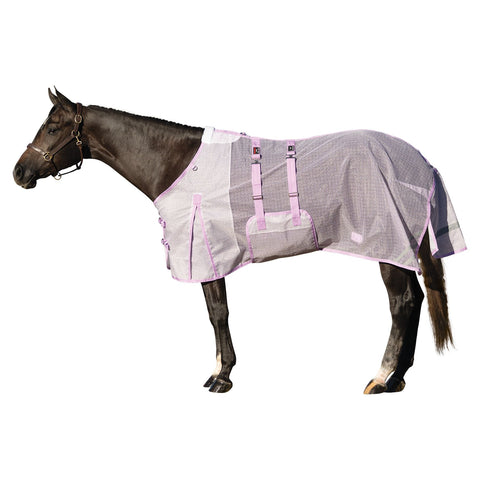
The bellyband closure carries that mesh where a surcingle sheet cannot. It brings the coverage under the barrel — the warm, sheltered strip where gnats and flies concentrate — and holds it flush without pinning his movement.
The cut is built around how a horse is actually shaped. There are no side seams, so nothing rides along the barrel where he rubs, rolls, and lies down. The contour back seam follows his topline instead of cutting straight across it, which is what keeps the sheet sitting where you put it.
Where the fabric sits against him all day, SilverTek® antibacterial nylon lines the chest, shoulders, and tail. Reflective stripes on the flank and tail add visibility in low light or night turnout, and detachable leg straps are included. The Euro fit conforms to most horses.
One honest note: this weave gives better insect protection against small to medium insects like gnats and flies. Mosquitoes, greenheads, and horse flies can still bite through a fabric this soft — if those are your worst offenders, our Mosquito Mesh® sheets are the tighter weave built for them.
Family-owned in Chagrin Falls, Ohio since 1948.
Rated Best Airflow
300D textured nylon mesh built for the greatest airflow in our fly lineup, so a sheet in August is still a sheet your horse can wear.
Bellyband Coverage
The bellyband brings the mesh under the barrel and holds it flush, covering the strip standard surcingle sheets leave open.
40% UV Protection
A published 40% UV rating over the topline — coat protection without the weight of a heavier fabric.
No Side Seams
No seam line riding along the barrel where your horse rubs and rolls, and a contour back seam that follows his topline.
How These Full-Coverage Fly Sheets Compare
Compare the manufacturers’ published construction, UV protection, coverage, lining, and fit features. Unpublished details are marked “not listed” rather than inferred.
| Feature | Schneiders Schneiders® Ripstop Nylon Mesh II Euro Bellyband Fly Sheet | WeatherBeeta ComFiTec Ripshield Plus With Belly Wrap Detach A Neck | Horseware Amigo® Bug Buster Fly Sheet |
|---|---|---|---|
| Published mesh construction | 300D textured, shiny, reflective nylon ripstop mesh | Fine mesh outer with a 1200D cross-hatch weave | Strong, lightweight polyester mesh; denier not listed in the cited source |
| Published UV protection | 40% UV protection | Over 45% UV protection | 65% UV protection |
| Underbelly coverage | Bellyband with elastic inserts, designed to fit snug and flush to the belly | Adjustable ultra belly wrap | Extra-wide belly flap |
| Neck coverage | No attached neck; the product page references a matching neck cover | Removable neck cover secured with three touch-tape tabs | Detachable, shaped neck cover |
| Contact-area lining | 70D SilverTek® nylon lining at the chest, shoulders, and tail flap | 210T nylon lining at the shoulders, mane, and tail flap | Shoulder and mane lining; material not listed in the cited source |
| Tail coverage | Extra-large, SilverTek®-lined tail cover | Two-piece full-wrap tail flap | Extra-wide tail flap |
| Movement features | Reinforced gussets extending higher and farther forward | Traditional side gusset | Front and rear leg arches |
| Leg straps | Detachable elastic leg straps adjustable from 20 to 38 inches | Elasticized, adjustable, removable web leg straps | Not listed in the cited source |
Engineering Built for the Hottest Summer Days
- ✓Ripstop Mesh — Best airflow fly sheet available
- ✓Best protection against gnats & stable flies
- ✓Better protection against mosquitoes, greenheads & horse flies
- ✓0.4 UPF UV rating
- ✓Light Play Durability
Everything That Flies Hate. Nothing Your Horse Doesn't Need.
Give Him Air and Cover the Belly
300D mesh rated Best Airflow, a bellyband that covers the strip most sheets leave open, 40% UV protection, and SilverTek® lined contact zones. Ships free on orders over $99, and backed by our Perfect Fit Guarantee.