
The Fly Mask Built to Stay Cool on His Face
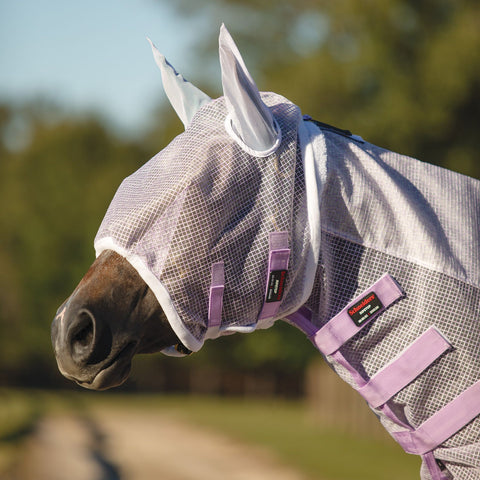
300D textured nylon mesh rated Best Airflow in our fly lineup, with mesh ear coverage and a 40% UV protection rating — for gnats, midges, and stable and deer flies.

The Fly Season Battle You Lose Every Single Summer
It gets worse through July and August. Stable flies come up out of wet ground and manure, deer flies come out of the treeline, and the tiny no-see-ums settle in around his eyes, ears, and muzzle. Turnout stops being a pleasure and becomes something he endures.
Fly spray is not the answer on a face. It evaporates in the heat, it rubs off on fence posts, and it does nothing for the ears. So the mask has to do the work — and by August you are usually back where you started, standing in the tack aisle in May, buying another one you are not sure will make it to Labor Day.

The Masks That Fail First Are the Ones He Won't Wear
Thick, coarse mesh traps heat against the face. On a hot, still afternoon that turns a mask into a small greenhouse over the most sensitive part of your horse — and a hot, itchy horse rubs. He rubs on the fence, on the gate, on his paddock mate, until the mask is off. A mask lying in the grass protects nothing, no matter what the packaging claimed about the weave.
Weave is the other half of it. A coarse mesh keeps big flies off and lets gnats and midges straight through to the skin around his eyes. A fine mesh stops the small stuff and can hold heat. Getting both right — fine enough for gnats, open enough to breathe — is harder than it looks, and most masks pick one and hope you do not notice.
That is why the same summer repeats. You are not replacing a mask that failed structurally. You are replacing a mask your horse voted against.
- ✗A mask lying in the paddock by noon, every time
- ✗Coarse mesh that traps heat against your horse's face
- ✗Gnats and midges getting through a weave that only stops big flies
- ✗Ears left open when the mask is the only thing that can cover them

Finally: A Fly Mask Engineered Around Real Airflow and Real Protection
That open weave does more than move air. The textured 300D nylon is comfortable against his face and stays light through the hottest afternoons, which matters more than any other feature: a hot, itchy horse rubs until the mask comes off, and a mask in the grass keeps nothing off him. No heat buildup means no rub-and-remove cycle, and that is what actually keeps the flies off from May through August.
The mesh is fine enough to keep small gnats and midges off him, along with medium-sized flies like stable and deer flies. The 40% UV protection rating shields him from harsh sun while he plays in the pasture, and the upgraded pattern sits better on the face than the mask it replaces.
It is rated for light play. If your horse is the one in the field who takes masks apart for entertainment, this is a mask to keep an eye on rather than one to forget about.
Schneiders has been fitting horses since 1948 — decades of learning what works in real barns, through real summer seasons, with real horses of every temperament.
Rated Best Airflow
300D textured nylon mesh, the most open weave in our fly lineup, so air moves across your horse's face instead of sitting against it.
Mesh Ear Coverage
The ears are covered in the same breathable mesh as the mask — the one place fly spray does nothing for him.
40% UV Protection
A published 40% UV rating shields your horse from harsh sun while he plays in the pasture.
Small to Medium Biters
Fine enough for small gnats and midges, and for medium-sized flies like stable and deer flies.
Compare Ear-Coverage Fly Masks for Your Horse
See how three specific fly masks compare across published construction, coverage, closure, UV, insect-protection, and fit-design details. Information not published on an exact product page is marked “not listed” rather than inferred.
| Feature | Schneiders Schneiders® Ripstop Nylon Mesh II Fly Mask with Ears | Cashel® Crusader™ Standard Fly Mask with Ears | Horseware® Rambo® Flymask Plus |
|---|---|---|---|
| Published mesh or material construction | 300D textured nylon mesh | Plastic-coated mesh | Described as durable material; denier and fiber composition not listed |
| Ear coverage | Soft mesh ears | Covered ears | Large ears made from a soft material |
| Published UV protection | 40% UV protection rating | 70% UV protection rating | UV protection stated; percentage not listed |
| Published insect-protection scope | Small gnats, midges, and medium-sized flies, including stable and deer flies | Small, irritating insects | Bugs during turnout; specific insect sizes or species not listed |
| Closure design | Two hook-and-loop closures: one under the cheek/chin and one at the throatlatch | Velcro closure under the jaw | Adjustable elastic mask closures |
| Nose coverage | Extended nose cover not listed for this exact product | Standard profile; an extended-nose version is listed separately | Detachable soft nose cover included |
| Poll or forelock feature | Poll slot for neck-cover attachment | Center poll hole for the forelock | Forelock opening or poll attachment not listed |
| Published eye or vision design | Dedicated eye guards or a vision-specific feature not listed | Product page states the mask does not impair vision | Eye guards are listed to maintain the mask’s shape and prevent rubbing around the eyes |
Built to Last Every Fly Season Through
- ✓Ripstop Mesh — Best airflow fly sheet available
- ✓Best protection against gnats & stable flies
- ✓Better protection against mosquitoes, greenheads & horse flies
- ✓0.4 UPF UV rating
- ✓Light Play Durability
Full Protection, Zero Compromise. Everything Your Horse Needs.
Give Your Horse Full-Season Fly Protection Starting Today
The Ripstop Nylon Mesh II gives your horse the best airflow of any Schneiders fly mask, full mesh ear coverage, and a 40% UV protection rating — comfort he will actually keep on all day. Schneiders has outfitted horses since 1948, and this mask carries that into every fly season. Order today and give him a cooler, calmer summer.