
Zip It On. It Stays On.
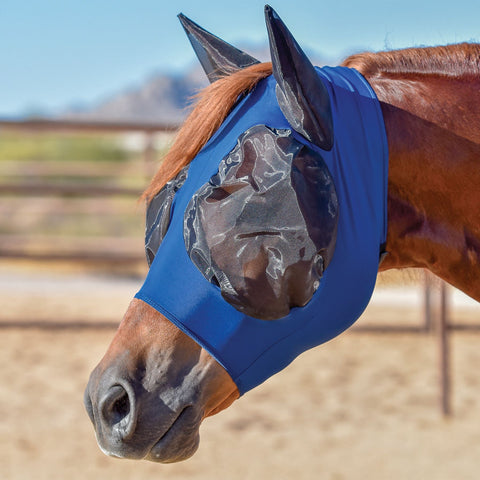
4-way stretch 8 oz. Lycra with a heavy-duty zipper, oversized eye holes under dark 2 oz. mesh, and a 95% UV protection rating — comfortable enough for all-day wear, and low enough to go under a bridle.

Your Horse Is Suffering While You're Still Figuring Out the Buckles
The ritual is exhausting. By mid-July, you've already replaced one mask that got ripped in turnout, spent twenty minutes every morning adjusting closures that never quite line up the same way twice, and watched your horse's forelock get matted and knotted because it keeps getting pinched under the edge. Your friends at the barn have the same complaints — the conversation never seems to change from one summer to the next.
And it's not just the turnout frustration. You trail ride. You compete. You want a mask your horse can wear comfortably under a bridle without creating pressure points on the browband. Most masks weren't built for that. They bunch up, they restrict, or they cause rubbing that leaves marks on your horse's face right where you need clean contact.
The bug pressure in summer is real. Gnats and midges don't need a big opening — they squeeze through mesh that looks fine from two feet away and find the soft skin around your horse's eyes within minutes. By August, some horses are so sensitized that even light fly pressure sends them into a head-shaking spiral that affects everything from flatwork to standing quietly for grooming.

Why Most Fly Masks Fail Before Labor Day
Rigid-framed masks solve the fit problem in one direction and create new ones in another. They stay put better, but horses that roll vigorously can catch a corner on a fence post, and the hard frame creates pressure over the eye socket if the mask shifts at all during movement. Riders who want to use a fly mask under a bridle know this problem intimately — a millimeter of shift under a fitted browband can mean real discomfort for your horse.
The forelock problem is one that rarely gets addressed in fly mask design, even though it affects virtually every horse owner who's tried to use a standard mask in warm weather. When a mask sits across the forehead, the forelock gets trapped underneath the front edge, flattened and pinched all day. Some horses respond by rubbing at the mask to relieve the irritation — which accelerates the exact failure cycle you were trying to prevent.
Mesh choice matters more than most buyers realize. Not all fly mask mesh is equal. A heavy, coarse mesh keeps large flies out but lets gnats through freely. A fine mesh blocks gnats but traps heat, especially on dark-colored horses in direct sun. Getting that balance right — fine enough for real gnat protection, open enough for airflow, dark enough to cut UV glare without heat buildup — is harder than it looks, and most budget masks don't bother to try.

A Fly Mask Engineered to Fit Like It Was Made for This Horse
The zipper is the other difference. A heavy-duty zipper closes in the same place every time, in any light, with gloves on — no lining up two strips of hook-and-loop in the dark and hoping today's fit matches yesterday's. And the forelock-saver design keeps your horse's forelock out of his eyes rather than pinned flat under the front edge.
The eye holes are genuinely oversized, covered with a dark 2 oz. screen mesh that stands off the eye and protects it from bugs and from UV. The rating is 95% UV protection, while the light screen weight keeps good airflow for horses living in moderate climates. The mesh is fine enough for gnats and midges and for medium-sized flies.
It is also low-profile enough to wear under a bridle, which is why trail riders reach for it.
One honest note: it is rated for light play. If your horse is the one who takes masks apart for entertainment, this is a mask to keep an eye on, not one to forget about.
Schneiders has been refining equine equipment since 1948.
Zipper-On Simplicity
The heavy-duty zipper closes the same way every time — no velcro alignment in the dark, no fumbling with buckles.
Forelock-Friendly Fit
The forelock-saver design keeps the forelock free and unkinked while 4-way Lycra conforms to your horse's face without shifting.
95% UV Protection
Large eye holes covered with a dark 2 oz. screen mesh protect your horse's eyes from bugs and from UV, at a published 95% rating.
Rides Under a Bridle
Low enough in profile to wear under a bridle — which is why it is a trail-riding favorite as much as a turnout mask.
How Three Fly Masks Handle Fit, Eyes, and Forelocks
Compare the published construction and protection details for three specific fly masks. This table uses only features listed by Schneiders, Cashel, and Horseware as of the date below; it does not represent independent performance testing.
| Feature | Schneiders Schneiders® UltraFlex® Comfort Plus Bug Eye Zipper Fly Mask with Forelock Saver | Cashel Crusader Fly Mask Standard | Horseware® Defense Fly Mask |
|---|---|---|---|
| Published UV protection | 95% UV protection | Blocks up to 70% of UV rays | 60% UV protection |
| Closure design | Heavy-duty zipper | Adjustable hook-and-loop closure strap | Zipped elastic hook-and-loop chin closure |
| Main material | Four-way stretch, 8 oz. Lycra | Soft-coated nylon micromesh | Stretch Lycra; 80% polyester and 20% elastane |
| Eye-area construction | Oversized eye openings covered with dark, 2 oz. screen mesh | Shaped eye darts hold the material away from the eyes and lashes | Structured mesh eye pieces create space around the eyes |
| Forelock accommodation | Forelock-saver design | Three-hole cap design allows the forelock to pass through | Dedicated forelock opening |
| Published sizes | X-Small, Small, Medium, Large, X-Large | XX-Small, X-Small, Small, Medium, Large, X-Large, XX-Large | Pony, Cob, Horse |
Engineering Behind the Four-Way Stretch Fit
- ✓UltraFlex® — Most secure fit fly mask
- ✓Best protection against gnats, stable flies & mosquitoes
- ✓Better protection against large flies
- ✓0.95 UPF UV rating — highest UV protection in the line
- ✓Light Play Durability
Fly Protection That Actually Stays On. Day After Day.
Give Your Horse Real Eye Protection — Without the Morning Hassle
4-way stretch Lycra, oversized mesh eye coverage, a heavy-duty zipper, a forelock saver, and a 95% UV protection rating, in five sizes from X-Small to X-Large. Schneiders has been refining equine equipment since 1948. Order yours and skip the morning wrestling match.