
One Dose That Follows the Parasite Through Its Life Cycle
Bots. The arterial stages of S. Vulgaris. Neither one shows up in a coat check — which is why the parasites a dewormer actually names on its label are worth reading.

What a Coat Check Cannot Show You
Barn life makes it easy to let it go. You're managing four horses, a job, and two kids in school. You deworm on the rotation your trainer showed you years ago, and most of the time everything seems fine.
The trouble is that what's happening internally isn't something you can see from the aisle. Zimecterin® Paste is labeled to kill important internal parasites, including bots and the arterial stages of S. Vulgaris — the kinds of things you would never spot running a hand along a topline.
That's the honest version of the problem. You're doing the responsible thing and you still can't see the result, which is exactly why the label list matters and why your veterinarian belongs in the conversation. Consult your veterinarian for assistance in the diagnosis, treatment and control of parasitism.

No Single Active Covers Every Parasite at Every Stage
Here's the part that's easy to miss. Dewormers are not interchangeable, and the class printed on the front of the box tells you less than the parasite list printed on the back. Zimecterin® Paste is a potent antiparasitic agent that is neither a benzimidazole nor an organophosphate, and its label names what it kills: large strongyles, small strongyles, pinworms, ascarids, hairworms, large-mouth stomach worms, bots, intestinal threadworms, summer sores and dermatitis. It also names the arterial stages of S. Vulgaris. Those specifics are the whole reason to read a label rather than trust a habit.
Bots are the case owners most often assume is handled, and nothing about a bot burden shows on the outside of your horse.
None of which means you should build a program on your own. Resistance patterns, fecal testing, and which horse actually needs treating this season are questions for you and your veterinarian, with the label list in front of you both.
- ✗Rotating on a schedule you inherited and have never revisited with your vet.
- ✗Assuming bots are covered without checking what the label actually names.
- ✗Guessing at body weight instead of measuring it.
- ✗No way to see from the barn aisle whether any of it worked.

One Syringe That Follows the Parasite All the Way Through
The dose is tied to your horse, not to a one-size amount. One syringe holds enough paste to treat a 1,250 lb horse at the recommended rate of 91 mcg of Ivermectin per lb of body weight, which is 200 mcg/kg. Each weight marking on the plunger delivers enough paste for 250 lb of body weight. Turn the knurled ring a quarter turn to the left, slide it to the prescribed marking, and lock it with a quarter turn to the right. Make sure your horse's mouth contains no feed, remove the cover from the syringe tip, insert it at the space between the teeth, and depress the plunger as far as it will go, depositing the paste on the back of the tongue. Raise your horse's head for a few seconds afterward.
Zimecterin® may be used in horses of all ages, including mares at any stage of pregnancy, and it is safe for use in foals and pregnant mares. Stallions may be treated without adversely affecting their fertility. Store at 68°F, with excursions between 59°F and 86°F permitted.
The recommended deworming program is January 1st, May 1st, and September 1st. Build the program around your own farm with your veterinarian — consult your veterinarian for assistance in the diagnosis, treatment and control of parasitism. Trusted since 1948, Schneiders stocks proven horse-care products with clear directions and practical barn-ready dosing. This item ships within the U.S. only.
The Labeled Spectrum, One Dose
Kills important internal parasites — including bots and the arterial stages of S. Vulgaris — with a single dose, along with large and small strongyles, pinworms, ascarids, hairworms, and intestinal threadworms.
Labeled for All Ages
Safe for use in foals and pregnant mares, and may be used in horses of all ages. Stallions may be treated without adversely affecting their fertility.
Dosed by Body Weight
One syringe treats up to 1,250 lbs at the recommended rate of 91 mcg of Ivermectin per lb. Each plunger marking delivers enough paste for 250 lbs.
A Three-Date Program
The recommended deworming program is January 1st, May 1st, and September 1st. Set yours with your veterinarian.
Compare the Label Before You Dose
A neutral, label-based comparison of three oral equine deworming pastes containing 1.87% ivermectin. Published similarities are shown directly, and information absent from a cited page is marked “Not listed.”
| Feature | Schneiders Zimecterin Paste 1.87% | DuraMectin Paste 1.87% | Farnam IverCare Paste 1.87% |
|---|---|---|---|
| Active ingredient | Ivermectin | Ivermectin | Ivermectin |
| Active-ingredient concentration | 1.87% | 1.87% | 1.87% |
| Product form and labeled route | Oral paste for horses | Oral paste for horses | Oral paste for horses |
| Maximum body weight treated per syringe | Up to 1,250 lb | Up to 1,250 lb | Up to 1,250 lb |
| Labeled dose rate | 91 mcg/lb (200 mcg/kg) | 91 mcg/lb (200 mcg/kg) | 91 mcg/lb (200 mcg/kg) |
| Body-weight amount per plunger marking | 250 lb | 250 lb | 250 lb |
| Bots included on published label or product page | Yes — oral and gastric stages are listed | Yes — oral and gastric stages are listed | Yes — bots are listed |
| Early or arterial Strongylus vulgaris stages included | Yes — early forms in blood vessels are listed | Yes — early forms in blood vessels are listed | Yes — arterial stages are listed |
| Published use for horses of all ages and pregnant mares | Yes — manufacturer identifies use for all ages, including pregnant mares | Yes — including mares at any stage of pregnancy | Yes — including mares at any stage of pregnancy |
| Net syringe contents on cited source | 0.21 oz (6.08 g) | 6.08 g | Not listed on the cited product page |
Precision Dosing for Horses Up to 1,250 Pounds
- ✓1.87% ivermectin — not a benzimidazole or organophosphate, so resistance is not a concern
- ✓Kills arterial stages of Strongylus vulgaris, the leading cause of verminous colic
- ✓Eliminates bot fly larvae embedded in the stomach lining
- ✓Syringe treats horses up to 1,250 lbs with adjustable weight-locking plunger
- ✓Recommended three times per year: January, May, and September
One Syringe. The Parasites That Matter Most. Gone.
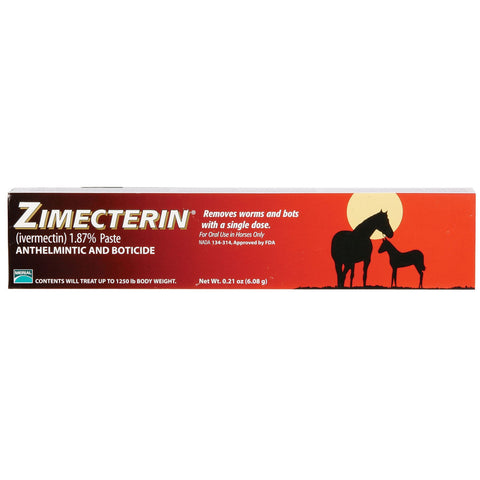
Full Labeled Coverage in One Weight-Calibrated Dose
Zimecterin®'s 1.87% Ivermectin covers the labeled spectrum, including bots and the arterial stages of S. Vulgaris, in one dose measured to your horse's body weight. Use it as part of the program you and your veterinarian have built, not in place of it. Consult your veterinarian for assistance in the diagnosis, treatment and control of parasitism. Ships within the U.S. only, with free shipping on orders over $99.