
Does last year's blanket still fit my horse?
Where to check when a horse has muscled up or changed shape over the summer, whether turnouts and stable blankets size the same, and how to stop shoulder rubs before they start.
By The Schneiders Product Team · Updated September 29, 2026
Family owned in Chagrin Falls, Ohio since 1948. We design our own blankets, sheets, and fly gear, and we turn horses out in it.
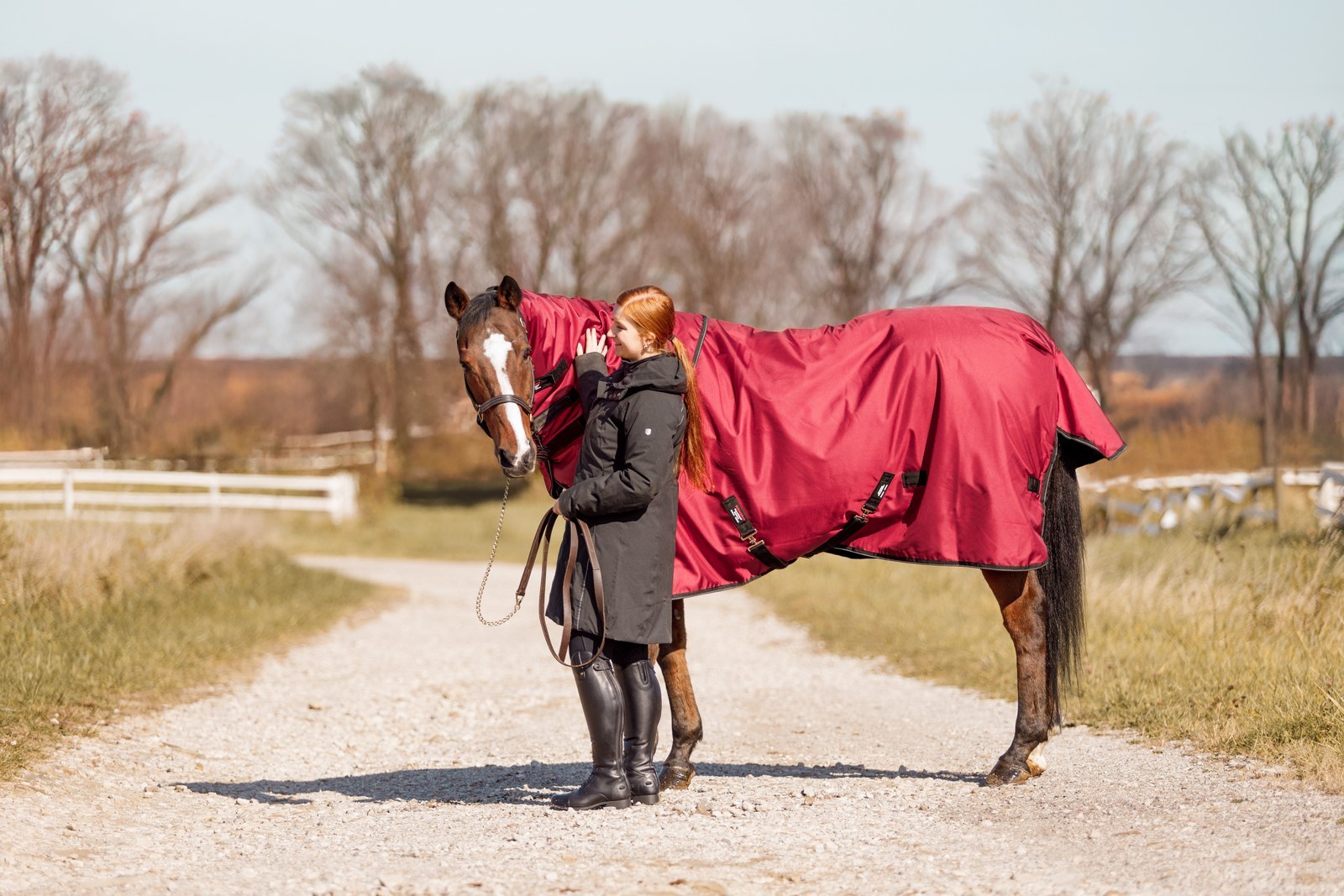
Measure again rather than assuming. Run a tape from the center of the chest, along the side, to the very edge of the tail, passing over the widest part of the shoulder and hindquarters. Then check three fit points on the horse: the shoulder should move freely when he puts his head down, you should fit a hand flat at the wither, and the tail flap should reach the top of the tail.
Horses change shape more than people expect. A summer of work, a growth year, a weight change, or a different shoeing cycle can all shift how a blanket sits. The blanket that fit in March is worth re-checking in September, before it's the only thing between your horse and a cold night.
My horse has muscled up all summer. Where exactly do I check whether last year's blankets still fit?
Then watch him move. A blanket that fits standing square can still bind at the shoulder at the walk, and that's what causes rubs.
A horse who has genuinely muscled up across the chest and shoulder often needs a different cut rather than a bigger size. Going up a size to fix a shoulder problem usually just gives you a blanket that slides back and hangs off the wither.
A blanket that fit in March can move by September because the horse underneath it changed shape faster than you noticed. Summer turnout, a heavier work schedule, or simply growing through a young horse's last growth spurt all add muscle across the chest, shoulder, and top of the hindquarters. The blanket itself hasn't shrunk, but the chest opening and the front edge that used to sit with a little give now sit snug against a wider frame. That is why a horse who was a comfortable 78 in April can be a tight 78 by fall even though the tape still reads 78. The measurement is only half the fit picture; the other half is how much the horse has filled out inside it.
The reason the shoulder is where this shows up first, rather than anywhere else on the horse, comes down to what happens with every stride. The front edge of a turnout or stable blanket is not a fixed point, it's fabric that has to travel with the horse's leg as he reaches forward. If the chest is cut too tight, or the drop at the front is too long for his build, that front edge drags across the point of the shoulder on every single step instead of sliding cleanly past it. Multiply that friction by thousands of strides in a season and you get the bald patch. It is a mechanical problem before it is anything else, which is why adding padding or a slicker liner treats the symptom without touching the cause. Fixing the cut or the drop removes the friction; a softer fabric just moves it around slower.
Watch: how to measure your horse for a blanket
- Stand him square on level ground, head in a normal position.
- Start at the center of the chest, where the two sides of the chest meet.
- Run the tape along his side, passing over the widest part of the shoulder and the hindquarters.
- Stop at the very edge of the tail. That measurement in inches is his blanket size.
- Between sizes? Round up. A horse who measures 79 takes an 80.
Should I size a turnout differently from a stable blanket, or is it the same measurement?
Cut matters more than the number. A euro or contour cut fits a deeper-shouldered horse very differently from a standard cut at the same size, which is why two blankets both marked 78 can fit nothing alike.
If you're between sizes and the horse lives out, most people size up in turnout and down in stable.
The reason the two aren't built to the same pattern comes down to what the horse is actually doing in each. A stable blanket dresses a horse standing still, or moving a few steps at most, so it can be cut close to the body without anything binding. A turnout has to move with a horse who is trotting, rolling, and lying down outside, so it's cut with more room through the shoulder and barrel, often with gussets at the shoulder and a deeper drop at the chest, specifically so the front edge can travel with the leg instead of catching on it. That extra room is also where a heavier layer underneath has to fit. A blanket built for standing in a stall simply doesn't have the ease built into the pattern for a horse moving at speed, which is why the same number on the tape does not always mean the same fit once you cross from one category to the other.
My horse rubbed his shoulders bald in blankets last winter. What should I change before I put them back on?
Look at where the hair is gone. Rubs at the point of the shoulder mean the blanket is too tight or too straight-cut through the chest. Rubs at the wither mean it's sitting down on him, usually because it's too big and has slid back.
Fixing it before the coat comes in matters, because bald patches from last winter will regrow now and be gone again by December if the same blanket goes back on.
The mechanism is worth understanding, because it explains why some fixes work and others just move the problem. Every time your horse takes a stride, the point of his shoulder rotates forward and back under the front edge of the blanket. If the chest is too tight, or the drop is too long for his build, that edge cannot glide over the moving joint, it drags against it instead, stride after stride, until the hair wears away. A slippery liner reduces the friction of that drag, and a shoulder guard adds a barrier between fabric and skin, but neither changes the underlying geometry. Only a cut with genuine room through the shoulder, or a built-in gusset that lets the front edge flex with the leg, removes the drag itself. That is the difference between managing a rub and ending it.
How many blankets does one horse actually need? I have six and still feel like I'm scrambling.
Six blankets and constant scrambling almost always means the working set is really two, and the other four are the wrong size, wrong weight, or no longer waterproof.
Lay all of them out now. Test each for waterproofing, check each for fit, and be honest about which ones you actually reach for. Most people find their real rotation is two blankets and a spare.


Not every horse is a standard shape
High withers, big shoulders, ponies, drafts, and seniors all have options that fit properly instead of almost.
Specialty SizesTurnout BlanketsBlanket CareHard-to-fit horse? Send us his measurements and a photo and we'll point you at the right cut -- ask our team.