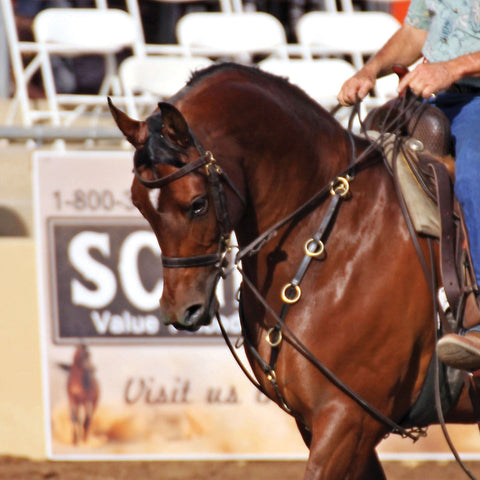
Stop Fighting Your Horse's Head—Start Shaping It
The Billy Royal® 10 Ring Training Martingale gives you 10 precise ring positions, handcrafted leather, and solid brass hardware to build a correct, consistent head set—without the argument. Backed by 78 years of equestrian expertise from Schneiders Saddlery.
Your Horse Has the Talent. Getting the Head Set Is the Hard Part.
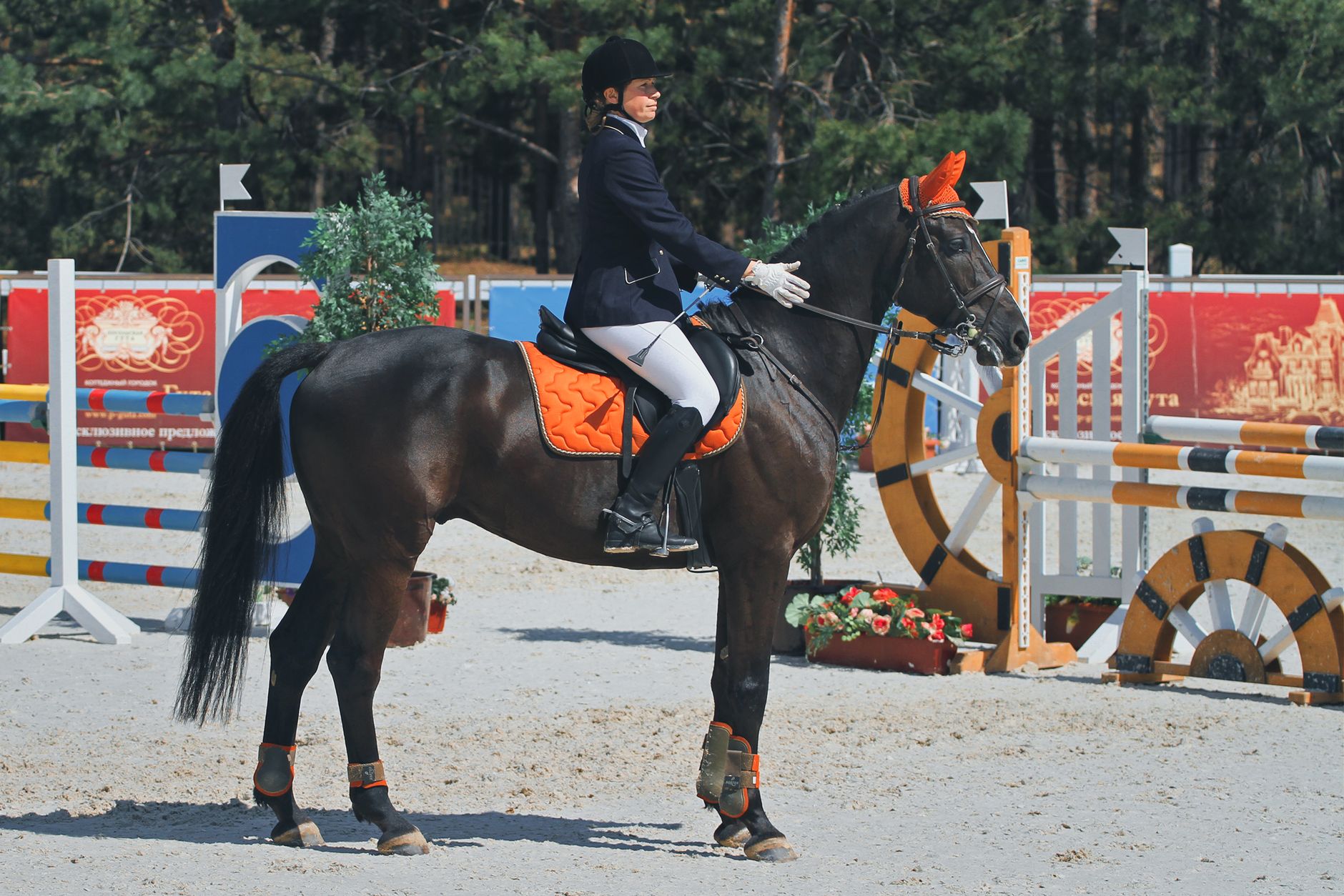
Picture the ride you had in mind when you bought this horse: round, forward, light in the bridle, nose tucked just inside vertical with the poll swinging freely. You've seen horses go that way. You know your horse is capable of it—you've felt it in brief flashes, usually the last thirty seconds of a workout when everyone is tired and nothing is fighting anyone. Then the moment passes and you're back to the old argument: horse above the bit, neck braced, hindquarters trailing, contact see-sawing. You know that if you could just hold that frame for longer, the muscle memory would take over and you'd be riding a different horse. The question is how to get there without turning every training ride into a negotiation.
The frustrating truth about head-carriage problems is that they are almost never about the horse's mouth. By the time a horse is consistently going above the bit or behind it, the issue has usually traveled into the neck, the back, and the hindquarters—and most of the standard single-ring running martingales on the market address exactly none of that. They give you one degree of leverage at one moment in the horse's range of motion, which means they're either doing nothing or doing too much depending on where the horse's head happens to be. That binary is what makes horses dull to the aid on one end or fussy and resistant on the other. You haven't fixed the problem; you've just installed a ceiling the horse bounces against.
If you train regularly, you know what this looks like in practice: you spend the first twenty minutes of every ride re-establishing the same contact point you lost at the end of the last ride. Your warm-up is really just an extended argument. By the time the horse is going reasonably well, you're out of time and your own position has deteriorated because you've been bracing against his brace. You leave the ring having accomplished maintenance at best, not progress. Multiply that by five rides a week over six months and you're looking at a significant chunk of riding time—and coaching money—spent not moving forward.
Most riders try the logical sequence: a running martingale with a single ring, then a standing martingale, then a draw rein, then a different bit, then lessons with a second trainer. Some of those interventions buy temporary improvement; few of them produce lasting change in muscle carriage. The running martingale is too blunt. The standing martingale teaches avoidance rather than softness. Draw reins, used without expert timing, are famous for creating the behind-the-vertical evasion that is actually harder to fix than the original star-gazing. And the bit changes—everyone has tried three or four bits—mostly just move the argument to a different part of the horse's face. What's missing is a tool with enough precision to meet the horse exactly where he is in his training and apply exactly the right amount of guidance, no more and no less.
One More Wasted Training Ride Is One Too Many
The real cost of a head-carriage problem is not just cosmetic. When a horse travels strung out and above the bit, the entire kinetic chain is wrong: the back is hollow, the hind legs are pushing instead of engaging, and the front end is absorbing more concussive force than it should. Over time that means more wear on the front feet and joints, a horse that fatigues faster, and a topline that never develops the way it should no matter how much you ride. You can see it in the horse's musculature if you know what to look for—the underside of the neck becomes overdeveloped while the topline stays flat. You're not just losing show-ring points; you're working against your horse's long-term soundness every ride.
There is also an emotional dimension that trainers rarely discuss openly. When your horse consistently evades your aids and you cannot produce a consistent picture of what you're trying to achieve, it erodes your confidence in your own horsemanship. You start second-guessing your timing, your position, your bit choice. You ride defensively instead of forward. Your horse, who is extremely good at reading your emotional state, feels the tentativeness and interprets it as confirmation that the evasion is working. The problem feeds on itself. Riders in this loop often describe feeling like they're going backward—and in terms of the horse's established habits, they sometimes are.
The financial math is straightforward and grim. A monthly training program at a mid-level barn runs $400–$800 per month on top of board. A single specialist consultation to address a head-carriage issue can run $150–$300. Bit trials add up to $50–$200 in shipping and return fees. After six to twelve months of chasing the problem with single-point tools and piecemeal advice, most riders have spent $2,000 to $4,000 and are still describing the same ride. A precision training martingale with real adjustability is not an expense—it's what you buy before you write any more of those checks.
- ✗Single-ring running martingales offer no precision—one position for every stage of training
- ✗Standing martingales train avoidance, not softness or topline engagement
- ✗Draw reins frequently create behind-the-vertical evasion worse than the original problem
- ✗Repeated bit changes move the argument rather than resolving the underlying carriage issue

Ten Rings. One Precise Answer for Every Stage of Training.
The Billy Royal® 10 Ring Training Martingale exists for exactly the situation described above. It is not a gadget, it is not a shortcut, and it is not a substitute for correct riding—it is a precision training aid that lets you apply exactly the right degree of guidance at exactly the right moment in your horse's training progression. Schneiders has carried the Billy Royal line for decades because it holds up to daily use, produces measurable results, and is built with the kind of materials and craftsmanship that a serious horse person can see and feel the moment they pick it up.
Here is how the ten rings actually work in practice. The ring placement is not arbitrary—each position creates a different moment arm, which means a different degree of poll flexion influence when the horse goes above the desired carriage point. At the lower ring settings, the influence is mild and forgiving, appropriate for green horses still learning to carry themselves or for horses re-learning softness after years of traveling incorrectly. As you move up the ring positions, the leverage increases progressively, letting you match the tool precisely to where the horse is in his development. Because the transition from one ring to the next is incremental rather than binary, you can step up one position when the horse has genuinely mastered the current one—and step back down without drama if you've moved too fast. No other single-ring martingale in this price range offers that resolution.
The cascade of benefits that follows from correct head carriage is what makes this investment worthwhile. When a horse learns to travel with his poll correctly elevated and his neck relaxed, the back begins to swing rather than brace. The hind legs step under the body with more engagement. The front end lightens. Transitions sharpen. Contact becomes consistent because the horse is seeking the bit rather than evading it. Riders who have been fighting a heavy, unresponsive front end for years are frequently amazed at how quickly lateral work becomes accessible once the horse is no longer braced through the neck. The martingale does not create collection, but it removes the head-carriage evasion that blocks collection from developing naturally.
When you order from Schneiders, you are not ordering from a catalog warehouse. You are ordering from a family business that has been fitting horses and riders since 1948—78 years of knowing what works and what doesn't, what wears out and what lasts. The Billy Royal line is carried because it meets Schneiders' standards for leather quality, hardware integrity, and training effectiveness. If the martingale does not perform as expected, Schneiders stands behind it. That is not a marketing phrase; it is a 78-year track record you can verify by talking to anyone who has shopped with us for more than a season.
10 Precise Ring Positions
Move one ring at a time as your horse progresses—never over-correct, never under-train. Match the tool exactly to where your horse is today.
Handcrafted Supple Leather
The finest, most supple leather that breaks in quickly and stays soft with regular conditioning. You'll feel the quality difference on the first ride.
Solid Brass Hardware Throughout
Solid brass rings and fittings resist corrosion and won't fatigue under daily training loads. The hardware that comes with the martingale is the hardware you'll still be using in five years.
Fully Adjustable Fit
Adjustable girth strap and wither/neck strap fit a wide range of horse sizes and body types. One martingale works across multiple horses in your barn.
What Riders Are Saying
"
My 6-year-old Quarter Horse mare was star-gazing at the lope no matter what I did—two other trainers had already tried their approaches and we were still nowhere. I attached the Billy Royal at the middle ring position and within three sessions she was rounding through her back and traveling with her poll at wither level. The leather is butter-soft straight out of the box, the brass hardware hasn't tarnished a lick after four months of daily use, and the ring stitching shows zero wear. This martingale paid for itself the week I avoided another $300 training session.
""
I event with a 9-year-old Irish Sport Horse who has a habit of inverting on the approach to oxers and scaring us both half to death. My trainer recommended the Billy Royal 10-ring over the cheaper options because she said the ring spacing actually means something—each position creates a measurably different moment arm. She was right. We moved from ring 4 to ring 7 over six weeks as Duke built topline, and his bascule over fences has genuinely improved. The dark oil finish looks sharp in the warm-up ring and the girth strap adjustment is the easiest I've worked with in fifteen years of eventing.
""
I rope and trail ride on two big paint geldings, neither of which has ever wanted to travel collected for more than ten seconds at a stretch. I was skeptical anything short of a full-time trainer would change that. Tried the Billy Royal on the advice of a friend who competes in reining—used the lowest ring setting to start so I wasn't overcorrecting—and within two months both horses are giving me a soft, round headset on trail without me having to nag constantly. The adjustable wither strap keeps everything centered even on my wide-chested one. Solid build, fair price, and Schneiders shipped it to my rural Montana address in three days flat.
"How We Stack Up
| Feature | Schneiders Billy Royal® 10 Ring Training Martingale | Weaver Leather Training Martingale | Professionals Choice SMX Running Martingale |
|---|---|---|---|
| Number of ring positions | ✅ 10 rings | ❌ 1 ring | ❌ 1 ring |
| Handcrafted leather construction | ✅ | ⚠️ machine finished | ❌ synthetic/nylon |
| Solid brass hardware throughout | ✅ | ⚠️ nickel-plated | ❌ stainless/nylon |
| Progressive training adjustment | ✅ incremental by ring | ❌ fixed | ❌ fixed |
| Independent girth strap adjustment | ✅ | ✅ | ⚠️ limited |
| Independent wither/neck strap adjustment | ✅ | ⚠️ basic | ✅ |
| Poll flexion precision control | ✅ 10-position | ❌ single point | ❌ single point |
| Suitable for green through advanced horses | ✅ full range | ⚠️ intermediate only | ⚠️ limited range |
| Long-term durability (5+ years daily use) | ✅ | ⚠️ hardware degrades | ❌ nylon wears |
| Backed by established tack authority (78 yr) | ✅ Schneiders since 1948 | ⚠️ mass market | ⚠️ mass market |
Built for the Barn That Trains Every Day
The Billy Royal® 10 Ring Training Martingale comes in Dark Oil, a finish that conditions naturally with use and develops a rich patina over time. The girth strap and wither strap are both independently adjustable so you can dial in a precise fit regardless of whether you're working a narrow Thoroughbred or a wide-bodied Quarter Horse. The 10 rings are positioned with strategic spacing so that each step up the scale produces a meaningful, not arbitrary, change in influence. This is the martingale that trainers reach for when they want to build a head set that stays, not one that disappears the moment the martingale comes off.
At $89.99 this is one of the best-value training aids in the Schneiders tack room—less than a single private lesson, priced well below comparable handcrafted leather martingales from specialty tack makers, and built to outlast three or four of the cheaper nylon alternatives. The combination of premium leather, solid brass hardware, and the Billy Royal ring-spacing system is what separates this from the crowded field of single-ring running martingales. If you train regularly and you're serious about developing correct carriage, this is the tool that belongs in your tack trunk.
- ✓10 strategically spaced ring positions for precise, progressive training
- ✓Finest-grade supple handcrafted leather in Dark Oil finish
- ✓Solid brass rings and all hardware—no plated parts that pit or flake
- ✓Independently adjustable girth strap and wither/neck strap
- ✓Designed to encourage correct poll flexion without forcing behind the vertical
What You Get