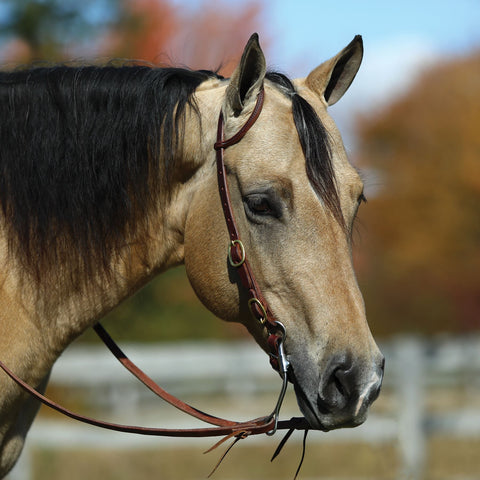
The Headstall That Fits Like It Was Made for Your Horse
Soft latigo leather, rolled one-ear construction, and quick-change buckle ends — built by hand in the USA, broken in from the day you open the box.
Most Headstalls Leave You Choosing Between Fit and Function
You’re at the gate at 5:45 in the morning, coffee in one hand and headstall in the other. Your gelding is standing quiet for once and you’ve got a full day of riding ahead — maybe a trail through the timber, maybe arena work on those sliding stops you’ve been chasing all season. You reach up to bridle him and the headstall sits crooked again. The ear slot is so stiff from cheap leather it took you four tries to get his ear through last week. He throws his head, takes a half-step back. You settle him down, try again. By the time you’re actually mounted, you’ve spent ten minutes wrestling with tack that should take thirty seconds, and he’s already a little tense from the experience before the first stride.
What most riders don’t register in the moment is that a poorly fitting headstall doesn’t just inconvenience you — it actively works against everything you’re trying to accomplish in the saddle. A headstall that pinches at the ear creates low-grade irritation every minute it’s on. Your horse isn’t being difficult when he tosses his head or gets behind the vertical; he’s telling you something is uncomfortable. That tension doesn’t evaporate once you swing up. It stays in his poll, his jaw, his willingness to yield laterally. Cheap hardware that won’t stay adjusted means your cheeks are uneven by the time you’re halfway through a pattern, and uneven cheeks mean uneven contact — which means you’re fighting crooked without knowing why. The headstall is the first point of contact in the whole communication chain. When it’s wrong, everything downstream suffers.
Add up the cumulative drag: you lose time every single time you tack up. You carry a small adjusting tool in your vest pocket because the buckles on cheaper headstalls freeze in one position after a season of sweat and weather. There’s a spot of raw skin behind your horse’s ear from a seam that never smoothed out, so now you’re using a little pad to buffer it — which changes the fit again. Your barn buddy uses a different headstall on each of her horses because she’s never found one that fits all three correctly, so she’s got six headstalls hanging in her tack room, most of them half-broken. Ring the show secretary and you’re late to the warm-up pen. Scramble at the trailhead and you’ve wasted daylight. A small piece of tack that doesn’t work right becomes a daily tax on your time and your horse’s comfort.
Most riders have tried the obvious fixes. You’ve bought the budget option and watched the stitching separate after eight months. You’ve bought the more expensive option and found that higher price didn’t guarantee better fit — just fancier tooling on the same stiff leather. You’ve soaked and conditioned a new headstall for weeks hoping the break-in period would eventually end. You’ve experimented with a different brand’s one-ear that seemed promising on the rack but rode stiff on your horse’s skull. You’ve watched tutorials about adjusting ear slots. None of these are wrong exactly, but they’re all workarounds for a root problem: most mass-produced headstalls aren’t built with the attention to leather quality and construction that actually matters when the headstall is on a living animal day after day, season after season.
The Frustration Compounds Every Single Ride
The frustration doesn’t stay in the tack room. When your horse associates bridling with discomfort, he starts anticipating it — pulling away before the headstall even reaches his ears, dipping his head, building a resistance that bleeds into every other ground-work interaction. Your trainer notices he’s bracey through the poll and suggests more softness work, which is right, but softness starts before you ever mount up. It starts with tack that doesn’t create tension before a ride begins. Meanwhile, the quick-change buckle system you thought would simplify bit swapping has frozen again, so you’re switching bits with a leather punch and quiet profanity instead of the thirty-second swap the design was supposed to allow.
There’s a quiet erosion that happens when your gear repeatedly lets you down. You start every ride already behind — already a little tense yourself because you watched your horse throw his head during bridling, already wondering whether today’s issues are training problems or tack problems, already feeling the low-grade guilt of not knowing which. Riding is supposed to be the good part of the day. For most people it’s the only hour that belongs entirely to them. When tack steals the first fifteen minutes of that hour through fumbling and adjustment and a horse who starts out sour, that’s not a small thing. That’s a meaningful loss of something you can’t get back.
The financial math is grim when you actually add it up. Two mediocre headstalls at $35–45 each, neither one quite right, plus conditioner every few months trying to salvage stiff billets, plus a pad to protect that raw patch behind the ear, plus the time spent — and you’ve spent the equivalent of a quality headstall on a problem a quality headstall wouldn’t have created. False economy is real in tack. The cheapest option at purchase is rarely the cheapest option by the end of the season, and it almost never accounts for what the horse pays in comfort while you’re figuring that out.
- ✗Stiff leather that requires weeks of break-in before it’s comfortable
- ✗Flat ear slots that pinch and cause head-tossing before the first step
- ✗Quick-change hardware that freezes and defeats the whole purpose
- ✗Uneven cheek adjustments that compromise contact and communication

Billy Royal® Rolled One Ear: Built the Way Cowboys Actually Use Gear
The Billy Royal® Latigo Rolled One Ear Short Cheek Headstall exists in that specific space where craft and function meet. It is a handmade headstall — actually handmade, in the USA — from 5/8” single-ply light harness leather that arrives already broken in. Not stiff. Not requiring weeks of conditioning before it feels right on your horse. The latigo leather is naturally supple and has a warmth to it that synthetic materials and cheaper hides simply don’t produce. It’s the kind of headstall that works correctly from the first ride, not the fifty-first.
The rolled one-ear design is the key functional choice. Rather than a flat ear slot that creates a pressure seam across the top of the ear, the rolled construction distributes contact evenly around the ear’s circumference — softer for your horse, far less likely to cause rubbing or pinching. The short cheek design positions the bit closer to the corner of the mouth for cleaner, more direct communication, cutting out the mechanical lag that longer cheeks create. The quick-change buckle ends — actual functioning quick-change hardware, not a cost-cut approximation — make bit swapping a genuine fifteen-second job when you ride multiple disciplines or multiple horses.
When the headstall fits correctly and your horse is comfortable from the first step, the benefits cascade through the whole ride. His poll stays soft. His jaw stays relaxed. He yields when you ask because there’s no background discomfort distracting him from your cues. You bridle faster, which means more time riding. The double-stitched construction and solid brass hardware mean this headstall outlasts three seasons of daily use without losing its shape, its adjustment range, or its clean ranch appearance.
Behind this headstall stands Schneiders Saddlery — a family-owned business that has been outfitting riders since 1948. Seventy-eight years of knowing what works and what doesn’t. We carry Billy Royal® because it meets the standard our own buyers use on their own horses. If anything about this headstall isn’t right, our team is here by phone or email and we stand behind every piece of tack we sell. That’s not a corporate policy — it’s a family reputation built across three generations and more horses than we could ever count.
Rolls Soft, Rides Soft
The rolled one-ear construction distributes contact evenly around your horse’s ear — no flat seam to create a pressure point, no pinching, no head-tossing before you leave the barn.
Quick-Change That Actually Works
Solid brass quick-change buckle ends swap bits in under 30 seconds — a genuine working mechanism, not a look-alike that still requires a tool to operate after one season of sweat.
Short Cheek Precision
The short cheek positions the bit closer to the corner of the mouth for a cleaner, more direct signal. Less mechanical lag means your horse responds to smaller, lighter cues.
Handmade in the USA
Every stitch placed by hand in an American shop. Double-stitched, double-adjustable cheeks hold their position through sweat, weather, and daily working use without loosening or pulling.
What Riders Are Saying
"
I’ve ridden barrel horses for twelve years and tried just about every headstall on the market. My gray mare is ear-sensitive — I’ve had headstalls she’d nearly come out of her skin to avoid. The Billy Royal rolled one-ear went on with zero drama on the first try. She’s lighter in the bridle now and not tossing her head at the gate anymore. The quick-change buckles work exactly as advertised — I swapped her shank bit for a correction in under thirty seconds at our last show. Worth every cent.
""
Bought this for my big-headed paint gelding after three headstalls that technically adjusted wide enough but still pinched him behind the ear. The latigo leather is genuinely soft right out of the bag — I’ve spent two months conditioning other headstalls trying to reach this point. First trail ride, he bridled quiet and stayed that way all eight miles. The brass hardware still looks clean after six months of hard use and Oklahoma humidity. Schneiders’ team talked me through sizing before I ordered, which I appreciated.
""
Run cattle three days a week minimum and my tack gets worked hard. This headstall has held up better than anything in the $40–60 range I’ve used before — double stitching is solid, adjustments stay put, leather hasn’t cracked or dried out through a full Montana summer. My rope horse used to fuss at bridling; he stands quiet with this one. When I need to swap to a shank for a colt I’m starting, the quick change actually changes quick. Honest gear for honest work.
"How We Stack Up
| Feature | Schneiders Billy Royal® | Weaver Leather | Circle Y |
|---|---|---|---|
| USA Handmade Construction | ✅ | ⚠️ | ❌ |
| Rolled Ear Design (reduces pinching) | ✅ | ❌ | ❌ |
| Light Harness Leather Grade | ✅ | ⚠️ | ⚠️ |
| Pre-broken-in Leather Feel | ✅ | ❌ | ❌ |
| Quick-Change Buckle Ends | ✅ | ❌ | ❌ |
| Short Cheek Design | ✅ | ⚠️ | ⚠️ |
| Double-Stitched Throughout | ✅ | ⚠️ | ✅ |
| Solid Brass Hardware | ✅ | ⚠️ | ✅ |
| Double-Adjustable Cheeks | ✅ | ✅ | ✅ |
| 78-Year Family Brand Heritage | ✅ | ❌ | ⚠️ |
The Construction Details That Separate a Good Headstall from a Great One
Light harness leather is a specific grade of hide — not ‘full grain’ as a marketing phrase, but an actual standard for flexibility and durability under working conditions. The 5/8” single-ply cut Billy Royal® uses gives you enough strength to handle a head-tossing horse without the bulk that makes cheaper headstalls feel clunky. The leather arrives with a broken-in softness that usually takes a full season to develop, which means your horse gets comfortable equipment from the first day rather than the fifty-first. The rolled stitched ear — hand-stitched, not machine-pressed — holds its shape and its smoothness over years of use in a way that flat-cut ear slots simply don’t.
The double-adjustable cheeks with brass hardware are a practical decision that compounds over the full life of the headstall. Brass doesn’t rust in humid climates or corrode under sweat the way plated hardware does after two seasons. The adjustments hold their position because the billets are cut to hold — not because you’ve tightened them past the point of easy re-adjustment. Schneiders has carried Billy Royal® for decades because this kind of detail-level thinking is what separates tack that lasts one owner from tack that gets handed down to the next one.
- ✓5/8" single-ply light harness leather — supple, not stiff, right out of the box
- ✓Rolled stitched one-ear style — distributes pressure evenly, helps reduce pinching
- ✓Quick-change buckle ends — swap bits without tools in under 30 seconds
- ✓Double-stitched, double-adjustable cheeks with solid brass hardware
- ✓Short cheek design — direct, precise bit communication with less mechanical lag
What You Get