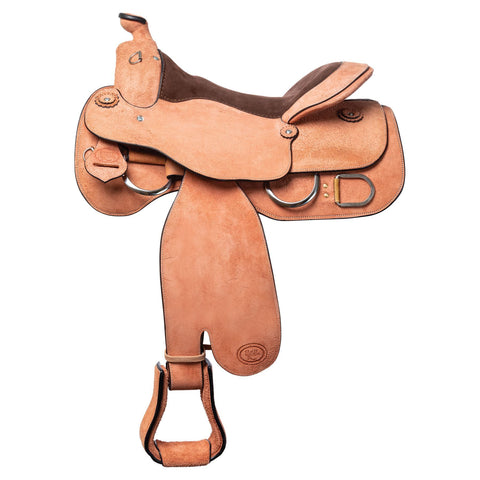
The Work Saddle Built for the Arabian You Actually Ride
Roughout leather, a lifetime-guaranteed rawhide-covered tree, and a fit engineered for Arabian conformation — not retrofitted from a quarter horse pattern and hoped for the best.

Every Generic Work Saddle You've Put on Your Arabian Has Been Lying to You
Picture this: you're forty minutes into a solid arena session and your Arabian is doing that thing again — shuffling behind, wringing his tail on the transitions, breaking at the base of the neck instead of lifting through his back. You shift your weight, soften your hand, go back to basics. Nothing changes. The horse isn't acting up. The horse is telling you something, and what he is telling you is that the saddle sitting on his back was not designed with him in mind. Quarter horse bars on an Arabian's high, prominent withers create a pressure point behind the shoulder blade that no amount of repositioning fixes from the saddle seat. You can feel it on his face: ears back, eye tight, patience running thin.
What makes the problem worse than it looks from the ground is what's happening underneath the leather. A QH-bar tree that rocks on an Arabian's flatter topline creates uneven pressure distribution across the entire panel length. Every stride transfers a small mechanical insult — too much pressure mid-panel, bridging at the front, relief in the back that the horse soon learns to seek by hollowing his topline. Over months, you start to see asymmetric muscle development behind the shoulder, reduced engagement from the hindquarters, and a horse that braces as soon as he hears the cinch buckle. By the time most owners connect the saddle to the behavioral changes, the compensation patterns are already set.
The daily management tax is relentless. The extra pad under the front to lift the pommel clear. The correction pad behind the shoulder to fill the gap. The fifteen-minute preflight ritual of checking level, checking balance, adjusting billets, rechecking after the horse moves off and the whole stack shifts three inches back. You learn to ride with one eye always on the saddle position because you know it will migrate. Trail rides become geometry problems. Arena work becomes guesswork because you're never sure whether a bad turn was the horse, your aids, or the fact that the saddle pitched right again at the canter departure. You tell yourself you've adapted. You have. The horse hasn't.
You've tried the obvious fixes. The treeless saddle that felt like riding a yoga mat and gave you zero security on a spooky horse. The used Circle Y that looked right in the photos and rocked like a boat when it arrived. The custom fit consultation that ran $400 and produced a set of measurements you handed to three different saddle makers who gave you three different trees. The thick felt pad layered under the shaped pad layered under the correction pad until you needed a stepladder to mount. None of it solved the fundamental problem: the saddle was built for a different horse, and no amount of accessorizing changes that.
The Wrong Saddle Doesn't Just Hurt Your Horse. It's Costing You Everything Else Too.
When the saddle fit is wrong, nothing downstream works right. A horse that's bracing against pressure behind the shoulder cannot swing through his back, which means he cannot engage his hindquarters, which means every collected movement — the leg yield, the shoulder-in, the working jog you're asking for in the show pen — requires twice the effort for half the result. Your scores reflect it. Your trainer notices it. The horses in the next class over seem to float; yours grinds. Vet checks turn up recurring soreness in the longissimus dorsi. The chiro comes out every six weeks and tells you what you already suspect. One sore-back visit, one follow-up, one round of muscle therapy, and you've spent more on damage control than the price difference between a properly fitted saddle and whatever compromise you settled for.
There is also the part nobody talks about: what it costs you emotionally to ride a horse you can't quite read. You second-guess every bad session. Is he being difficult, or is he in pain? Is that resistance a training gap, or a saddle-fit emergency? The uncertainty erodes your confidence in your own eye and your own feel — the two tools every horseperson spends years developing. You start pulling back on the ambitious work because you're not sure the foundation is sound. The horse that was supposed to be your competitive partner becomes a weekly puzzle instead of a partnership, and the hours in the barn that used to restore you start to feel like problem-solving you didn't sign up for.
Meanwhile, the financial hemorrhage keeps going. The collection of pads you've bought trying to make the current saddle work — thick felt, thin felt, correction pads, therapeutic pads — adds up to hundreds of dollars of mitigation gear that would not be necessary with a properly fitted tree. The resale hit on the saddle you're going to have to sell at a loss because you bought it hoping it would work. The entry fees for the shows you scratched because your horse wasn't moving well enough to be competitive. The time — farrier visits rescheduled, rides cut short, long drives to clinicians looking for answers that were in the tack room the whole time. A saddle that fits correctly pays for itself. A saddle that doesn't will keep presenting the bill in ways you don't always recognize as saddle-related until you've already paid.
- ✗Saddle rocks and migrates rearward every ride
- ✗Horse braces, tightens through the back, resists collection
- ✗Stacking pads to compensate for poor tree fit
- ✗Recurring chiro and vet bills from uneven pressure

Billy Royal Built This Saddle for One Horse. The One With the Short Back and High Withers You've Been Trying to Fit for Years.
The Billy Royal Pro Arabian Work Saddle exists because Arabian owners kept showing up with the same problem: a horse with a conformation the western saddle market has historically treated as an inconvenience. Billy Royal did not treat it as an inconvenience. They built a tree specifically for the Arabian's shorter back, higher withers, and different topline angle, wrapped it in rawhide for rigidity and longevity, and covered it in high-grade roughout leather that gives you a seat that actually holds you in place during the work. The result is a saddle that sits level on an Arabian without shimming, that does not rock or bridge, and that the horse will tell you — in the way horses always tell you — is different from everything else you've put on his back.
The mechanism matters here. The rawhide-covered tree is the foundation everything else depends on. Rawhide over a quality tree blank creates a rigid, dimensionally stable structure that does not flex under load, does not twist through tight turns, and does not creep over time the way synthetic-covered trees do. That rigidity means the pressure distribution across the panel stays consistent from the first ride to the five hundredth. The roughout leather seat eliminates the slippage that sends you behind the motion on a reactive horse; you stay centered because the leather grips rather than slides. The reinforced stainless dee rings are positioned and rated for the actual lateral forces working and reining movements generate — not decorative hardware that bends under a dally. The skirt is cut at 27 inches long by 15 inches drop, dimensions chosen for the Arabian's proportions, not rescaled from a quarter horse pattern.
When the tree fits, everything else in the ride changes. The horse stops bracing at the base of the neck because there is no pressure point behind the shoulder blade forcing him to brace. He swings through his back on a longer, more relaxed stride. Collection becomes a physical possibility rather than a daily negotiation. You stop thinking about the saddle because there is nothing to think about — it stays where you put it, holds you where you need to be, and disappears into the background the way good tack is supposed to. The chiro visits space out. The pads come off. The horse that used to pin his ears at girthing time walks over to meet you at the gate.
Billy Royal has been building performance saddles since long before Arabian-specific tack was a marketing category, and the Pro Work Saddle carries a lifetime guarantee on the tree — the component that determines every other outcome. Schneiders Saddlery has carried Billy Royal since 1948, when we opened in Chagrin Falls, Ohio, and in 78 years we have seen which saddles earn repeat customers and which ones come back. This one earns repeat customers. If anything about the fit is not right, call us — we have tack-room conversations, not scripted returns processes — and we will make it right. That is the only way a family business stays in business for three generations.
Arabian-Engineered Tree
Tree geometry matched to Arabian conformation — higher withers, shorter back, different topline angle — so it sits level without shims on day one.
Rawhide-Covered, Lifetime Guaranteed
Rawhide wrap creates a rigid, non-twisting structure that holds its shape and pressure distribution through years of hard working use.
High-Grade Roughout Leather Seat
Roughout texture grips your seat without adhesive gimmicks — keeps you centered on a reactive horse in tight working maneuvers.
Reinforced Stainless Hardware
Stainless dee rings resist rust and are sized for actual working loads, not decorative use — dally, tie, pack, or pull without worrying about the hardware.
What Riders Are Saying
"
My Khaled is a 16-year-old Egyptian Arabian with the classic short back and sky-high withers that has eaten two western saddles over the years. The Billy Royal Pro fit him on the first try — no shims, no pads stacked three deep, just leather on a horse that finally looks comfortable again. After four months of trail work and some ranch sorting he's moving through his back like he did at eight. I wish I'd found this saddle a decade ago and saved myself the fitting circus.
""
I bought this for my National Show Horse mare to use during conditioning rides between show seasons. The roughout seat keeps me planted when she's being opinionated on the trail, and the stainless dee rings haven't shown a spot of rust after a genuinely wet Oregon winter. The skirt dimensions are exactly right for her short coupling — no bridging, no rocking. At $2,200 I hesitated, but I've already sold two cheaper saddles that didn't fit. This one stays.
""
I use this saddle for working cattle on my half-Arabian gelding, and it has held up to exactly the abuse you'd expect: long days, tight turns, the occasional emergency dismount into a fence post. The rawhide-covered tree has never creaked or twisted. The roughout leather looks better now than when it arrived — it's developed a real working patina. Billy Royal built something serious here, and Schneiders shipped it fast with zero hassle. Repeat customer for life.
"How We Stack Up
| Feature | Schneiders Billy Royal Pro Arabian | Circle Y Park & Trail | Billy Cook Ranch |
|---|---|---|---|
| Arabian-Specific Tree Geometry | ✅ | ❌ | ❌ |
| Rawhide-Covered Tree | ✅ | ❌ | ⚠️ |
| Lifetime Tree Guarantee | ✅ | ⚠️ | ❌ |
| High-Grade Roughout Leather | ✅ | ⚠️ | ✅ |
| Reinforced Stainless Dee Rings | ✅ | ⚠️ | ✅ |
| 27" x 15" Arabian Skirt Dimensions | ✅ | ❌ | ❌ |
| Three Seat Size Options (15-17") | ✅ | ✅ | ✅ |
| Fast Break-In Period | ✅ | ⚠️ | ⚠️ |
| Schneiders 78-Year Expert Backing | ✅ | ❌ | ❌ |
| Ships All 50 States, Free Over $99 | ✅ | ⚠️ | ⚠️ |
What 35 Pounds of Purpose-Built Leather Actually Gives You
At 35 pounds this is a working saddle with mass, and that mass is structural. The high-grade roughout leather used throughout is not a style choice — roughout is more durable than smooth-out, grips the horse's back more consistently, and breaks in to conform to your horse without the months of stiffness that plague cheaper leather. It is available in 15, 16, and 17-inch seat sizes, covering the range from compact riders who need feel to larger riders who need real estate. The skirt dimensions — 27 inches long, 15-inch drop — were calculated for the Arabian's short coupling, not borrowed from a general catalog and relabeled. Every dimension on this saddle was put there because someone thought about the horse it was going to sit on.
The break-in period is genuinely short. Roughout leather does not require the weeks of conditioning and manipulation that dense full-grain smooth leather demands before it becomes supple; the texture that gives it grip also makes it more pliable from the start. Most riders report that the saddle feels settled and comfortable within the first several rides, which means you are not months into ownership before you know whether it actually works. Billy Royal has been building saddles long enough to understand that a saddle that is painful to break in often does not get broken in — it gets sold. The Pro Work Saddle is designed to be used from the beginning.
- ✓Rawhide-covered tree with lifetime guarantee
- ✓High-grade roughout leather throughout
- ✓Remarkably comfortable seat with unparalleled contact
- ✓Reinforced stainless dee rings
- ✓Available in 15", 16", or 17" seat — skirt 27" x 15" drop
What You Get