Stop the Hour-Long Cool-Out. Your Horse Deserves Better Than Standing There Soaked.
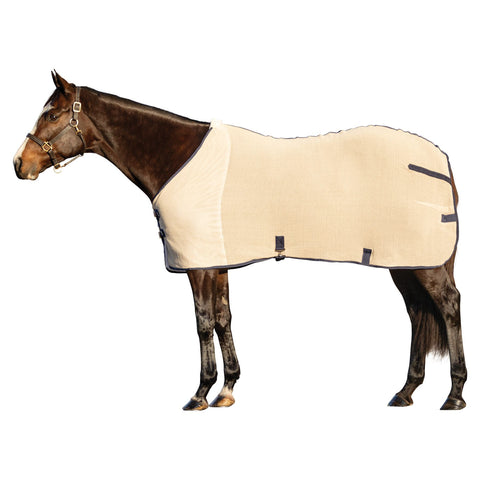
The Dura-Tech® Irish Knit Anti-Sweat Stable Sheet uses open-loop 100% pre-starched cotton to pull moisture away from the skin and route it into the air — fast. Less waiting. No chills. No skin funk. One sheet, three jobs.
The Post-Ride Wait That Robs Your Evening — and Your Horse's Comfort
You finish a hard workout — maybe a trail ride in August heat, maybe a jump school that ran forty-five minutes longer than planned. Your horse is blowing, dark with sweat from ears to flank. You untack, give a rinse if it's warm enough, and then what? You stand there. You walk slow circles around the barn aisle. You check your phone. You wait for your horse to stop steaming. Every horse person knows this exact moment — the post-ride limbo where you're stuck between done riding and actually done. The horse can't go in the stall soaked. He can't go out in the field if there's a breeze working. And he sure can't stay in the aisle indefinitely while you've got dinner to put on the table or a job to get back to. This is the cool-out problem. It sounds small, and it isn't.
What most people don't realize is that a horse that dries naturally without any help isn't really drying — it's sitting in an evaporative cooling process that can drop its core temperature faster than you want, especially when barn airflow picks up at dusk. The coat clumps and stays damp at the base, right against the skin, where it creates the perfect warm, moist environment for rain rot and dermatophytosis to take hold. You might not see the skin funk for a week or two, but it was brewing the moment that wet horse went into a stall without proper help. And a horse that gets chilled after heavy work isn't just uncomfortable — it's a horse that may tie up tomorrow, be stiff through the back the day after that, and generally feel off in a way that's hard to pin down but impossible to miss in the saddle. None of that shows up on a vet bill as cool-out related. All of it traces back here.
If you ride more than twice a week, the time math adds up fast. Forty-five minutes of cool-out waiting, twice a week, is over seventy hours a year standing in a barn aisle watching your horse drip. If you show — hunter-jumper, western pleasure, dressage, eventing — you're adding in-hand cool-out time between classes, sometimes in full sun with your next round thirty minutes away and a horse still damp from the last one. Eventers deal with this after cross-country when horses are truly cooked. Trail riders deal with it after long summer rides when the horse comes back lathered from the chest piece forward. Everyone deals with it. The question is whether you deal with it effectively or just wait and hope nothing goes wrong.
The usual workarounds all fall short in their own ways. Throwing a fleece cooler on a soaked horse sounds smart until you realize most fleece traps moisture at the surface and holds it against the coat — you've insulated the problem rather than solved it. A wool cooler works better but weighs nearly as much as a saddle pad when it's wet, takes two days to dry itself, and has to be professionally laundered to keep from felting. Walking the horse until it's dry is effective but requires a person to keep walking, and most of us don't have a dedicated groom standing by for that. Some people leave horses tied on the high-tie and cross their fingers, which works fine until the night the temperature drops twenty degrees unexpectedly and the horse goes home stiff and sore. None of these approaches solve the actual problem: moving moisture away from the horse's skin and into the surrounding air efficiently and quickly, without chilling the horse in the process.
The Real Cost of Getting Cool-Out Wrong — Season After Season
Skin problems are the first domino to fall. Rain rot on a show horse doesn't just look bad in the ring — it itches enough to make some horses fidgety and reactive under saddle, and the open sores attract flies during summer shows when you least want the distraction. Treat it with a medicated shampoo and antimicrobial protocol and you're looking at a minimum of two weeks of careful management, a coat that takes another month to grow back clean, and a horse who isn't at its best right when you need it to be. Meanwhile, the muscle stiffness that follows repeated poor cool-outs accumulates across a whole season in ways your vet might describe as training-related tension or back sensitivity. What it actually is, is a horse that got chilled after hard work enough times that its muscles now brace and protect as a default, and that shows up as resistance, short-striding, or a back that won't swing the way it should.
There is the practical cost and then there is the quieter, grinding frustration of spending time at the barn that goes nowhere. Forty minutes of cool-out pacing when you came out for a forty-minute ride is not what anyone signed up for. Horse people accept a certain amount of discomfort and inconvenience as part of the deal — it's horses, that's the agreement. But unnecessary waiting, waiting that better equipment could eliminate, has a way of eroding the joy that brought you to the barn in the first place. You start taking shorter rides in summer to avoid the cool-out overhead. You skip the harder schools because the aftercare takes too long. The horse gets less work. Fitness levels drop. The whole program slides backward over a season because of a problem that looks minor from the outside but compounds every single week.
Then there is the plain financial cost of the workarounds. Quality wool coolers that actually work run between $150 and $250 new. Used hard across two to three show seasons, the wool pills, the binding unravels, and you're back to shopping. Veterinary visits for a skin infection — culture, diagnosis, prescription antimicrobials — start at $150 for a mild case and climb quickly for anything systemic. One round of treatment for a bad rain rot outbreak will cost you more than the sheet that would have prevented it entirely. Add chiropractic or equine massage for chronic post-work stiffness at $80 to $150 per session and the math becomes straightforward: prevention is dramatically cheaper than the cascade of problems that follow poor cool-out management.
- ✗Wet coat stays damp at the skin for hours, creating conditions for rain rot and skin infections
- ✗Fleece and heavy wool coolers trap moisture against the coat rather than moving it away
- ✗Repeated chilling after hard work leads to muscle stiffness and back tension that compounds across a season
- ✗Vet bills, medicated treatments, and chiropractic visits add up fast when cool-out problems go untreated

What the Dura-Tech® Irish Knit Does — and Exactly How It Does It
The Dura-Tech® Irish Knit Anti-Sweat Stable Sheet was built specifically to solve the cool-out problem — not repurposed from something else, not a fleece cooler with a new hang tag. The Irish knit weave is an open-loop cotton construction that creates thousands of small air pockets across the entire surface of the fabric. Those air pockets are the mechanism. Drape this sheet over a sweating horse and the natural convective airflow through those cotton loops pulls moisture away from the skin and draws it toward the fabric's surface, where it evaporates into the surrounding air. The horse cools down. The horse dries out. You do it in a fraction of the time you'd spend waiting with no sheet at all — and without the chilling risk that comes from leaving a wet horse in moving air without protection.
The choice of 100% pre-starched cotton matters and is not interchangeable with synthetic alternatives. Synthetic fabrics can mimic moisture-wicking at the surface, but they hold heat, and in a barn environment they begin to smell fast — anyone who has tried to use a synthetic cooler through a full show season knows exactly what this means. Pre-starched cotton has a surface energy that pulls moisture by capillary action through the fiber itself, and it breathes in a way that synthetics simply do not replicate. The open Irish knit pattern amplifies this by creating surface area without trapping air between the fabric and the coat — which is the critical design difference between an anti-sweat sheet and a cooler. You want air moving across the horse, not a microclimate building underneath the fabric. The smooth nylon lining at the shoulders solves the one place where an open-weave fabric can generate friction, protecting the shoulder and neck where horses carry the most movement.
The practical results stack in a way that's easy to see over a season. The horse reaches a comfortable temperature faster, which means lower tie-up risk and less post-work muscle stiffness. The coat dries without clumping, which means no mat lines and no skin funk developing underneath. The fleece withers pad prevents spine pressure during long cool-outs — a detail that matters particularly for horses that are narrow or sensitive through the back. The adjustable front surcingle holds the sheet in position without binding the barrel, so airflow continues underneath while the horse moves around the stall. And because the cotton is machine-washable and dries fast, the sheet is clean and ready for the next ride without a production line of hand-washing and flat-drying.
Schneiders has been fitting horses since 1948 — 78 years in Chagrin Falls, Ohio, now into the third generation of the same family. When something wears out before it should, or doesn't fit correctly, we stand behind it. That is not a policy we print on a hangtag to close the sale. It is how a family business stays in business for eight decades. The Dura-Tech® label is our own private brand, which means we control the specifications, the materials sourcing, and the quality inspection at every step. When you buy this sheet from Schneiders, you are buying from the people who designed it and who will answer the phone if something goes wrong.
Open Irish Knit Weave
Thousands of air-loop pockets pull moisture away from the skin and route it to the surface to evaporate — instead of holding dampness against the coat.
Anti-Rub Shoulder Lining
Smooth nylon lining at the shoulders reduces friction where horses move most, helping prevent the rubs that open-weave designs commonly cause.
Fleece Withers Cushioning
Padded withers contact point prevents spine soreness during extended cool-outs — especially important for horses who are narrow or sensitive through the back.
Three-Way Versatility
Works as a post-ride cool-out sheet, a trailering sheet, or a blanket underlayer on colder nights — one sheet covers three jobs without extra cost or closet space.
What Riders Are Saying
"
My mare Constellation sweats through from her mane base all the way back, even on moderate work days. I've tried fleece coolers, wool coolers, a mesh sheet — nothing dried her out without leaving her clammy for hours. This Irish knit gets her from dripping to dry in about twenty-five minutes, even in summer humidity. The shoulder lining means no rubs where her neck crests, which has always been a problem with open-weave sheets. Exactly what I needed for our show day routine between rounds.
""
I ride endurance — forty to fifty miles at a stretch — and cooling my gelding Riverbend after a long day has always been my biggest aftercare headache. This sheet goes on right after I pull the saddle, and he's dry and comfortable before I've broken down the trailer. The cotton breathes in a way my old synthetic cooler never did. No mildew smell after storage, no pilling after a full season of hard use, and the front surcingle stays put even when he paws. Worth every cent at this price point.
""
I use this on my KWPN gelding Maestro as an underlayer under his medium-weight stable blanket once temperatures drop into the forties. It adds warmth without bulk, and the pre-starched cotton stays smooth without bunching under the outer blanket. I also throw it on after our flat work sessions since he runs warm. Two uses, one sheet, no issues after two full seasons. The fleece withers padding is a detail I really appreciate — he's narrow through the back and sensitive to any pressure there.
"How We Stack Up
| Feature | Schneiders Dura-Tech® Irish Knit Anti-Sweat Sheet | Tough-1 Irish Knit Sheet | WeatherBeeta Irish Knit Cooler |
|---|---|---|---|
| 100% pre-starched cotton construction | ✅ | ✅ | ⚠️ |
| Anti-rub shoulder lining | ✅ | ❌ | ⚠️ |
| Fleece withers cushioning pad | ✅ | ❌ | ❌ |
| Hook & loop assist closure | ✅ | ❌ | ❌ |
| Two-buckle open front | ✅ | ✅ | ✅ |
| Adjustable front surcingle | ✅ | ⚠️ | ✅ |
| Machine washable | ✅ | ✅ | ✅ |
| Suitable as blanket underlayer | ✅ | ⚠️ | ⚠️ |
| Quick-dry construction | ✅ | ✅ | ⚠️ |
| Satisfaction guarantee | ✅ | ❌ | ❌ |
Three Uses, One Sheet — The Math Is Simple
At $79.99, the Dura-Tech® Irish Knit Anti-Sweat Stable Sheet replaces at least three scenarios where you would otherwise be waiting, improvising, or spending more money. As a post-work cool-out sheet it shortens the dry-down by half or more. As a trailering sheet it keeps the horse comfortable on hauls without the weight or bulk of a wool cooler. As an underlayer under a stable blanket, it adds warmth on cold nights without the bunching and pressure that a poorly fitting underlayer creates. The pre-starched 100% cotton washes clean in a standard machine and dries faster than any wool alternative you can name — which means it is actually usable every ride day without a two-day laundry turnaround.
The hardware details make a real difference in daily use. The two-buckle open front with hook and loop assist closure means you can get the sheet on a fidgety, post-work horse quickly without fighting snaps or pins. The adjustable front surcingle holds everything in place as the horse moves without restricting airflow underneath. The fleece withers pad prevents the sheet from sitting hard on the spine during long cool-outs. These are not features added to justify a price point — they are the result of 78 years of the Schneiders family listening to what actually breaks, rubs, and fails in daily barn use.
- ✓100% pre-starched cotton Irish knit open-loop construction
- ✓Smooth nylon anti-rub lining at both shoulders
- ✓Fleece withers pad for extended cool-out comfort
- ✓Two-buckle open front with hook and loop assist closure
- ✓Adjustable front surcingle — secure fit without barrel restriction
What You Get