The Stable Sheet That Refuses to Fall Apart
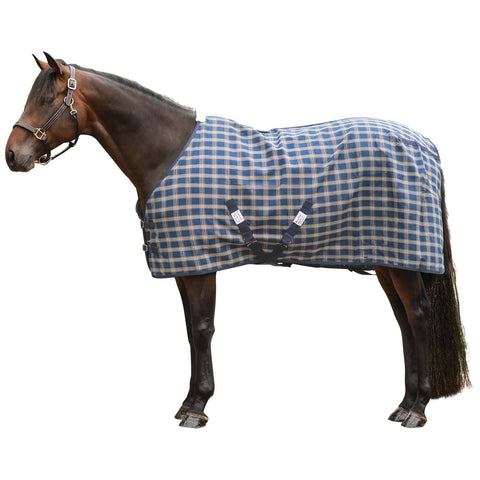
1200D ripstop polyester built for horses that actually move — full coverage, fleece-padded withers, and enough toughness to double as a show cover. Schneiders has been fitting horses right since 1948.

Every Spring, Another Sheet Headed for the Trash
It starts the same way every year. You pull your horse's stable sheet out of the tack room after a winter of use and hold it up to the light. There's a rip along the shoulder seam — again. The binding on the leg straps has frayed through, the surcingle hardware is pitted and stiff, and there's a gaping tear where your mare had a disagreement with the fence panel in the back paddock. It looked fine in the catalog. The reviews were decent. And yet here you are, standing in the barn aisle with a pile of shredded polyester and a horse that needs covering before the weather turns tonight.
The problem isn't just that cheap stable sheets rip — it's what happens when they rip at the wrong moment. A torn shoulder seam expands every time your horse lies down and rolls back to standing. What started as a two-inch tear becomes a six-inch flap by morning, leaving one shoulder fully exposed while the rest of the sheet still sits over his back. He's not cold enough to trigger alarm, but he's not covered properly either. Low-grade drafts across one shoulder, night after night, are exactly the kind of thing that stacks into stiffness, shortened stride, and a horse that's harder to warm up than he should be. Your vet doesn't flag it as a blanket problem. Why would they?
And then there's the daily routine of a sheet that doesn't fit right. You're in the barn at 6 AM and the sheet has rotated 15 degrees to the left because the surcingles lost their hold. The tail flap is twisted. One leg strap has unclipped and is dragging on the stall floor. You straighten it, re-clip it, adjust the belly band, and remind yourself to pick up electrical tape to reinforce the shoulder lining that's peeling away from its backing. This happens every single morning. In January. In the dark. Before coffee. Your barn manager has started leaving sticky notes about it.
You've tried the budget approach — buy two cheap sheets and rotate them. You've tried the opposite — spend $140 on a "premium" sheet from a brand with a nice logo and a lot of promises. The $140 one lasted two seasons before the withers lining compressed into nothing and started creating rub marks. The rotated budget pair made it through one winter between them before both gave out the same week. The pattern becomes clear: most stable sheet manufacturers are not equestrians. They're textile vendors who know what price points the market will bear. The product is engineered to sell, not to survive a 1,200-pound animal who sleeps in his own paddock and uses fence posts as back-scratchers.
A Bad Sheet Doesn't Just Cost You Money — It Costs Your Horse
Shoulder rubs from a poorly fitted sheet don't heal in a day. Once the hair starts breaking off at the point of the shoulder, you're looking at weeks of bare skin, careful padding arrangements, and riding around the problem. Competition horses show it first — judges notice a rough coat over the shoulder the way they notice an uneven topline. Trail horses and lesson horses carry it differently: you start accommodating the rub when you saddle up, shifting the pad, second-guessing the fit. Every accommodation creates a new pressure point downstream, and the original cause never gets fixed because it's still hanging in the stall every night doing exactly the same damage.
There's also what this does to your head. You start dreading the morning barn check in cold snaps, not because anything is seriously wrong, but because you know you're going to spend the first ten minutes managing a sheet that isn't doing its job. You add "check blanket" to the mental checklist right beside "check water" and "check hay" — except water and hay don't require emergency re-rigging at 5:45 AM. That background anxiety is real. Horse people carry a lot of it already. Your equipment should be removing it, not adding to it. A sheet that works correctly disappears from your attention entirely. That's what you're actually paying for.
Run the math on the cheap-sheet cycle and it's brutal. Two budget sheets at $60 each, replaced annually, is $120 per horse per year — $600 over five years — for sheets that never quite worked right to begin with. Add one vet visit for a shoulder rub that needed monitoring ($85 farm call minimum), one show scratch because your horse looked rough coming out of the trailer, and the soft costs stack well past what a solid, properly engineered stable sheet would have cost the first time. Buying well once is almost always cheaper than buying adequately twice. The stable sheet you replace every year is not the economical choice, no matter what the price tag says.
- ✗Shoulder seams that rip under normal use and expand with every roll
- ✗Surcingles that lose center overnight, leaving the sheet twisted by morning
- ✗Withers lining that compresses flat and creates rub marks within a season
- ✗Hardware that corrodes and stiffens so leg straps won't unclip cleanly

Built in Chagrin Falls, Tested by Horses Who Don't Cooperate
The Dura-Tech® Ripstop Poly Plaid Stable Sheet is Schneiders' answer to everything that goes wrong with stable sheets not built by people who keep horses. We've been fitting horses in Chagrin Falls, Ohio since 1948 — 78 years of watching what works in real barns, on real horses, through real Ohio winters and the muddy springs that follow them. This sheet exists because our team knew exactly what a stable sheet needed to do and built it to do those things, specifically, without compromise on the details that actually matter.
The 1200D ripstop double-woven polyester is the foundation. Ripstop is woven with a reinforcing thread pattern that stops tears from propagating — if a fence post catches a corner, the damage stays local instead of running the length of the sheet. The nylon-lined shoulder eliminates the primary failure point on most stable sheets: bare polyester rubbing against your horse's shoulder point with every movement. Fleece at the withers means no pressure at the most contact-sensitive spot on a horse's back. Crisscross surcingles with detachable leg straps keep the sheet centered through rolling, lying down, standing back up, and whatever else your horse decides to do at 2 AM.
The result is a sheet you put on and stop thinking about. Morning check: it's where you left it. Show day: it doubles as a clean cover on the trailer so your horse arrives looking prepared. Transitional weather: it layers under heavier blankets without bunching, because the cut gives enough depth for full hindquarter coverage without excess bulk. One sheet. Multiple use cases. No emergency tape. No 6 AM re-rigging. Just a horse that's covered correctly, every night, all season.
Schneiders has stood behind every Dura-Tech product we've ever sold. If something isn't right, we make it right — that's what 78 years of family ownership looks like in practice. We ship to all 50 states, we answer the phone, and we've built enough sheets to know exactly what a horse needs from one. The Ripstop Poly Plaid Stable Sheet ships with that history behind it and the people who built it still answering for it.
Ripstop Fabric That Won't Run
1200D double-woven polyester stops tears at the source — damage stays local instead of running the length of the sheet
Fleece-Padded Withers
Soft contact at the most pressure-sensitive point on your horse's back, eliminating the rub marks cheaper sheets leave behind
Nylon-Lined Shoulder
Targets the #1 failure point on most stable sheets — the shoulder — with a reinforced lining that holds up season after season
Dual-Use Design
Functions as a stable sheet, a layering liner in transitional weather, or a clean show cover on the trailer — one sheet, three jobs
What Riders Are Saying
"
My Quarter Horse gelding is hard on everything — he's 16.2 and built like a freight train, and he's destroyed three stable sheets from other brands in two years. This one has held up through six months of daily use, two trail trips in the trailer, and one very bad night where he got cast against the stall wall. The nylon shoulder lining is still intact. No rubs, no rips, no hardware failures. Worth every cent of the $84.
""
I show Dressage at the regional level and I'm particular about how my mare arrives at the showgrounds. This sheet has become my go-to trailer cover because it's clean, holds its shape, and doesn't compress over the withers the way most stable sheets do. After six shows this season her shoulder hair is in perfect condition. I bought a second one for my OTTB coming back into work. Schneiders never oversells — this is exactly what they say it is.
""
I have three horses and I'm not made of money, so I need equipment that actually lasts. I bought this for my older Arab who runs cold in his stall even in moderate weather. He's worn it most nights from October through April for two full seasons. The surcingles are still holding, the leg straps clip clean every time, and the plaid pattern still looks good enough that my barn friends keep asking where I got it. Real durability for a fair price.
"How We Stack Up
| Feature | Schneiders Dura-Tech® Ripstop Poly Plaid | Rambo Stable Sheet | WeatherBeeta ComFiTec |
|---|---|---|---|
| 1200D Ripstop Poly Fabric | ✅ | ❌ | ❌ |
| Fleece Withers Padding | ✅ | ✅ | ⚠️ |
| Detachable Leg Straps Included | ✅ | ✅ | ✅ |
| Crisscross Surcingles | ✅ | ✅ | ⚠️ |
| Nylon-Lined Shoulder | ✅ | ❌ | ❌ |
| Doubles as Show or Transit Cover | ✅ | ⚠️ | ❌ |
| Hook-and-Loop Front Assist | ✅ | ❌ | ⚠️ |
| Full Hindquarter Coverage | ✅ | ✅ | ⚠️ |
| Ships All 50 States | ✅ | ❌ | ❌ |
| Under $90 | ✅ | ❌ | ❌ |
The Finer Points That Actually Matter
The 2-buckle open front with hook-and-loop assist closure sounds like a minor detail until you're trying to sheet a horse who's decided the wind noise from the north is personally targeting him. The closure system lets you get the front secured with one hand if needed, and the hook-and-loop layer keeps the chest panel flat and gap-free once buckled. No flapping chest panel in a drafty barn aisle. No gap letting cold air in at the front where a horse loses heat fastest.
The back seam runs along the center — a deliberate structural choice that distributes stress away from the sides where most blanket seams fail under lateral movement. The sheet is cut with generous depth from front edge to tail flap, which means it actually covers the hindquarters of a horse with a round croup rather than just suggesting that it might. Sizes run true to horse size, not to minimize fabric per unit. These are the decisions that separate a sheet designed by equestrians from one designed by a production team working from a cost sheet.
- ✓1200D Ripstop double-woven polyester outer shell
- ✓Fleece wither padding for comfort and rub prevention
- ✓Nylon-lined shoulder for lasting durability at the primary wear point
- ✓Crisscross surcingles and detachable leg straps included
- ✓2-buckle open front with hook-and-loop assist closure
What You Get