
Build Better Training Jumps — Without the Rot, Warp, or Worry
The Horsemen's Pride Jump Block gives you a weatherproof, stackable foundation for cavalettis, cross poles, and gymnastic grids — at a price that makes equipping your entire arena finally make sense.

Your Wooden Jump Standards Are Working Against You
It's early morning, dew still on the grass, and you're hauling jump blocks out of the barn to set up a gymnastic grid before your lesson starts. You've got the arena to yourself, a willing horse warmed up, and a solid training plan in your head. Then you pick up the old wooden block from the corner — and it's soft in the middle, a little punky from last winter's wet, and one corner has split into a ragged edge that could catch a hoof at exactly the wrong moment. You set it down, find the duct tape, do a field repair that you know isn't really a repair, and get on anyway. That compromise is baked into your training session before you've thrown a leg over.
Wood is beautiful, and there's a long tradition of it in jumping arenas. But that tradition comes with a tax most riders don't fully calculate until they're replacing standards for the third time in eight years. Wood absorbs moisture every time it rains. It swells and contracts with the seasons. Paint chips and peels, exposing bare grain that soaks up more water, and the cycle accelerates. By the time a wooden block looks bad enough to replace, it's already been compromising your horse's safety for months — soft corners that don't hold pole cups at a consistent height, rotted bases that shift when a rail is knocked, and surfaces that are genuinely sharp when they splinter. The deterioration is slow enough that you adapt to it without noticing how far you've drifted from safe.
Every time you move a heavy, water-logged wooden block, you're burning energy you need for riding. Every time you store blocks outside — because who has unlimited covered space? — you're watching your investment degrade. Splinters catch in leather gloves and work aprons. Rotted corners fail to hold poles at the consistent heights that matter enormously when you're training a horse to a specific stride or gymnastics distance. And every spring, you're pulling blocks out of storage and wondering which ones are still safe and which ones are going to be an insurance claim waiting to happen. The decision-making overhead of managing degrading equipment is real, and it takes mental space away from your actual training work.
Riders who've been through this cycle have tried everything. Paint and sealant helps for a season, then the freeze-thaw cycle defeats it. Metal blocks are heavy, rust at the joints, and are miserable to move solo. PVC pipe DIY solutions look homemade because they are, and they don't stack cleanly or hold pole cups at consistent heights. Foam blocks are light but compress unevenly over time and bounce unpredictably when a horse raps them. There has not been a clean answer — until you look at what thick-walled, high-density plastic construction actually does when it is engineered specifically for this purpose, not repurposed from another industry.
Every Cancelled Training Session Has a Cost
When jump equipment isn't reliable, training plans quietly fall apart. You skip the gymnastic grid because the footing on the blocks looks questionable. You simplify the course because you don't trust the poles to stay at the height you set. Your horse starts anticipating flatter work, and the gymnastics that sharpen a jumping horse's eye and scope get left out of the rotation for weeks at a stretch. The training deficit accumulates invisibly. You don't realize how much scope development you've surrendered until you're at a show and your horse is backing off fences that should be comfortable — because the grid work that builds confidence and adjustability simply hasn't happened.
There is also the mental weight of managing deteriorating equipment — the constant low-level awareness that something might fail. Riders who love their horses think about safety constantly, and equipment that can't be fully trusted adds to that cognitive load in a way that is hard to quantify but very real to experience. You should not have to ride a gymnastic line wondering whether a block is going to crumble when your horse raps the ground pole on the approach. That mental bandwidth belongs to your position, your timing, and your horse's rhythm — not to background infrastructure anxiety about whether your gear is going to hold.
Replacing wooden jump standards every few years, factoring in the labor to haul and dispose of the old ones, adds up faster than most riders acknowledge. A single set of wood standards might cost $150 to $300, look fine for two seasons, then deteriorate sharply in years three and four. Multiply that across a full arena setup — enough blocks for a proper gymnastic grid plus a small course — and you are spending over $1,000 every four to five years just keeping the jump equipment functional at a marginal safety threshold. That is not investment in better training; it is the cost of standing still, paying repeatedly for the same equipment without the compounding benefit of gear that actually lasts.
- ✗Wooden blocks rot, splinter, and become unsafe — often before you notice the change
- ✗Water-logged wood gets heavier every season, making course setup miserable work
- ✗Inconsistent block heights after weathering throw off your stride and gymnastics work
- ✗Replacing deteriorated equipment every few years eats your gear budget without improving anything

Weatherproof, Stackable, Ready Every Single Time
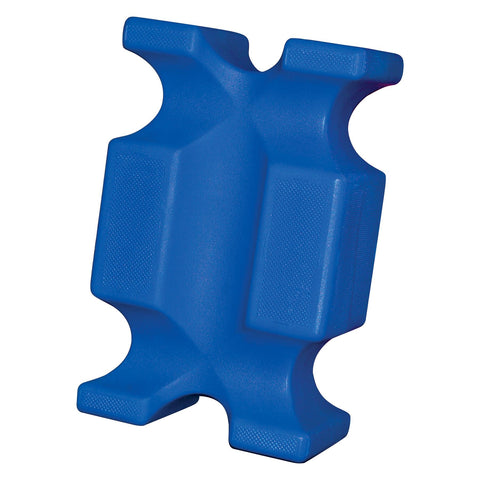
The Horsemen's Pride Jump Block solves the rotation problem cleanly: thick-walled, high-density plastic construction that does not absorb moisture, does not rot, does not splinter, and does not change weight or geometry between wet seasons and dry ones. At 24 inches long, 15 inches wide, and 9 inches deep, each block gives you a stable, flat foundation for cavalettis and cross poles, and they stack cleanly when you need additional height for parallels and verticals. Set them up in spring, leave them in the outdoor ring all year, and come back to them in the same condition you left them.
High-density plastic is the right material here for a specific mechanical reason. It is rigid enough to hold pole cups at a consistent height — meaning the 9 inches you set today is the same 9 inches six months from now, after a winter of freeze-thaw cycles outdoors. The thick-walled construction means the block does not flex or compress under load the way cheaper single-wall plastics or foam alternatives do. When your horse raps a rail and the pole drops, the block stays exactly where you placed it. That consistency is what makes gymnastic training repeatable, and repeatability is how horses actually learn.
Because the blocks are lightweight without being fragile, you can reorganize a course quickly — critical if you are doing gymnastics work with fast-moving distances, or teaching back-to-back lessons and need to adjust jump heights between students without a crew. Stack two blocks for 18 inches of height. Move one solo from one end of the arena to the other without straining your back. Leave them out in the rain all week because you simply do not have to think about moisture. That changes your relationship with the jump equipment entirely, from something you manage around to something that is just there when you need it.
Schneiders has been supplying working riders and trainers since 1948 — 78 years of understanding what holds up in real arenas and what fails the first hard winter. The Horsemen's Pride Jump Block ships to all 50 states and is backed by Schneiders' full satisfaction guarantee. If it does not perform the way we have described, we want to know about it. That is how a family-owned business in its third generation operates — not with fine print and return windows, but with accountability to riders who depend on their gear.
Never Rots or Splinters
Weatherproof high-density plastic holds up through rain, snow, and hard Ohio freeze-thaw cycles without softening, cracking, or developing the sharp edges that make old wood blocks a hoof hazard.
Stackable for Variable Height
Use singly for cavalettis and ground poles or stack for additional height — build cross poles, small verticals, and parallels from the same set of blocks without buying separate equipment for each fence type.
Consistent Heights, Season After Season
Thick-walled rigid construction means the height you set today is the height you get after six months outdoors — no compression, no warping, no drift that throws off your gymnastics distances.
Light Enough to Move Solo
Durable without being heavy, so one person can reorganize a full course, adjust heights between lessons, or reset a gymnastics grid quickly — without calling for help or burning energy before you ride.
What Comes With This Schooling Pair
- Matching jump blocks sold as a pair
- Suitable for cavalettis
- Suitable for parallel arrangements
- Suitable for cross poles
- Suitable for training jumps
- Stackable for additional height
- Lightweight, sturdy, weatherproof construction
How We Stack Up
| Feature | Schneiders Horsemen's Pride Jump Block | Kincade Jump Block | Dublin Standard Block |
|---|---|---|---|
| Weatherproof construction | ✅ | ⚠️ | ❌ |
| Stackable for height variation | ✅ | ⚠️ | ⚠️ |
| Consistent height after seasonal use | ✅ | ⚠️ | ❌ |
| Safe for year-round outdoor storage | ✅ | ⚠️ | ❌ |
| Lightweight enough to move solo | ✅ | ✅ | ❌ |
| No splinter or rot risk | ✅ | ✅ | ❌ |
| Thick-walled rigid construction | ✅ | ❌ | ⚠️ |
| Available across all 50 US states | ✅ | ⚠️ | ⚠️ |
| Satisfaction guarantee | ✅ | ⚠️ | ⚠️ |
| Backed by family-owned retailer since 1948 | ✅ | ❌ | ❌ |
Built for the Realities of Working Arenas
The Horsemen's Pride Jump Block measures 24 inches long by 15 inches wide by 9 inches deep — dimensions chosen to give you stable base geometry without excessive bulk. The block sits flat and does not wobble, which matters when you are trying to hold pole cups at consistent heights across a full course. The weatherproof construction is honest about how most arenas actually operate: equipment lives outside, and gear that requires covered storage or seasonal maintenance is gear that eventually gets skipped. These blocks require neither.
They work equally well as the base of a cavaletti for flat work, as the wings of a ground pole setup for young horses learning to look at something different, or stacked two-high for an 18-inch fence in a gymnastic grid. At $79.99 each, they price competitively against wood standards when you factor in longevity — you are not budgeting for replacement in three years, and you are not spending a Saturday afternoon repainting and sealing just to get through another season.
- ✓24"L x 15"W x 9"D — stable base geometry for consistent, repeatable jump heights
- ✓Thick-walled high-density plastic — rigid and load-bearing, not spongy or compressible
- ✓Weatherproof construction — safe to store outdoors year-round with no maintenance required
- ✓Stackable design — build cavalettis, cross poles, verticals, or parallels from one block set
- ✓Lightweight without sacrificing durability — one person can set and reset a full course solo
Why Riders Can Keep Reworking the Same Pair
One Pair, More Ways to Arrange Your Schooling Area
These blocks offer a movable, stackable support system for riders who want to change among several pole and jump exercises without relying on full-size standards for every setup.
Put a More Flexible Base Under Your Pole Work
Choose Horsemen's Pride Jump Block in blue, red, or white and receive a pair designed for cavalettis, parallels, cross poles, and training jumps.