The Spur Strap That Stays Put When It Matters Most
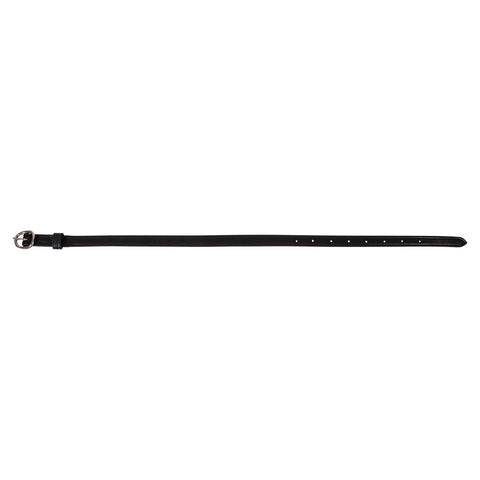
Joseph Sterling Black Leather English Spur Straps — top-grain English leather, stainless steel hardware, 1/2" x 19 1/2", sold in pairs. Built for the rider who can't afford to think about their tack mid-course.
When Your Spur Strap Fails You in the Ring, Everything Else Follows
You've been on the show grounds since six in the morning. Your horse is braided, your boots are polished, and you've walked the course twice. You're standing in the in-gate, waiting for the number before yours to clear, when you feel it — that small, unmistakable shift at your heel. Your spur strap has twisted. Or the buckle prong has worked loose from the hole. Or, worst of all, the leather has let go entirely at the hardware. In the ten seconds you have before your number is called, you do what you can. You ride anyway. And for the next sixty seconds or three minutes, depending on your discipline, a small but constant piece of your focus is on your foot instead of your horse.
The thing about a failing spur strap is that it compounds. It isn't just an inconvenience — it changes how you ride. When your spur migrates upward on your boot heel, your ankle angle shifts to compensate. That shift travels up the chain: your lower leg position changes, your hip angle adjusts, your contact becomes uneven. A judge working from C will see a rider who looks braced on one side and can't quite put their finger on why. Your trainer watching from the rail will notice it immediately. And you'll feel it in your horse's response, even if you're the only one who knows the cause. A piece of hardware that costs less than a lunch can cost you a ribbon, a score, or worse — your horse's confidence in a steady, consistent leg.
This plays out not just in competition, but in every training ride leading up to it. A strap that stretches gradually over a few weeks of schooling doesn't announce itself. You find yourself tightening the buckle one hole, then another, then cinching it so snug the leather begins to crack at the fold. Or the strap is long enough that the tail won't stay in the keeper and flaps against your boot. You start schooling a correction or a flying change and your spur isn't where your muscle memory expects it to be. Your horse gets an ambiguous signal. You wonder if the response you got was the horse's fault or yours. In reality, it was your equipment's fault — but that's cold comfort when you're trying to figure out if your lateral work has actually regressed.
Most riders have tried to solve this through repetition rather than replacement. They've bought the inexpensive straps from a catalog bin, used them until they failed, bought the same thing again. Or they've tried to extend the life of a failing strap with saddle soap, with extra conditioning oil, with a strategic extra hole punched with a nail and a hammer at the barn. They've pinned straps in place with a safety pin threaded through the keeper when the keeper stopped gripping. These are the kinds of workarounds that experienced riders know well and talk about only among themselves, because there's something embarrassing about admitting that a twelve-dollar piece of leather has been dictating the quality of your training for three months. The problem isn't stubbornness or lack of attention. The problem is that most spur straps on the market are simply not built for the actual demands of consistent, daily riding.
Cheap Hardware Doesn't Just Fail Quietly — It Costs You More Than You Think
The ripple effects of a low-quality spur strap extend further than any single bad ride. When your lower leg isn't consistent because your spur is migrating or your strap is torquing, your horse learns to tolerate imprecision rather than respond to clarity. That's a training problem that takes weeks to undo once you've identified it. You might spend two or three sessions thinking your horse has developed a new evasion, trying different approaches, adjusting your position and aids, when the actual variable is that your spur is half an inch higher than it was last month. In disciplines where precision is the entire point — dressage, equitation, hunters — that ambiguity doesn't stay contained to one movement. It bleeds into the horse's trust in your leg as a consistent signal.
There is also the emotional cost that nobody talks about when discussing tack. Confidence in competition comes from preparation, and preparation includes knowing your equipment will behave. When you've had a strap fail on course or in a test, you carry that experience forward. You add one more pre-ride check to your routine, one more small anxiety to manage at the in-gate. Top riders talk often about the mental discipline required to stay present in the ring — to let go of the last jump and ride to the next one. Every piece of tack that forces you to think about itself rather than your horse is a cost to that discipline. The best tack is the tack you forget you're wearing.
And then there's the money. The instinct is to buy inexpensive straps because they're inexpensive — to treat them as a consumable rather than an investment. But a strap that lasts six months costs twice as much per year as a strap that lasts four years, and that math doesn't account for the hidden costs: the extra conditioning products, the emergency replacements purchased at a show for twice the normal price, the judging penalties and the training time lost to equipment-related inconsistency. A pair of well-made English spur straps, priced honestly for the materials and construction, is one of the highest return-on-investment purchases in your entire tack trunk. You just have to buy the right ones once.
- ✗Buckle prongs that work loose mid-ride and don't stay in the hole
- ✗Leather that stretches and cracks at the fold within a season
- ✗Hardware that pits and rusts after the first wet winter
- ✗Straps that shift and twist, throwing off your lower leg position

Joseph Sterling: Top-Grain English Leather. Stainless Hardware. Built to Disappear on Your Boot.
The Joseph Sterling Black Leather English Spur Straps are the answer to every one of those problems — not because they promise the moon on the hang tag, but because they're made from materials that are simply better than what you'll find in the bargain bin. Top-grain English leather, 1/2" wide by 19 1/2" long, with stainless steel hardware throughout. Sold in pairs. That's the whole product description, and that's intentional. When the materials and construction are right, you don't need a list of special features to justify the price. The strap does its job and you forget it's there.
Here's how they work. The 1/2" width is the established standard for English spur straps because it threads cleanly through the spur loops on every major English spur on the market without bunching or folding. The 19 1/2" length accommodates tall dress boots and shorter paddock boots with equal reliability — enough material to buckle securely and tuck the tail properly into the keeper, but not so much excess that it flaps. The top-grain English leather is cut from the part of the hide where the fiber structure is tightest and most uniform, which means it resists stretching under repeated stress and develops a patina rather than cracking as it ages. The stainless steel hardware is selected specifically because it doesn't pit, rust, or develop rough edges that abrade the leather over time. Every component is chosen to work with every other component across years of use, not months.
The cascade of benefits is straightforward. Your spur stays exactly where you placed it on your boot, ride after ride. Your lower leg stays in the same position it was in during your last schooling session. Your horse gets consistent, clear communication from your leg. Your trainer stops having to diagnose problems that aren't actually problems. You stop thinking about your tack and start thinking about your riding. Over a show season, that compounds into better scores, cleaner courses, and a horse who trusts your leg as a reliable aid rather than an unpredictable one. That's not marketing language — that's just what happens when your equipment stops being a variable.
Behind the Joseph Sterling straps is Schneider Saddlery, family-owned in Chagrin Falls, Ohio since 1948. Seventy-eight years of outfitting riders at every level means we've seen exactly what happens when tack is built to a price point rather than to a standard — and we've made our reputation by knowing the difference. Every product we carry has to meet the expectations of riders who know what they're looking at. If the Joseph Sterling straps don't perform exactly as described, we'll make it right. That's not a limited-time offer or a complicated claims process. It's how a third-generation family business stays in business for 78 years.
Top-Grain English Leather
Cut from the tightest-grained part of the hide for maximum resistance to stretching, cracking, and deformation under daily use.
All-Stainless Hardware
Buckles and hardware won't pit, rust, or develop rough edges — season after season, wet barn winters included.
Standard 1/2" x 19 1/2" Fit
Fits every major English spur loop without bunching or excess tail — works from short paddock boots to tall dress boots.
Sold in Pairs, Priced Fairly
Both straps in the box at $34.99. No upsells, no separate purchases — just the complete set you need to ride.
What Riders Are Saying
"
My mare Copperton and I have been competing hunters for six years and I've burned through every budget spur strap you can name. I put the Joseph Sterlings on back in March before our spring circuit started and they haven't moved a millimeter. The leather broke in after the third ride — soft, flat against my boot, no creasing at the hardware. Our trainer actually commented on how clean my lower leg looked. That's the thing: when your tack fits right and stays put, you ride better. These are the straps I'll keep buying.
""
I do dressage with my 17-hand KWPN, Galileo, and I'm picky about anything that touches the saddle pad area. The stainless buckles on these are immaculate — no rough edges, no pitting after months in a humid barn. At 19 1/2" they fit my tall boots without any awkward overlap. I wore them through my First Level tests and into my first Third Level schooling season. The leather has developed a gorgeous patina and has never once stretched or slipped. At $34.99 for the pair, I don't know why I waited so long to try Schneiders for straps.
""
Eventing means your tack takes a beating — cross-country mud, stadium arena footing, dressage warmup twice in a weekend. I put the Joseph Sterling straps on Buckshot before our first recognized horse trial in May and they came through all three phases without a single adjustment. The leather stayed supple even after getting soaked on the water complex. The hardware didn't show a spot of rust when I cleaned up that evening. For a working eventer on a budget, these are exactly what you want: quiet tack that does its job and lets you focus on the course.
"How We Stack Up
| Feature | Schneiders Joseph Sterling | Ovation | TuffRider |
|---|---|---|---|
| Leather Grade | ✅ | ⚠️ | ❌ |
| All-Stainless Hardware | ✅ | ⚠️ | ❌ |
| Standard 1/2" Width | ✅ | ✅ | ⚠️ |
| 19.5" Length for Tall Boots | ✅ | ⚠️ | ⚠️ |
| Sold as True Pair (Matched) | ✅ | ✅ | ⚠️ |
| Corrosion-Resistant Hardware | ✅ | ⚠️ | ❌ |
| No Stretch After Break-In | ✅ | ⚠️ | ❌ |
| Show-Ring Clean Finish | ✅ | ⚠️ | ❌ |
| 78-Year Retailer Guarantee | ✅ | ❌ | ❌ |
| 4.8-Star Verified Reviews | ✅ | ⚠️ | ⚠️ |
What 78 Years of Fitting Riders Taught Us About Spur Straps
We've been watching riders tack up since 1948. In that time, the single most common tack-related training problem we hear about — after saddle fit — is inconsistent lower leg position caused by equipment that slips, stretches, or fails to hold its buckle setting. The solution is almost always the same: better leather, better hardware, better construction. The Joseph Sterling straps are priced at $34.99 because that's what it takes to use the right materials. We don't offer a cheaper version because a cheaper version doesn't solve the problem.
The 1/2" width is load-bearing in more than one sense. Narrower straps concentrate stress on a smaller contact area with the leather, which accelerates cracking at the fold and hardware holes. The 19 1/2" length gives you enough material to buckle on the third or fourth hole — away from the end of the strap where leather is weakest — with enough tail to sit securely in the keeper. These aren't arbitrary dimensions. They're the result of decades of feedback from riders who told us what actually fails and what doesn't.
- ✓Top-grain English leather construction — tighter fiber structure than corrected or split-grain leather
- ✓All-stainless steel hardware — corrosion-resistant through all-weather riding and barn conditions
- ✓1/2" width — standard for every major English spur style on the market
- ✓19 1/2" length — fits tall dress boots and shorter paddock boots with proper buckle placement
- ✓Sold in pairs — both straps included, matched in cut and hardware
What You Get