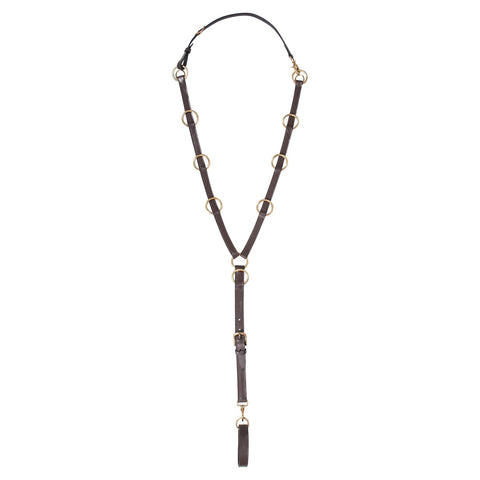
Ten Rings. One Martingale. Total Control Over Your Horse's Frame.
The Premier 10 Ring Training Martingale gives you precise, adjustable leverage at every stage of your horse's development — built from hand-rubbed buffalo leather and solid brass hardware by the team at Schneiders Saddlery, family-owned in Chagrin Falls, Ohio since 1948.
Your Horse Knows How to Evade the Bit — And Your Current Gear Lets Him Get Away With It
Picture a perfectly ordinary Tuesday schooling session. You've blocked out ninety minutes, the arena is empty, and your horse warmed up quietly enough that you let yourself think today might be the day things click. You pick up a working trot, ask for contact, and within two strides the head comes up, the back drops out, and you're back to chasing a horse who is actively reorganizing his body to avoid engaging. By the time you've circled twice and tried a half-halt, you've lost the rhythm, the impulsion, and what was left of your patience. You cool out staring at the arena fence, knowing you'll be back here doing the same dance on Thursday.
What most riders don't realize is how quickly an evasion pattern compounds on itself. Every time your horse successfully pops his head up to escape rein pressure — even for a half-second — he logs that as a successful strategy. Horses are extraordinarily good at finding the path of least resistance, and if your tack is giving them an inch of ambiguity about where the pressure boundary is, they will find it and exploit it every single time. A standard running martingale gives general downward guidance but offers no graduation — the horse hits one pressure point or none. A standing martingale is blunt, restrictive, and offers no conversation. Neither tool lets you fine-tune the message to exactly where your individual horse is in his training today.
In practice, this plays out in ways that grind on you: a horse who feels like he's working correctly for fifteen minutes and then dissolves the moment you move from a large circle to a straight line; a horse whose transitions feel like arguing; a horse who flatters at the walk and falls apart the moment you ask for collection. You're spending training time patching the same hole in the same fence over and over instead of actually building toward something. Your trainer tells you to ride him forward into the contact but he hasn't met your horse, who responds to more leg by telescoping his neck up and running flat. The advice is right in theory and useless in your arena on a Tuesday.
Most riders in this situation have tried the obvious things. You've probably tried different bit combinations — a softer mouth piece, a copper roller, something with a port to give the tongue relief. You may have tried a flash noseband to keep the mouth from opening and the jaw from twisting away. Some of you have tried draw reins, which work when someone is holding them correctly and create a nightmare when used wrong. Maybe you've spent money on a bodyworker, a chiropractor, a second saddle fitting, checking hocks, checking back, checking SI joints. Some of that work may have been genuinely useful. But if the training foundation isn't there — if the horse has never learned that yielding to pressure is safe and releasing pressure is the reward — none of the downstream fixes stick. What you need is a tool that can teach the lesson systematically, one ring at a time.
The Longer This Goes On, the Harder the Habit Is to Break — and the More It Costs You
An evasion pattern left unchecked doesn't stay contained to your Tuesday schooling session. It bleeds into everything. Your warm-up at shows gets longer because you need twice as many circles to settle him before entering the ring. Your flat work suffers because you're managing the head instead of developing the topline. Your jumping rounds carry tension in the neck and back that limits how well he can use himself over a fence — and judges see it, even when you think you're hiding it. Your trail rides become battles of attrition when he's tired and defaults to old habits. One training deficit becomes a horse who is less rideable in every discipline you ask him to work in, and the gap between where he is and where you want him to be grows wider with each month that passes without a real solution.
There's an emotional cost here that doesn't get talked about enough in tack reviews. Riding should not feel like conflict management. When you're dreading the canter transition, second-guessing your aids, and bracing against the next head flip before it even happens, the joy evaporates fast. You start shortening your sessions to avoid the worst of it. You stop schooling things you know will trigger the evasion and stick to what's comfortable. Your confidence erodes in small increments, each session leaving a deposit of frustration that accumulates until getting on feels more like obligation than pleasure. That's the thing nobody tells you about tack problems — they don't stay in the tack room. They follow you to the barn.
On the purely financial side, the workaround math adds up fast. One extra bodywork session because the tension in his neck is causing back soreness: $150. A second bit purchase because the first one didn't fix the root problem: $80-220. Draw reins from the trainer's recommendation: $45. Chiropractic visit: $200. A new saddle fitting to rule out fit as the cause: $100-200. You can spend $600 to $900 chasing a training problem with equipment and therapy that addresses symptoms — and still be right back where you started because the fundamental issue, a horse who hasn't learned to accept and yield to rein pressure reliably, was never addressed directly. A martingale that gives you ten precise points of communication, built from leather that will last fifteen years if you care for it, at $89.99 is not an expense. It is the cheapest diagnostic and training tool you will buy this year.
- ✗Head tossing that breaks your contact at every transition
- ✗Standard martingales with no graduation between too much and too little
- ✗Sessions that feel like conflict instead of conversation
- ✗Money spent on symptoms while the root training gap stays open

Ten Ring Positions. Precise Conversation. One Tool That Grows With Your Training.
The Premier 10 Ring Training Martingale was built around a single truth experienced trainers have known for decades: productive work comes from giving the horse a clear, consistent, adjustable pressure point to find and yield to — not a blunt stop, not a vague suggestion, but a specific, reproducible boundary that rewards the correct response instantly. With ten ring positions across the chest strap, you have the range to meet your horse exactly where he is today and progress him toward where you want him to go — without switching equipment each time your training advances.
The mechanism is straightforward and biomechanically sound. Each ring position changes the angle at which rein pressure reaches the bit, adjusting how much downward and inward guidance the horse receives when he raises his head above the point of correct carriage. Set low, ring positions 1 through 3 offer a broad, gentle reminder suited to young horses just learning what contact means. The middle positions, 4 through 7, provide the active training range where most horses spend their development — enough leverage to make the conversation clear, not enough to create defensive tension. Positions 8 through 10 give experienced trainers precise upper-range guidance for horses working on collected work or recovering from established evasion habits. The neck strap and girth strap are fully independent and adjustable to fit horses from compact Quarter Horses to tall Warmbloods without compromise.
What follows from having the right pressure point in the right place is a cascade of downstream improvements riders often describe as their horse finally making sense. When the head carriage stabilizes, the back swings freer. When the back swings, the hind end can engage properly. When the hind end engages, transitions become lighter and more balanced. Riders report that within three to five sessions with the Premier martingale dialed to the correct ring position, they start feeling a horse who is seeking contact rather than evading it — a fundamentally different animal to ride. The hand-rubbed, oiled buffalo leather keeps the strap supple against the horse's chest and neck, with no stiffness to trigger defensive reactions in sensitive horses. Solid brass rings and hardware hold their position under work and resist corrosion through seasons of use.
Schneiders Saddlery has been equipping working horse people in Chagrin Falls, Ohio since 1948 — 78 years of selecting gear based on what actually holds up in arenas and on trails, not what photographs well in a catalog. When you order from us, you get a 100% satisfaction guarantee backed by a team who will pick up the phone, knows what a martingale is supposed to do, and will make it right if something isn't working. The Premier 10 Ring Training Martingale ships free on orders over $99, and we deliver to all 50 states. This is the gear your horse's training has been waiting for.
10 Precise Ring Positions
Dial in the exact pressure angle for your horse's training stage — from green and contact-shy to advanced horses working on collection.
Hand-Rubbed Buffalo Leather
Premium oiled buffalo leather arrives supple and stays that way — no long break-in period, no stiff edges against sensitive skin.
Solid Brass Hardware
Every ring and buckle is solid brass for long-term strength and corrosion resistance through seasons of arena and outdoor use.
Fully Adjustable Fit
Independent neck strap and girth strap adjustments fit horses from compact Quarter Horses to tall Warmbloods without compromise.
What Riders Are Saying
"
My 7-year-old Warmblood mare had a serious habit of flipping her nose at the canter transition — we'd been fighting it for two full show seasons. Within three schooling sessions with the Premier martingale set to ring 6, she started accepting contact without the drama. Our last hunter derby, the judge commented on her consistent frame. That's not luck, that's the right tool finally in our hands.
""
I train green OTTB rehabbers and I go through a lot of training equipment. The buffalo leather on this martingale is noticeably different — supple right out of the packaging, no break-in battle. Set it to ring 4 for the young ones, ring 7 for my more established horses who need a reminder to come through. The brass hardware hasn't shown a speck of rust after a year of Florida humidity. Worth every dollar of the $89.
""
Trail and ranch work is all I do, and I was skeptical a training martingale would hold up to the miles. My sorrel gelding is heavy-necked and loves to root on the trail when he's tired. Two months in with the Premier set to ring 5 and he's seeking contact instead of evading it. The adjustable neck strap fits his big draft cross neck perfectly. Solid piece of kit from people who clearly know horses.
"How We Stack Up
| Feature | Schneiders Premier 10 Ring Training Martingale | Professionals Choice Pro Martingale | Weaver Leather Training Martingale |
|---|---|---|---|
| Number of ring adjustment positions | ✅ 10 positions | ⚠️ 3 positions | ⚠️ 3 positions |
| Leather type | ✅ Buffalo leather | ⚠️ Synthetic/leather blend | ⚠️ Standard cowhide |
| Hand-rubbed oil finish | ✅ | ❌ | ❌ |
| Hardware material | ✅ Solid brass | ⚠️ Nickel-plated | ⚠️ Nickel-plated |
| Independent neck strap adjustment | ✅ | ✅ | ✅ |
| Independent girth strap adjustment | ✅ | ⚠️ Limited range | ✅ |
| Graduated training range (green to advanced) | ✅ Full range | ⚠️ Limited | ⚠️ Limited |
| Corrosion-resistant hardware | ✅ | ⚠️ Prone to tarnish | ⚠️ Prone to tarnish |
| Backed by 78-year family equestrian retailer | ✅ | ❌ | ❌ |
| 100% satisfaction guarantee | ✅ | ⚠️ Manufacturer warranty only | ⚠️ Manufacturer warranty only |
What Makes the Premier Different From Every Other Martingale in the Tack Room
Most training martingales give you two options: on or off. The Premier gives you ten. That graduation is not a marketing number — it represents the actual range of training conversations that happen between a green horse first learning to accept contact and an advanced horse working toward consistent collection. A trainer moving a horse from ring position 4 to ring position 6 over a six-week schooling block is tracking real progress in a way that simply isn't possible with a standard running or standing martingale. The hand-rubbed, dark-oiled buffalo leather is selected for suppleness and durability over finish — it flexes comfortably against the horse's chest and neck without the break-in battle you get from stiffer leathers, and it accepts oil and conditioner evenly to extend its life well beyond what synthetic alternatives can match. The solid brass hardware — rings, snaps, and buckles — is chosen for the same reason: not because it looks good in photographs but because it does not corrode, it does not weaken at stress points, and it does not fail under load. This is the martingale you buy once and hand off to the next horse in your barn.
The geometry of the 10-ring design also matters from a biomechanical standpoint. Because the rings are distributed across the chest strap in measured increments, the rein angle change between adjacent positions is deliberate and predictable — not a random jump from one attachment point to another. This predictability matters when you are training, because it means you can systematically test whether your horse responds better at ring 5 versus ring 6, note the response, and repeat it. Training is observation and repetition. Equipment that gives you repeatable, graduated inputs is equipment that actually teaches something. At $89.99, this martingale sits at a price point that reflects the quality of material and design — competitive with mid-range options and significantly underpriced relative to what you'd pay for equivalent leather work from specialty saddlers.
- ✓10-ring graduated chest strap for precise head carriage control
- ✓Premium hand-rubbed and oiled dark buffalo leather
- ✓Solid brass rings, snaps, and buckles throughout
- ✓Fully independent adjustable neck strap and girth strap
- ✓Fits standard English and Western chest configurations
What You Get