
Finally, a Sheet That Handles the Weather Without You Babysitting It
The Schneiders® Airmesh II pairs 600D ripstop waterproofing with strategic mesh ventilation — so your horse stays dry in a shower and cool when the sun comes back out. One sheet. One decision. Done.
The Sheet That Looks Fine at 7 AM Can Wreck Your Horse by Noon
It's late May in the mid-Atlantic. You turn your mare out at 7 AM under a grey sky — overcast but warm, around 62°F. The forecast says scattered showers, high of 78. You grab a light fly sheet because the heavy turnout is overkill and the mesh-only sheet is going to let rain straight through. She looks fine walking out the gate. By 10 AM, the showers roll in — not a downpour, just the kind of steady drizzle that lasts three hours. You can't get back to the barn until 1 PM. When you pull in, she's standing at the gate looking miserable, coat soaked under the fly sheet, steam rising off her back, and that careful coat condition you've been nursing since March is gone in a morning.
What makes spring and fall so hard on horses isn't cold or heat in isolation — it's the transition hours. A horse standing in a wet fly sheet isn't just uncomfortable. She's burning calories to stay warm that you'd rather she put toward topline and muscle. Wet coat against skin for three or four hours at 65°F drops her effective temperature well below the thermoneutral zone, triggering the same metabolic stress response as a January freeze without the snow to show for it. And because the sun came out at noon and dried everything off, you might not even realize how bad the morning was until you see the weight tape tell the story three weeks later — or until she comes up stiff for a ride that should have been easy.
Anyone who's managed a horse through a shoulder-season rotation knows the morning ritual: check the radar, check the forecast, look at what the pasture herd is wearing, make a judgment call, and then worry about it all day from your desk. Do you add a liner? Do you switch sheets at lunch? Do you call the barn and ask someone to swap? At a full-service facility, every unplanned management touch costs board money. At a self-care barn, it means a second trip you hadn't planned and an hour you didn't have. And if you get it wrong — too heavy and she sweats, too light and she soaks — you're back to square one with a horse that's itchy, steamy, or both, and a relationship with your barn manager that's wearing thin.
The standard solutions all compromise somewhere. A waterproof sheet with no ventilation turns into a sauna the moment it warms up. A mesh fly sheet breathes beautifully but offers exactly zero rain protection. Layering a liner under a waterproof sheet adds bulk and restriction at the shoulder, and most horses telegraph their displeasure by rubbing on the fence until something tears or comes loose. Some owners go through two or three sheet changes per day during peak shoulder season — burning time and money on a problem that shouldn't be this complicated, cycling through sheets that were each designed to solve half the puzzle.
Every Bad Sheet Choice Has a Price Tag — and Your Horse Pays It First
A horse that's been soaked and chilled doesn't just look bad — she acts differently. Stiffness at the start of a ride, reluctance at the first fence, a cold back that takes twice as long to warm up. The ripple goes further than most people track: a wet, cold horse burns calories keeping warm that you'd rather see going into topline and steady weight. The bad sheet decision you made on a Tuesday morning shows up in your ride quality the following month.
There's a specific kind of horse-owner exhaustion that comes from sheet anxiety. You've got it if you've ever pulled into the barn parking lot rehearsing the scenario in your head: was it warm enough, did it rain hard, is she too hot, is she too cold? You should be arriving to ride, not to triage. That decision fatigue — the constant low-grade worry about whether your current sheet is adequate for conditions you can't fully predict — takes something away from the relationship you actually want to be building with your horse. It turns barn time into problem-solving time, and it follows you home when you should have stopped thinking about it.
The workaround math adds up fast. A dedicated sheet-changer at a self-care barn runs $15–25 per visit, and shoulder season can easily generate 30 or more unplanned check-ins from April through June. That's $450–$750 in barn labor alone for one season — not counting the replacement sheets you buy after the mesh one tears at a seam by July or the waterproof one cooks a horse and develops that permanent ammonia smell that no amount of washing fixes. When you price it honestly, a $99.99 sheet that does both jobs correctly isn't a discretionary purchase — it's an end to the workaround budget you've been quietly running for years.
- ✗Mesh-only sheets soak through in any real rain, leaving horses wet and chilled
- ✗Solid waterproof sheets trap metabolic heat, triggering dangerous sweat-then-chill cycles
- ✗Layered sheet systems restrict shoulder movement and invite fence-rubbing blowouts
- ✗Mid-day sheet changes burn barn labor budget or force unplanned second trips

The Airmesh II Was Built for Exactly the Day That Breaks Every Other Sheet
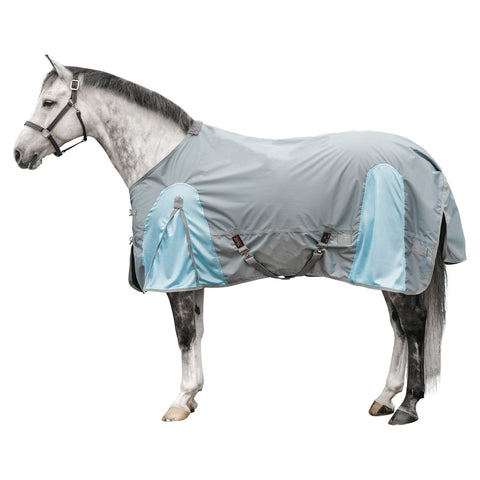
The Schneiders® Airmesh II Euro Surcingle Turnout Summer Sheet solves the shoulder-season dilemma by combining two things most manufacturers treat as mutually exclusive: real waterproofing and real ventilation. It's not a compromise between the two — it's an engineered partition. The right materials placed in the right locations to do the right job, so your horse gets protection where weather hits and airflow where heat builds, at the same time, in the same sheet.
The outer shell is 600D ripstop — the same denier you'd find on a mid-weight blanket, used here because pasture durability genuinely requires it. Waterproofing runs along the front, back, and sides, covering every panel that takes direct rain impact. The shoulders and hips — the two spots where horses generate and trap the most metabolic heat during movement and standing — are built with open Airmesh panels that let convective airflow move through, dropping the effective temperature underneath without creating any opening for rain penetration. The euro surcingle closure distributes belly pressure evenly and stays secure through rolling, running, and pasture tussling, which means the sheet stays where you put it and doesn't need constant re-adjustment.
The practical cascade goes like this: your horse stays dry without sweating. She maintains core temperature through a passing shower without getting overheated when the sun comes back out. The 600D shell survives fence contact and pasture roughhousing without the seam failures that take mesh sheets out of rotation by midsummer. Because the fit is right and the closures hold, you're not driving back to the barn at lunch to straighten a sheet that worked its way sideways in the mud. One sheet, one decision each morning, and the weather stops being something you manage and starts being something that just happens.
Schneiders has been answering questions like this since 1948 — 78 years of family-owned business in Chagrin Falls, Ohio, built around the specific problems working horse people actually face in the field. Every product that carries the Schneiders name goes through the same test: does it actually work for the horse? The Airmesh II does. If it doesn't work for yours, we make it right. That's not a policy statement — that's how a third-generation family business earns the next generation of customers.
Weatherproof Where It Counts
Waterproofing covers the front, back, and sides — every panel that takes direct rain impact — so showers pass without soaking through.
Ventilated Where Heat Builds
Strategic Airmesh panels at shoulders and hips allow convective airflow through the highest heat-retention zones, preventing dangerous sweat buildup.
Pasture-Tough 600D Ripstop Shell
The same denier used in mid-weight blankets — built to survive fence contact, rolling, and herd play without seam failure all season.
Euro Surcingle Closure System
Distributes belly pressure evenly for a secure, non-restrictive fit that stays put through mud, rolling, and full-day turnout without re-adjustment.
What This Turnout Summer Sheet Includes
- Waterproofing along the front
- Waterproofing across the back
- Waterproofing along the sides
- Airmesh panels at the shoulders and hips
- Open-front hook-and-loop closure design
- Criss-cross surcingle closure option
- Euro fit designed to conform to most horses
How We Stack Up
| Feature | Schneiders Schneiders Airmesh II Euro Sheet | Horseware Rambo Fly Sheet | WeatherBeeta Free II Sheet |
|---|---|---|---|
| Airmesh ventilation panels at shoulder & hip | ✅ | ✅ | ❌ |
| 600D ripstop outer shell | ✅ | ❌ | ✅ |
| Waterproof front, back & sides | ✅ | ❌ | ✅ |
| Euro surcingle belly closure | ✅ | ❌ | ✅ |
| Pasture-safe for herd turnout | ✅ | ✅ | ⚠️ |
| Under $100 price point | ✅ | ❌ | ❌ |
| 78-year family brand backing | ✅ | ❌ | ❌ |
| Full size range (60"–84") | ✅ | ✅ | ✅ |
| Machine washable construction | ✅ | ⚠️ | ✅ |
| Free shipping threshold at $99 | ✅ | ❌ | ❌ |
What '600D Ripstop' and 'Airmesh Panels' Actually Mean for Your Horse
Denier is a measure of fabric thread density — 600D means the threads are dense enough to resist tears from fence posts, gate latches, and other horses' teeth without adding the weight of a winter blanket. Ripstop adds a reinforcing grid woven into the base fabric, so if a small tear does start, it stops at the next grid intersection instead of running. In practical terms, it means this sheet survives a full turnout season without becoming a repair project by August.
Airmesh is an open-weave construction that allows air to move through the fabric the same way a screen door lets a breeze through without letting rain in sideways. Placed at the shoulders and hips — where horses concentrate and trap the most metabolic heat — these panels act as passive exhaust vents, letting warm, moist air escape while the waterproofed panels around them handle precipitation. The result is a sheet that works with your horse's thermoregulation instead of fighting it, which is why horses in the Airmesh II consistently present with better coat condition and steadier weight through transition seasons than horses managed in either full-waterproof or full-mesh alternatives.
- ✓Lightweight 600D ripstop outer shell — durable without bulk
- ✓Strategic Airmesh ventilation panels at shoulders and hips
- ✓Waterproofing along front, back, and sides for full rain coverage
- ✓Euro surcingle closure for secure, even-pressure belly fit
- ✓Designed for stall or pasture — holds up in full-herd turnout
How the Mixed-Panel Design Handles Transitional Turnout
One Sheet for Coverage and Targeted Airflow
This lightweight Schneiders turnout sheet combines waterproof coverage zones with Airmesh shoulder and hip panels, offering a practical design for rainy, changeable weather during the milder months.
Choose a Lighter Layer for Unpredictable Mild Days
Explore available fits and colors for the Schneiders® Airmesh II Euro Surcingle Turnout Summer Sheet and select the option suited to your horse.