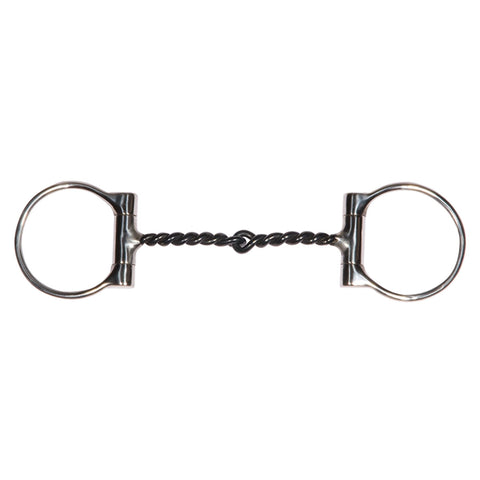
The Bit That Bridges the Gap Between Light Contact and a Heavy-Handed Horse
A twisted sweet iron snaffle that asks more without demanding everything — the go-to transition tool when your horse needs refinement, not force. Trusted by riders across all 50 states, backed by 78 years of equestrian expertise from Chagrin Falls, Ohio.

Your Horse Leans, Pulls, and Tunes You Out — And a Standard Snaffle Isn’t Getting Through Anymore
You tack up with the same bit you’ve used for three years, swing into the saddle, and within the first hundred feet of the arena you can already feel it: that dead weight on the reins, your horse’s nose just slightly in front of the vertical, his back hollow, his jaw locked. You pick up contact and instead of softening he pushes right back into your hands. By the end of a forty-minute ride your forearms are burning and your horse hasn’t truly listened to a single half-halt. You ride back to the barn frustrated, your horse sweaty and still braced, and you know deep down that tomorrow will probably look exactly the same.
The real problem isn’t stubbornness — it’s a communication gap, and the wrong mouthpiece is making it worse. A smooth snaffle that was fine when your horse was green and compliant often becomes invisible to a horse that has learned how to brace against uniform, predictable pressure. Horses are masters at finding the path of least resistance. When the same mouthpiece delivers the same dull signal every ride, they learn to lean into it rather than respond to it. Your hands aren’t the problem. Your timing isn’t the problem. The tool you’re using to communicate simply isn’t reaching him anymore — and asking harder with a tool that isn’t working just trains him to brace harder.
On a practical level, this plays out in exhausting ways every single day. Trail rides that should be relaxing turn into hour-long arm workouts because your horse falls on the forehand and pulls for the whole first mile. Arena sessions that should be progressive flatwork become battles of attrition where you’re working far harder than your horse. Transitions feel sticky — he comes back to the walk eventually, but not in the moment you asked. Lateral work is resistant because he’s not truly soft in the jaw. You start bracing in your own body to counteract his bracing, and now you’ve both developed bad habits that compound by the ride. Clinicians tell you to “soften your hand” but when there’s a hundred pounds of horse pushing against that hand, softening feels like surrender.
You’ve probably already tried a few things. A thicker mouthpiece to make it “milder.” A sharper twist to try to wake him up. A French link to eliminate the nutcracker effect. Maybe you even borrowed a Pelham from a friend because your trainer mentioned it might be time to move to a curb. The thicker mouthpiece made no difference. The sharper twist made him head-toss and root. The French link was an improvement but still didn’t fix the bracing. And the Pelham felt like you were using a sledgehammer to have a conversation. What you actually need is something between those two extremes — a bit that wakes up his attention without punishing him, that asks clearly without screaming, that sits in the right gap between where he is and where you want him to be.
Every Ride You Skip This Fix, the Habits Deepen — In Both of You
A horse that consistently braces against the bit doesn’t stay at a plateau — he gets more confirmed in that pattern with every ride. The muscular development follows the brace: he builds the underside of his neck, his back stays tight, and over months of incorrect work his topline actually loses the muscle you’ve spent years building. Horses that lean chronically on the forehand are also putting excess stress on their front feet and joints. What started as an inconvenient training problem can quietly become a soundness concern. And because you’re compensating with your own body — gripping the reins harder, blocking with your elbows, bracing through your lower back — you’re developing your own compensatory tension patterns that will take their own time to undo once you solve the bit problem.
Beyond the physical toll, there’s a real emotional cost to riding a horse that won’t listen. Riding is supposed to feel like a conversation — an athletic partnership that’s both technical and joyful. When every session is a negotiation you never quite win, you stop looking forward to the barn. You start cutting rides short because you can feel the frustration rising and you don’t want to take it out on your horse. You hesitate to take him to shows or clinics because you know he’ll be distracted and strong in a new environment, and you’ll spend the whole session managing him instead of riding him. That loss of confidence, in him and in yourself, is hard to quantify but completely real. Riders in this situation often describe feeling like they’ve lost their horse somewhere along the way.
And then there’s the financial math. If you’re paying for monthly lessons, a clinician visit, or regular training rides to work through a training problem that the wrong equipment is perpetuating, you’re throwing money at a symptom rather than a cause. Riders in this situation sometimes spend $200 or more trying three or four bits that don’t work, or pay for extra training rides that produce improvement in the trainer’s hands but not in their own — because the horse is learning to accommodate the trainer’s skill set rather than actually changing his way of going. A $60 bit change at the right moment can save six months of expensive, frustrating work. The question isn’t whether you can afford to solve this correctly. It’s whether you can afford to keep doing what isn’t working.
- ✗Horse leans into smooth snaffles and ignores half-halts
- ✗Transition to a curb bit feels premature and too severe
- ✗Arms and shoulders fatigued after every ride from constant pulling
- ✗Training progress stalls because horse won’t soften in the jaw

The Offset D Ring Twisted Sweet Iron Snaffle: The Exact Gap Between Too Soft and Too Much
The Schneiders Offset D Ring Twisted Sweet Iron Snaffle Bit was designed specifically for the horse that has outgrown a smooth snaffle but isn’t ready for the leverage of a curb. At $59.99 it sits in a price range that makes sense for everyday training use, but it’s built around two features that actually solve the problem — the offset D ring geometry and the twisted sweet iron mouthpiece — working together to create clearer communication without escalating to a stronger bit. This is not a bit that demands compliance through severity. It’s a bit that earns it through clarity.
Here’s how the mechanism works. The twist in the mouthpiece increases surface area variation, which means the horse feels pressure differently than on a smooth barrel or oval. That variation keeps his attention on the rein signal rather than letting him tune it out. The sweet iron finish encourages a wet mouth by oxidizing slightly with use — that surface rust is not a defect, it’s intentional, and a horse with a wet mouth is a horse that accepts the bit rather than fighting it. The offset D ring shifts the attachment point relative to the mouthpiece, which changes how the bit rotates on contact and gives the rider more immediate release the moment pressure is released. Snaffles work on direct pressure, and the offset geometry makes that pressure-and-release cycle crisper and easier for the horse to read. That clarity is what stops the brace.
What you’ll actually feel in the saddle: your horse will start responding to lighter rein pressure because the signal is more distinct. His jaw will soften as the sweet iron does its work. Lateral bends that felt sticky become easier because he’s not locked through his jaw. Transitions sharpen because the release is faster and he can feel exactly when you’ve let go. Riders who switch to this bit consistently report the same sequence: the first few rides their horse is more attentive, within one to two weeks the horse starts seeking the contact instead of bracing against it, and within a month the work that felt impossible starts feeling like partnership again. You get to go back to focusing on your position and your aids instead of managing a constant tug of war.
Behind this bit is Schneiders Saddlery, founded in Chagrin Falls, Ohio in 1948 and still family-owned through three generations — 78 years of equestrians selling to equestrians. That means the people who chose this bit for our catalog have actually ridden horses in snaffles that weren’t working. We ship to all 50 states, we back everything we sell with our satisfaction guarantee, and we’ve been doing it long enough to know the difference between equipment that photographs well and equipment that does the job. The Offset D Ring Twisted Sweet Iron is in this catalog because it works.
Twisted Mouthpiece Breaks Through the Brace
Surface variation delivers a clearer signal than a smooth snaffle, giving the horse something distinct to respond to rather than lean against.
Sweet Iron Promotes a Soft, Wet Mouth
The sweet iron finish oxidizes with use — that light rust is intentional. A wet, accepting mouth is the foundation of soft contact and willingness.
Offset D Ring Sharpens the Release
The offset geometry changes how the bit rotates on contact, making pressure and release crisper. Horses learn faster when the reward (release) is immediate and clear.
True Transition Bit — Not Too Mild, Not Too Much
Designed for the horse that has outgrown a smooth snaffle but isn’t ready for curb leverage. Asks more without punishing, bridges the gap without escalating.
What Riders Are Saying
"
I’ve been riding western pleasure and trail for twenty years and I’ve tried nearly every snaffle on the market. My eight-year-old Quarter Horse, Buckshot, developed a habit of leaning into the bit on long trail rides — pulling my arms out by mile three. I switched to the Schneiders Offset D Ring Twisted Sweet Iron and within two weeks he was carrying himself. The salivation from the sweet iron makes a real difference in how he accepts contact. At $59 it’s half the price of what I expected to pay for these results. This bit earns its spot in the bridle every single ride.
""
My Thoroughbred off-the-track mare, Sylvia’s Run, came to me dead-sided and above the bit. My trainer suggested we try an offset snaffle with more mouthpiece feel before stepping up to a Pelham. The twisted sweet iron was exactly the middle ground we needed. She softened within the first week of flat work and started accepting contact without flipping her head. I competed her in hunters last month and our flat scores improved noticeably. The quality at this price point from Schneiders is exactly what I’ve come to expect from them after years of buying their tack.
""
Running a training barn means I go through bits regularly — between client horses and my own event horses I need equipment that holds up and actually does what it promises. I put the Offset D Ring Twisted Sweet Iron on a warmblood gelding I’m bringing along for his first Novice season. He was stiff in the jaw and resistant on the left rein specifically. Three months of dressage flatwork with this bit and he’s tracking up beautifully and genuinely reaching for the contact. Sweet iron really does encourage a wet mouth. Schneiders priced this honestly and it performs like a bit twice the cost.
"How We Stack Up
| Feature | Schneiders Schneiders® Offset D Ring Snaffle | Myler Bits | Korsteel Bits |
|---|---|---|---|
| Sweet Iron Mouthpiece | ✅ | ❌ | ⚠️ |
| Offset D Ring Design | ✅ | ⚠️ | ❌ |
| Twisted Wire for Sensitivity | ✅ | ⚠️ | ✅ |
| Promotes Natural Salivation | ✅ | ❌ | ❌ |
| Transition Bit (Snaffle to Curb) | ✅ | ⚠️ | ❌ |
| Direct Pressure Snaffle Action | ✅ | ✅ | ✅ |
| Price Under $65 | ✅ | ❌ | ✅ |
| Rust-Encouraged Sweet Iron Finish | ✅ | ❌ | ❌ |
| 78-Year Brand Guarantee | ✅ | ❌ | ❌ |
| Ships to All 50 States | ✅ | ✅ | ⚠️ |
Built for the Horse in the Middle — Not Ready for a Curb, Too Confirmed for a Plain Snaffle
Most bit progressions jump from a smooth eggbutt snaffle straight to a curb or Pelham, leaving a gap where a lot of horses actually live: past the easy compliance of early training, not yet ready for the leverage pressure of a curb. The Offset D Ring Twisted Sweet Iron fills that gap deliberately. The D ring provides a stable, non-sliding attachment that gives the horse a consistent feel, while the offset shifts the pivot geometry enough to create a quicker, cleaner release cycle. The twisted wire mouthpiece adds the surface variation needed to hold attention without introducing the severity of a thin twisted wire or a corkscrew. Used correctly with a soft hand, this bit rewards the horse for seeking soft contact rather than teaching him to avoid or brace against pressure.
Sweet iron is the most misunderstood material in the bit world. New riders often mistake the surface oxidation for poor quality. In fact, it’s a centuries-old feature: sweet iron oxidizes to produce a mild, slightly sweet taste that horses accept readily, and that acceptance promotes natural salivation. A horse that drools slightly in his bit is a horse that is chewing, relaxed in the jaw, and genuinely soft through the bridle. Stainless steel bits are consistent and hygienic, but they offer no flavor. Copper encourages salivation but can be too appealing, causing horses to mouth and fuss. Sweet iron splits that difference — it encourages acceptance without overstimulation. At $59.99, the Schneiders Offset D Ring Twisted Sweet Iron is priced for daily training use, because a transition bit only works if it’s on the horse consistently.
- ✓Offset D ring for crisper, faster pressure-and-release cycle
- ✓Twisted sweet iron mouthpiece for surface variety and salivation
- ✓Direct snaffle pressure — no leverage, immediate response
- ✓Recommended for horses heavy in the hand but not ready for a curb
- ✓Priced for everyday training use at $59.99
What You Get