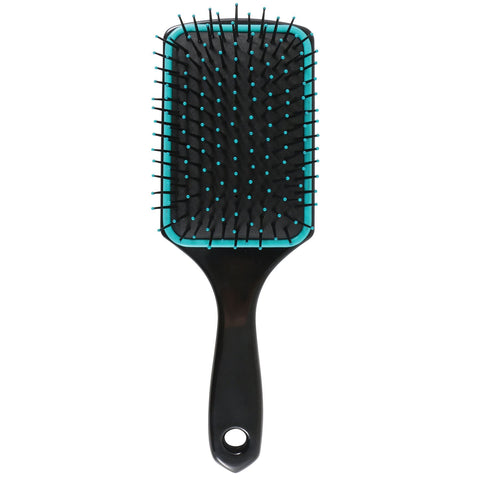
Stop Ripping Hair. Start Brushing Right.
The Schneiders Paddle Brush was built by horse people who know that a 9¾-inch rubber-tipped paddle covers more coat in fewer strokes — helping protect the mane you've been growing since spring.

That Tangled Mane Isn't Just Ugly — Your Brush Is Making It Worse
Picture the barn aisle at 6 a.m., two hours before the halter class. Your horse is clean, blanketed, and ready — except for the tail. It's been wrapped all week and now it's a compressed column of snarls from dock to tip. You've got the right show coat, the right conditioner, the right ribbon. And then you pick up the wrong brush, the one with the hard plastic bristles and the narrow head you've been using since high school, and you start pulling. The horse shifts. The brush snags. You feel — actually feel — the hair give way. A small cloud of copper-colored fibers drifts to the rubber mat. You tell yourself it's just a few strands. It isn't.
What's happening underneath those bristles is worse than it looks. Hard plastic tines don't bend when they hit a tangle — they lever against the hair shaft like a crowbar, snapping individual strands at their weakest point. Over a week of daily brushing you can lose the equivalent of months of tail growth. Horses grow tail hair roughly half an inch per month. A cheap brush used daily can easily strip an inch or more of effective length every thirty days through breakage alone, and that's before you count the hairs that pull out at the follicle entirely. If your horse's tail has looked mysteriously shorter every year despite no obvious trauma, the brush you're using is almost certainly part of the reason.
The daily grind compounds the problem in ways that don't show up until show season. You're brushing with a narrow paddle because that's what was hanging in the barn aisle. You make twenty passes where five should do. The extra strokes create friction, static, and frizz, all of which make the next session harder. You spray on more detangler to compensate, which attracts more dust, which means more brushing tomorrow. You notice the horse has started pinning his ears when you reach for his mane. He's not being dramatic — the bristles are uncomfortable on his poll and crest, and he's learned what the brush means. The grooming session that should be a quiet, bonding part of your morning becomes a negotiation.
You've probably tried to fix this. Maybe you switched to a wide-tooth comb for tails and accepted the lost time. Maybe you started finger-detangling section by section, which works but costs twenty minutes you don't have before a class. Maybe you bought a different brush from the feed store — different brand, same hard plastic, roughly the same results. You've tried the cheap paddle brush from the big-box pet retailer, which is fine for dogs but too flimsy to push through a horse's coat without flexing sideways on every stroke. Every solution you've tried has involved accepting either damaged hair, wasted time, or an unhappy horse. There's a reason horse people pass around the same handful of grooming complaints at every show: the right brush for this job has been genuinely hard to find at a price that makes sense.
One Bad Brush Session Sets Back Weeks of Work
The ripple effects of using the wrong brush go beyond coat damage. In the show ring, judges in western pleasure, hunter under saddle, and halter classes are looking at the whole picture — and a frizzy, broken-off tail or a mane that won't lie flat because the bristles lifted the cuticle instead of smoothing it reads as poor horsemanship before you've even picked up the rail. You can have the most athletic horse at the show and lose to a lesser mover because presentation signaled that you cut corners in the barn. Those corners aren't actually cut, of course — you're spending more time on that tail than the blue-ribbon barn is, because you're fighting your tools instead of working with them. The problem isn't your effort. It's your equipment.
There's an emotional cost that doesn't show up in any grooming log. You know what it feels like to spend forty-five minutes on a tail before a class and then watch your horse clamp it the moment you walk into the ring because something in the process made him sore or anxious. You know the particular frustration of pulling burrs out of a freshly conditioned mane because the brush that was supposed to be a time-saver left the hair so static-charged it attracted every piece of debris in the paddock. You've told yourself it's fine, it's just grooming, it's not worth the frustration — but it is worth the frustration, because a horse that trusts the grooming process is easier to handle at shows, easier to keep clean, and noticeably calmer at the tie rail. The brush is part of that trust, whether you think of it that way or not.
The financial cost of the wrong brush hides in your supply budget. You're buying detangler spray in the large pump bottle and going through it faster than you should because you need it to compensate for bristles that don't glide. You're buying separate conditioning sprays for mane and tail. You've probably replaced a budget paddle brush at least once a season because the bristles spread or the head cracked. Add it up over a show year and the workarounds cost more than a well-made brush ever would have — and none of them actually fix the root problem, which is bristles that fight the hair instead of working with it.
- ✗Hard plastic bristles snap hair instead of gliding through tangles
- ✗Narrow brush heads mean twice as many strokes and twice as much friction
- ✗Static buildup from wrong bristles attracts dust and undoes conditioning
- ✗Horses that dread the brush become harder to handle at shows and on the road

Rubber-Tipped, Pro-Sized, and Built to Last Through Every Season
The Schneiders Paddle Brush is the answer to exactly that set of problems, not because of marketing language, but because of two specific design decisions that everything else flows from. The brush head measures 9¾ inches long — genuinely paddle-sized, the kind of coverage the pros use — and every one of those bristles is tipped in rubber rather than hard plastic. Those two facts change the entire experience of grooming a horse's mane and tail, and they change it immediately, on the first pass.
The rubber tips work because they flex on contact rather than leveraging against the hair shaft. When a rubber-tipped bristle hits a tangle, it gives slightly, distributing the resistance across the width of the paddle head instead of concentrating it at a single snag point. That flex is what prevents the snap. The bristle works its way through the knot from the outside in, the same direction a careful hand would, rather than attacking it from above the way a rigid tine does. At the same time, the large paddle head means you're covering a full section of mane or tail in three or four passes instead of ten or twelve. Fewer passes mean less friction, less static, less frizz, and a horse that isn't bracing by the time you finish. The rubber also provides just enough grip on each stroke to smooth the cuticle down as it passes, which is what gives a finished coat that flat, light-reflecting look without conditioner spray.
The cascade of benefits builds from there. Less breakage means more length retained month over month — horses that have been brushed with this paddle consistently over a season show measurably thicker, longer tails come fall than they did in spring, because you're growing hair instead of replacing it. Horses that associate brushing with a comfortable sensation rather than a pulling one start to drop their heads into the groom session instead of bracing against it. Your grooming time drops because one pass does the work of three. Your detangler and conditioning spray budget drops because you're no longer compensating for bristle damage with product. The brush is also rated for the longest manes and tails — if you're managing a Friesian, a Haflinger, or a sport horse with a mane that touches the shoulder, it handles the volume without the head flexing sideways the way a lighter brush does.
Schneiders has been in Chagrin Falls, Ohio since 1948 — 78 years of horse people serving horse people, three generations of family ownership, and a 4.8-star rating that comes from customers who come back season after season. When we put the Schneiders name on a grooming tool, it means we've used it ourselves, we stand behind it, and if it doesn't do what we say it does, we make it right. At $5.99 this brush doesn't ask you to take a leap of faith. But based on what customers tell us, you'll find yourself wondering why you waited.
Rubber-Tipped Bristles
Flex through tangles instead of snapping hair — every stroke is gentle on the shaft and comfortable for the horse
Pro Paddle Coverage
At 9¾ inches long, the head covers a full section of mane or tail in three to four passes instead of ten to twelve
Built for the Longest Hair
Designed specifically to handle the volume and length of full manes and tails on warmbloods, drafts, and gaited horses
Cuticle-Smoothing Finish
The rubber tips lay the hair cuticle flat on every pass, producing a natural shine without added spray or conditioner
What Riders Are Saying
"
My Hanoverian mare has the thickest, most knot-prone tail I've ever dealt with. I was spending 20 minutes every morning just getting her presentable for the hunter ring. This brush cut that to maybe five minutes — the rubber tips glide through tangles instead of grabbing and snapping. She's stopped clamping her tail when I come near her with a brush, which tells you everything. I've been showing for 22 years and this is now the only paddle brush in my grooming box.
""
I trail ride a stocky little Mustang with a mane that grows sideways no matter what I do. I'd broken three cheap brushes on it in two seasons. The Schneiders paddle brush has lasted two years of twice-weekly use on rocks, mud, and burrs and it's still going strong. The bristles are actually gentle enough that I can use it on his face for the forelock without him flinching. At $5.99 I bought a second one to keep in my trailer.
""
Showing western pleasure on the circuit means the mane has to lie perfectly flat and glossy on show morning. I've gone through every paddle brush the catalogs sell. This one from Schneiders is the first that lays the hair down instead of lifting it. The large head means I can do a full section in three or four passes instead of ten. I ordered four — one per horse — and told every person at our barn where to get them. Game changer at a dollar-store price.
"How We Stack Up
| Feature | Schneiders Schneiders Paddle Brush | Tough-1 Paddle Brush | Generic Plastic Paddle |
|---|---|---|---|
| Rubber-tipped bristles | ✅ | ❌ | ❌ |
| Pro 9¾" paddle length | ✅ | ❌ | ❌ |
| Full mane & tail rated | ✅ | ⚠️ | ❌ |
| Prevents hair breakage | ✅ | ❌ | ❌ |
| Safe on face & forelock | ✅ | ⚠️ | ❌ |
| Cuticle-smoothing finish | ✅ | ❌ | ❌ |
| Ergonomic grip handle | ✅ | ⚠️ | ❌ |
| Show-day performance | ✅ | ⚠️ | ❌ |
| Durable daily-use construction | ✅ | ⚠️ | ❌ |
| Value under $6 | ✅ | ❌ | ⚠️ |
What Every Feature Actually Does in the Barn
The 9¾-inch length isn't an arbitrary number — it matches the working width that professional groomers on the A circuit use because it lines up with the natural section size of a horse's mane and covers the full width of a tail wrap in one stroke. The rubber-tipped bristles help reduce hair breakage at every friction point, which is why this brush is gentle enough for the forelock and poll as well as the mane and tail. The handle geometry puts your wrist in a neutral position through a full grooming stroke, which matters when you're doing six horses in a morning. Everything about the construction is chosen for daily working-barn use, not for sitting in a display case.
We ship to all 50 states and orders over $99 qualify for free shipping. If you're outfitting a barn with multiple horses, buying several brushes in a single order keeps the cost of a solid grooming tool well under the price of a single bottle of detangler spray.
- ✓Rubber-tipped bristles flex through tangles without breaking hair
- ✓Large 9¾-inch paddle head covers more coat per stroke
- ✓Designed for the longest manes and tails of any breed
- ✓Safe and comfortable on face, forelock, and poll
- ✓Durable construction built for daily working-barn use
What You Get