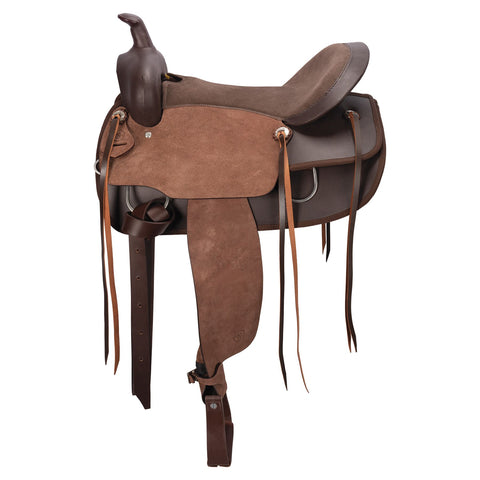
The Trail Saddle That Works as Hard as You Do
Roughout suede grip where it counts. Synthetic ease-of-care everywhere else. An extra-padded seat on a fiberglass tree that fits most modern horses. Built for riders who actually ride — not for display on a saddle rack.
Your Saddle Is Quietly Costing You Every Ride
Picture the ride you planned for two weeks. The weather finally cooperated, your horse is sound and forward-going, and you’ve carved out five hours to disappear into the woods. By mile three your inside leg is screaming because your old leather fenders are stiff as barn boards, twisting your knee outward at a slow, grinding angle. By mile six you’re standing in your stirrups just to give your tailbone a rest from a seat that has all the give of a park bench. The scenery is stunning. You can’t enjoy any of it. What was supposed to be the payoff — the reward for all the stall cleaning and early mornings — has become a grind of its own. That’s not a trail ride. That’s an endurance test with a horse involved.
The maddening part is that most trail riders accept this as standard. You buy a saddle, you expect some break-in time, you expect your sit bones to ache for a few rides. But here is what the tack shop often doesn’t tell you: a poorly designed trail saddle doesn’t only make you uncomfortable — it actively changes the way you ride. When the seat is hard and the fenders are stiff, you compensate. You tense your lower back, you perch forward, you grip with your knee instead of sitting into your hip. Your horse reads every bit of that tension through his back. A horse that would otherwise stride out willingly starts to hollow, shorten his step, or rush through terrain because his rider is braced against the saddle instead of moving with him. One problem piece of equipment creates a chain of problems that looks, from the outside, like a horse issue.
And then there is the maintenance spiral that nobody puts in the marketing copy. Traditional full-leather western saddles are beautiful — nobody argues that — but they demand a time commitment that adds up fast. Conditioning, cleaning, storing away from humidity, keeping skirts flat and oiled so they don’t curl at the edges. After a long trail ride through creek crossings and muddy stretches, cleaning a full-leather saddle is practically its own project. You are scrubbing mud out of every tooled crevice with a toothbrush, then conditioning to prevent cracking before you put it away. On a Wednesday evening after work, when all you wanted was to rinse your tack and get dinner on the table, that is a significant ask. A lot of riders quietly scale back how often they ride because the cleanup is almost as exhausting as the ride itself.
Riders who figure this out try to solve it with workarounds. Some swap to a full-synthetic saddle — lightweight, zero conditioning — but they feel plasticky and slick, and the grip disappears the moment the horse starts sweating. Others add thick aftermarket seat cushions that clip onto the pommel, which addresses one problem while creating another by raising the rider’s center of gravity and making it harder to feel what the horse is doing underneath. Some riders buy an inexpensive leather saddle hoping to “break it in,” a process that can take a full season of sore knees and frustrated rides. What all of these approaches share is that they are compromises. And after a while, compromise stops being acceptable.
A Bad Saddle Doesn’t Just Hurt You — It Hurts Your Horse and Kills Your Motivation
When your saddle makes you uncomfortable, you compensate in ways you probably don’t notice. You shift your weight to the offside, you drop your inside shoulder, you tip forward going uphill and brace back going down. These are small movements, but your horse registers every one. A horse that carries a rider who is constantly re-adjusting and bracing will start to anticipate discomfort and move defensively — shortening his stride, resisting the downhill, rushing past trail obstacles instead of moving through them quietly. What reads from the ground as a spooky or difficult trail horse is very often a horse responding to mixed and uncomfortable signals from a rider whose gear won’t let them sit still.
There is an emotional cost to this that does not get discussed much in tack reviews. You showed up. You planned the ride, you hauled out, you tacked up. And then an hour in you are already counting down to the trailer. The trail is beautiful and you cannot be present in it because your hips are locked and your knees ache and your lower back is sending signals you cannot ignore. Trail riding is supposed to be the thing that makes the rest of the horse ownership equation worth it. When the equipment turns the ride itself into something you endure rather than enjoy, you start quietly questioning whether it’s still worth the effort — and that is a dangerous place to arrive.
The financial cost of workarounds adds up faster than most riders tally. A quality aftermarket seat cushion runs $80 to $120. A set of replacement fenders that actually flex properly costs $150 and up, plus potentially a shop visit to swap them. Leather conditioner applied regularly on a full-leather saddle runs $25 to $40 per year at minimum, plus your time. And if you eventually give up on the budget saddle entirely and buy a second one, you have now spent the price of a good saddle twice over — except you got the frustrating experience first. Getting the right saddle from the start is almost always the cheaper path, and it is always the more enjoyable one.
- ✗Stiff leather fenders twisting your knee on every ride
- ✗Hard seats that leave you counting down miles instead of enjoying them
- ✗Post-ride cleanup that takes longer than the ride itself
- ✗Tension in your seat that transfers directly to your horse’s back

One Saddle That Solves the Whole Problem
The Schneiders® Roughout and Synthetic Hybrid Western Trail Saddle was designed specifically for riders who have been through the compromise cycle and are done with it. The concept is simple: put roughout suede exactly where grip matters — the seat and fenders — and use high-quality synthetic materials everywhere else. You get the tactile connection that keeps you centered on a steep descent or through a rocky creek crossing. You get the easy cleanup that means a muddy Saturday ride does not become a Sunday chore. No tradeoff required.
The engineering behind this saddle is deliberate and straightforward. The fiberglass tree gives the saddle structural integrity without the weight of a wood tree — it holds its shape ride after ride, season after season, and will not warp if it gets caught in a rainstorm. Semi-quarter horse bars mean it fits the modern stock-type horse, the quarter horse, the appendix, the paint, the morgan, without creating bridging pressure behind the shoulder blade. The synthetic fleece lining cushions the horse's back and creates a non-slip contact surface that helps reduce the shimmy and lateral slide that can happen with smooth leather skirts on a sweating horse. And the extra-padded seat is padded in the way that actually matters — not a thin cosmetic layer of foam, but real cushioning that lets you complete a five-hour ride the way you planned it.
When your saddle keeps you comfortable and balanced, everything downstream improves. You stop compensating, your horse stops bracing, and the trail becomes something you can actually pay attention to. Riders who have switched to this saddle consistently report that their horses move out more freely, are easier to position on technical footing, and seem less reactive overall on the trail. That is not a coincidence. It is what happens when the rider can sit still and quiet in a saddle that is doing its job properly. You are riding with your horse instead of against your equipment.
Schneiders has been fitting horses and riders since 1948 — 78 years as a family-owned operation in Chagrin Falls, Ohio. We stand behind what we sell because our name is on it and our customers are our neighbors, our community, and in a lot of cases, the same families coming back for three generations. If you have a question about whether this tree will work for your horse's specific back shape, call us and talk to someone who actually knows saddle fitting. This saddle ships free on orders over $99 and is backed by our full satisfaction guarantee.
Roughout Suede Grip
Suede seat and fenders keep you centered on technical terrain without pinning your leg or requiring break-in time.
Wipe-Clean Synthetic Skirt
Synthetic pommel and skirt clean up in minutes — no conditioning, no cracking, no half-hour post-ride tack care routine.
Extra-Padded Seat
Substantial seat padding keeps you comfortable through long hours on the trail, not just the first mile.
Fits Most Modern Horses
Semi-QH bars and synthetic fleece lining fit the modern stock-type horse comfortably without pressure points or bridging.
What Riders Are Saying
"
I’ve been putting 30-mile weekend rides on this saddle with my 17-year-old quarter horse, Scout, and it has completely changed how I feel at the end of a long day. The extra padding on the seat is the real deal — not just marketing language. After a full day of creek crossings and muddy footing, I cleaned the whole saddle in under ten minutes. My knees stopped aching after the very first proper ride. Honestly, I waited too long to replace my old full-leather saddle.
""
I used this on a three-day backcountry trip in the Cascades with my mustang mare. She can be picky about saddle fit — previous saddles left dry spots behind her shoulders — and she moved beautifully under this one from day one. The roughout seat kept me planted on the steep descents, and the synthetic skirt wiped clean every evening in five minutes flat. At this price point I expected compromise. I didn’t find any.
""
My teenage daughter and I share this saddle between her Arab cross and my stockier Paint, and it fits both horses well enough for trail work. The grip of the suede fenders made an immediate difference in her position — she used to slide around in her old saddle, and now she sits quiet and centered. I’ve recommended it to three people in our riding club already. When we called Schneiders with a fit question before buying, someone who actually knew saddle fitting picked up the phone. Old-school company feel.
"How We Stack Up
| Feature | Schneiders Schneiders® Hybrid Trail | Circle Y Park & Trail | Billy Cook Trail |
|---|---|---|---|
| Roughout Suede Grip Seat & Fenders | ✅ | ❌ | ⚠️ |
| Synthetic Skirt — No Conditioning Required | ✅ | ❌ | ❌ |
| Extra-Padded Seat | ✅ | ✅ | ⚠️ |
| Fiberglass Tree | ✅ | ❌ | ❌ |
| Semi-QH Bars (Wide Fit) | ✅ | ✅ | ✅ |
| Synthetic Fleece Lining | ✅ | ❌ | ❌ |
| Price Under $700 | ✅ | ❌ | ❌ |
| Lightweight (Under 28 lbs) | ✅ | ⚠️ | ❌ |
| Satisfaction Guarantee | ✅ | ⚠️ | ⚠️ |
| Family-Owned Brand — Est. 1948 | ✅ | ❌ | ❌ |
Built for the Real Trail — Not the Show Pen
This saddle is 599.99 dollars and designed for riders who put actual miles on their gear. The fiberglass tree keeps it light enough to handle on your own. The roughout suede gives you the grip of a quality leather saddle without the maintenance overhead. The synthetic skirt and pommel handle creek crossings, mud, and sweat the way trail conditions actually demand. It is not trying to be a show saddle or a parade piece. It is trying to make your Saturday ride the best part of your week, every week.
Features at a glance: roughout suede fenders and seat for grip and comfort; synthetic skirt and pommel for easy wipe-down cleaning; fiberglass tree for lightweight durability; semi-quarter horse bars for a fit that works on most modern horses; synthetic fleece lining for horse back cushioning and non-slip contact; extra-padded seat for long-distance rider comfort. Backed by Schneiders® since 1948.
- ✓Roughout suede seat and fenders — genuine grip without break-in
- ✓Synthetic skirt and pommel — wipe clean in minutes
- ✓Fiberglass tree — lightweight, warp-resistant, season after season
- ✓Semi-QH bars with synthetic fleece lining — fits most modern stock horses
- ✓Extra-padded seat — real cushioning for real long-distance riding
What You Get