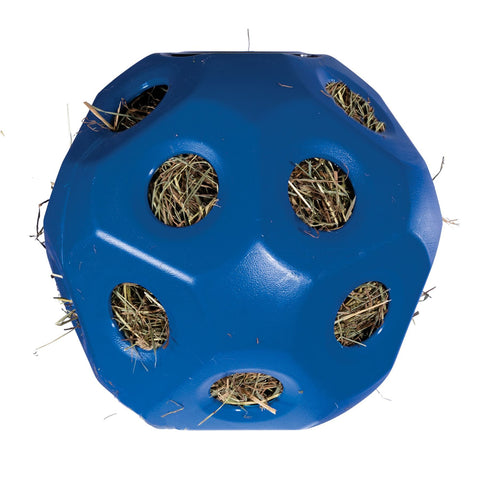
Stop the Bolt. Start the Graze.
The Schneiders® Slow Feed Hay Ball Feeder turns every meal into a 45-minute foraging session — cutting hay waste and giving your horse the slow, steady grazing pace horses have evolved to eat on. Just $79.99.

Your Horse Was Never Meant to Eat Like That
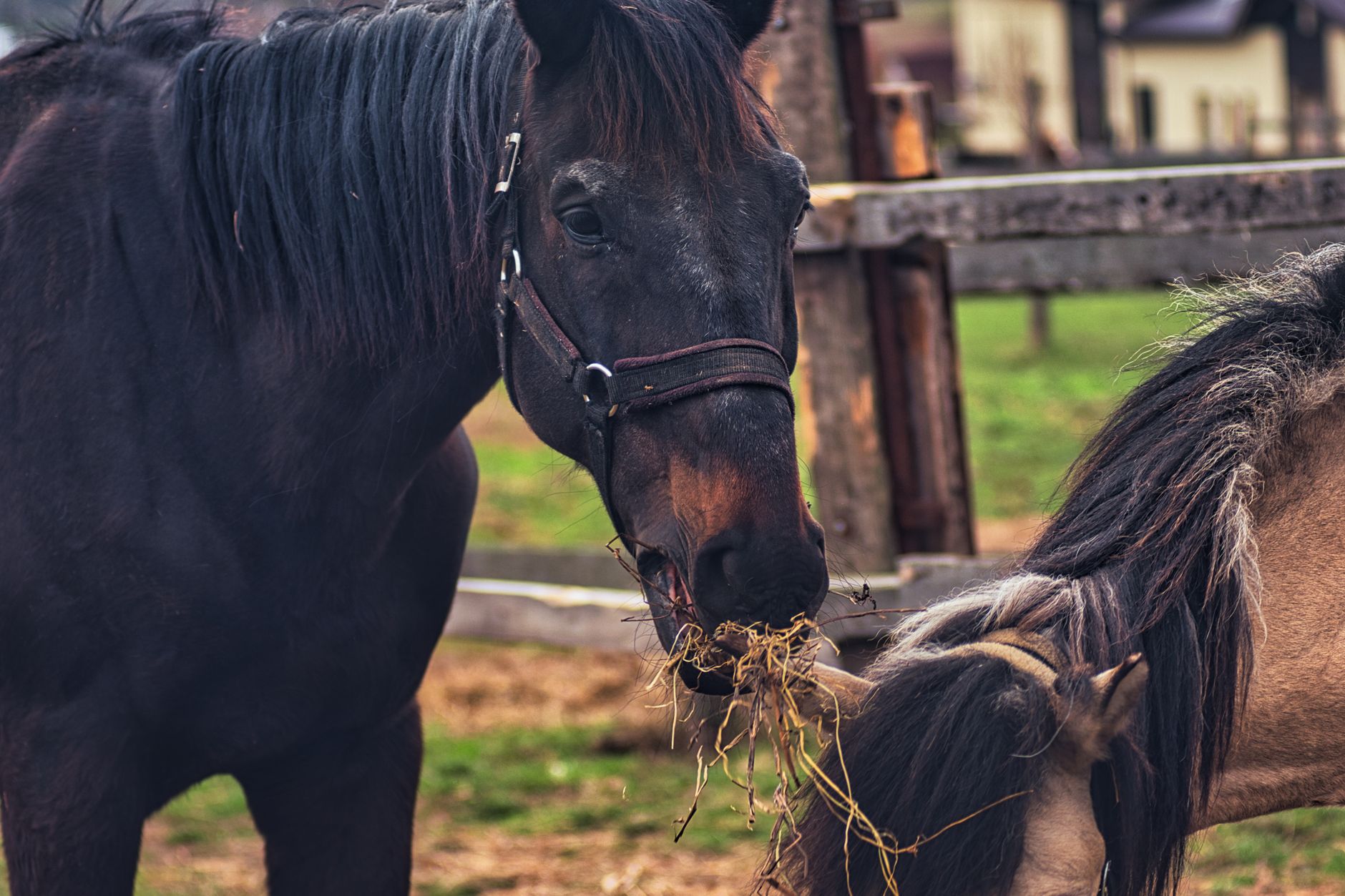
Picture a typical morning at the barn. You drop a fresh flake into the stall or toss it over the fence, and before you've even latched the gate, your horse has his nose buried in the pile. Head down, pulling great mouthfuls, swallowing in long rapid gulps. In ten minutes — maybe twelve if you're lucky — the hay is gone. He stands there, belly full but not settled, pawing at the ground or pawing at the door for more. To most horse owners, this just looks like enthusiasm. It's actually a slow-motion emergency.
The horse's digestive system evolved over millions of years to process a near-constant trickle of fibrous forage — not two or three large meals bolted in under fifteen minutes. When a horse eats fast, he swallows air with every mouthful, bypasses proper chewing and saliva production, and dumps a large volume of partially processed feed into a stomach that is only the size of a volleyball. The hindgut fermentation that follows a big, fast meal is chaotic. Gas builds faster than the intestine can move it. That is the starting pistol for spasmodic colic. Ulcers come from a different angle: without the steady trickle of hay and the saliva it triggers, stomach acid sits against exposed mucosa during the long hours between meals. Gastric ulcers are now diagnosed in upward of 60 percent of performance horses and 90 percent of racehorses — and meal-feeding speed is a primary driver.
On a practical, daily level, the damage is quieter but just as real. Your hay bill reflects waste you may not even track: hay pulled from a pile and dropped underfoot, trampled into shavings or mud, soiled and left. Industry estimates put ground-fed hay waste between 25 and 40 percent of what you put out. That is one flake in every three to four going into the bedding or the dirt. Meanwhile, the horse who finishes fast stands idle for the next several hours — and horses that are bored and under-stimulated develop stable vices like wood-chewing, cribbing, weaving, and stall-walking. These behaviors are not personality quirks. They are signs of a gut and a mind that are not getting what they need.
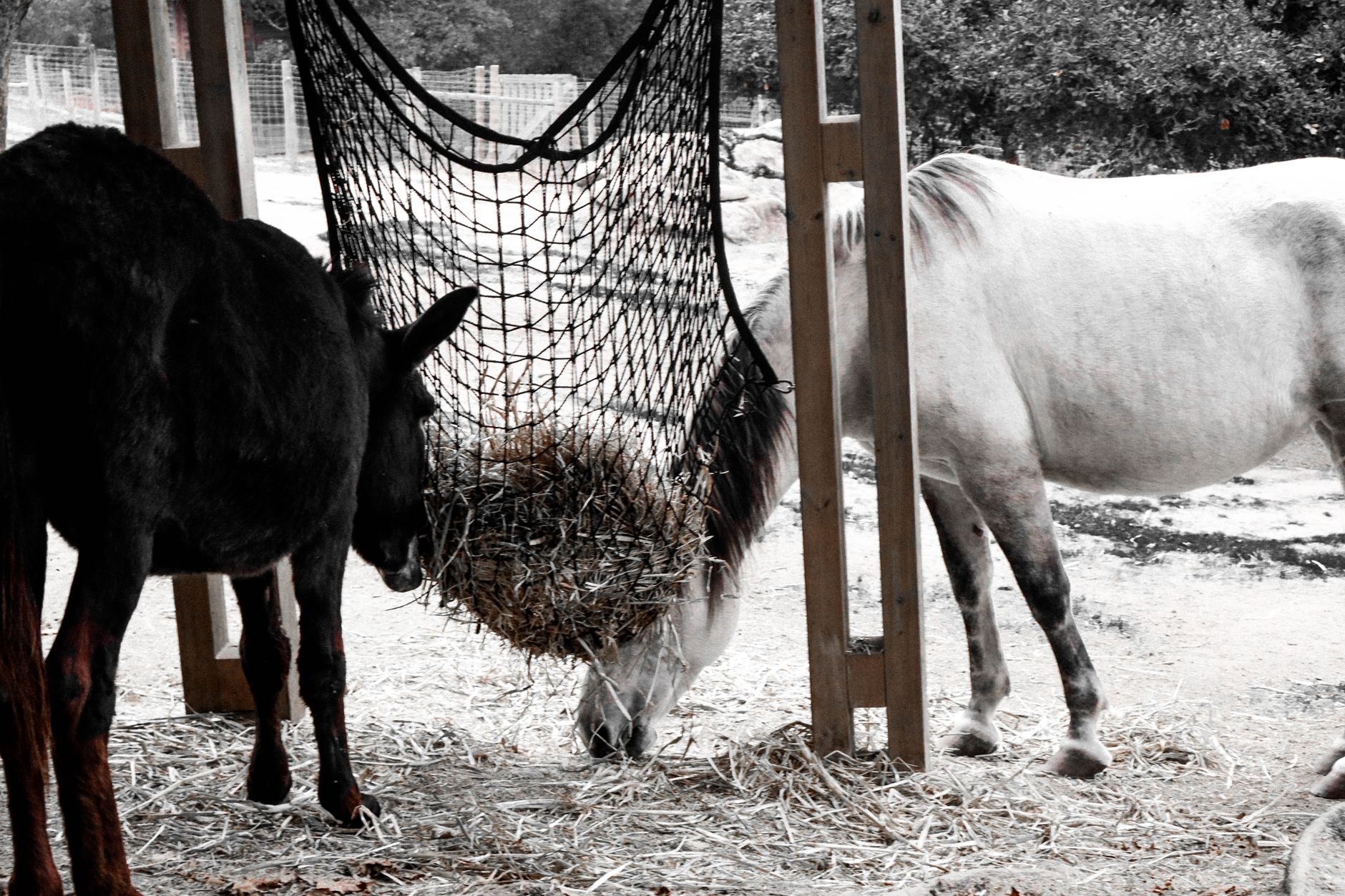
Most horse owners know there's a problem. They try feeding smaller, more frequent meals — which works, but only if someone is at the barn five or six times a day, every day, including weekends. They try spreading hay in multiple piles to slow the pace — and find it just means more waste in more places. They try old-style hay nets — and watch them get chewed through, tangled in halter rings, or left hanging empty while the horse learns to rip big mouthfuls through the mesh. None of these solve the core problem: that the feeding environment itself does nothing to slow the horse down.
Every Fast Meal Is a Bet Against Your Horse's Health
The ripple effects of bolt-feeding spread further than most owners realize until something goes wrong. That two-AM phone call from the barn manager about a horse rolling and sweating in his stall does not arrive out of nowhere — it arrives after months of meal after fast meal stacking up pressure in the gut. Spasmodic and gas colic episodes cost anywhere from $300 to $800 for a farm call, IV fluids, and pain management, and that assumes the horse passes without needing surgery. Colic surgery runs $5,000 to $12,000 and carries real mortality risk. Even horses who never colic acutely are often running with chronic low-grade discomfort — reluctance to go forward under saddle, girthiness, ear-pinning at feed time, inconsistent performance — symptoms that look behavioral until a scoping reveals ulcer grades 2 or 3 covering half the stomach lining.
There is an emotional dimension here that is easy to underestimate. When your horse is hurting and you do not know why, you start second-guessing everything: your riding, your feeding program, your barn choice. You scroll through forums at 11 PM reading conflicting advice on ulcer supplements. You feel guilty every time you watch him pace after a meal because you wonder if you are the reason he's uncomfortable. Horse ownership is supposed to be joyful, and a horse with gut trouble quietly drains that joy — replacing it with background worry that never fully goes away, no matter how much Omeprazole you're feeding or how many ulcer supplements sit on the barn shelf.
The financial math is brutal when you add it all up honestly. A 1,200-pound horse burning through two-plus flakes a day at $15 to $20 per bale means hay is already one of your largest monthly costs. Losing 30 percent of that to waste is the equivalent of throwing $50 to $80 straight into the shavings every month — $600 to $1,000 per year, per horse, before you account for the supplements and vet calls the fast eating creates. Horse owners routinely spend $40 a month on gastric support supplements that treat a symptom of the underlying problem, while the problem — eating too fast — continues unchanged. The math stops being painful the moment you interrupt the cycle at its root.
- ✗Hay gone in under 12 minutes, hours of empty-gut idle time
- ✗25–40% waste trampled into bedding and mud
- ✗Colic and ulcer vet bills erasing your hay savings
- ✗Boredom vices: wood-chewing, cribbing, stall-walking
The Schneiders® Slow Feed Hay Ball Feeder: Foraging, the Way It Was Meant to Work
The Schneiders® Slow Feed Hay Ball Feeder is the simplest and most durable answer to bolt-feeding we've seen in 78 years of outfitting horse people — and we have seen a lot of approaches come and go. At $79.99 it is not the cheapest option on the market, but it is the one that actually works the way the vet wants your horse to eat: small, consistent bites, over a long stretch of time, triggered by natural foraging behavior rather than a static pile sitting on the ground.
The design is deliberately simple because simple is what survives in a barn. The rigid sphere holds a full flake of hay inside a mesh that limits how much the horse can extract with each bite. He has to work the ball — mouthing, nosing, and rolling it — to get hay to come through the openings. That is not a trick or an annoyance; it is how horses ate on open range for thousands of years, moving constantly and picking small mouthfuls from scattered grass. The ball replicates that pattern. Because the horse must keep moving and working to access the hay, meal time stretches from eight minutes to 40 or 50 minutes on the same quantity of feed. Chewing is slower and more complete. Saliva production goes up. The stomach gets a steady, buffered trickle instead of one large bolus.
The cascade of benefits is real and measurable over a few weeks. Hay waste drops dramatically because the hay stays inside the ball rather than getting pulled out onto the ground. The horse's gut sounds improve. Owners report less pawing, less stall-walking, and a noticeably calmer demeanor — the kind of calm that comes from a horse whose hunger is satisfied at a pace its body can actually use. Horses that had been on ongoing gastric support often see those needs reduce or disappear once the feeding pace normalizes. The ball holds up in mud, rain, and UV — it does not collapse, knot, or unravel the way net feeders do — and it is easy to rinse clean at the end of the week.
Schneiders has been fitting horses and the people who love them since 1948 from our home in Chagrin Falls, Ohio. We are a third-generation family business and we stand behind what we sell. If the Slow Feed Hay Ball Feeder does not deliver the results you need, we will make it right. That is not a marketing line — it is how three generations of this family have operated, and it is how we intend to keep operating.
Extends Meal Time 4–5x
Stretches an 8-minute bolt into a 40–50 minute foraging session — exactly the pace a horse's gut is built for.
Cuts Hay Waste Up to 40%
Hay stays inside the ball instead of getting pulled onto the ground, trampled, and wasted. Most owners recover the cost in the first month.
Extends Chewing Time
Small, steady bites over more time — the slower foraging pace horses have evolved to eat on.
Cuts Boredom and Stable Vices
A horse that is working for its hay for 45 minutes is a horse that is not cribbing, weaving, or chewing boards. Natural foraging keeps the mind engaged.
What Riders Are Saying
"
My 17-year-old OTTB, Copperfield, used to finish a two-flake feeding in under eight minutes flat. I watched him do it every single morning — head down, teeth raking, hay flying everywhere. Three months after switching to the Schneiders Hay Ball, he's taking 40 to 50 minutes on the same amount of hay. His topline has filled back in, he's calmer between feedings, and my hay bill dropped enough to cover the feeder in the first month. This thing paid for itself before I even noticed.
""
We run a 12-horse hunter/jumper barn and hay waste was brutal — a full flake would be trampled into the bedding inside 20 minutes. I bought two Hay Balls to test on our worst offenders, a pair of Warmbloods who practically inhaled their feed. They both slow down dramatically with the ball, the hay stays contained, and neither one has shown the low-grade wood-chewing and stall-walking they used to do between feedings. We ordered six more. The build quality is exactly what I'd expect from Schneiders.
""
My 28-year-old QH mare Sadie has Cushings and a history of laminitis, so tightly controlled, slow hay intake is non-negotiable for her. The Hay Ball does exactly what it says — she works at it steadily for an hour instead of gorging. Our vet commented on how much better her insulin response looked at the last check. I've tried three different slow-feed nets over the years and they all got destroyed within a season. This ball is built differently. Solid, easy to hose off, and Sadie actually seems to enjoy the puzzle of it.
"How We Stack Up
| Feature | Schneiders Schneiders® Slow Feed Hay Ball | Hay Chix Net | Derby Originals Ball |
|---|---|---|---|
| Rigid ball design for natural ground rolling | ✅ | ❌ | ✅ |
| Slow-feed mesh sized for horses (not ponies) | ✅ | ✅ | ⚠️ |
| UV-stabilized shell — no cracking after 1 season | ✅ | ⚠️ | ⚠️ |
| Ground use — no hanging hardware required | ✅ | ❌ | ✅ |
| Easy top-load fill in under 60 seconds | ✅ | ⚠️ | ⚠️ |
| Holds full flake of hay | ✅ | ✅ | ⚠️ |
| Wipe-clean exterior — no knots or cord | ✅ | ❌ | ✅ |
| No chew-through cord or netting | ✅ | ❌ | ✅ |
| 78-year brand with satisfaction guarantee | ✅ | ❌ | ❌ |
| Ships free over $99 to all 50 states | ✅ | ⚠️ | ⚠️ |
Built for Real Barn Conditions, Not Catalog Photos
The Schneiders® Slow Feed Hay Ball Feeder is designed to live outside year-round. The rigid shell is UV-stabilized to resist sun brittleness, the mesh openings are sized to slow but not frustrate — horses learn the system quickly and continue to show enthusiasm for it rather than walking away — and the whole unit wipes or rinses clean in under two minutes. There are no hanging hooks to fail, no knots to untie in the dark, and no cords to chew through. It sits on the ground or in a corner of the stall, and it works equally well in a run-in shed, a dry lot, or a standard 12×12 stall.
The ball is available in blue and is sized to serve full-size horses and large ponies. Fill it through the top — one to two flakes depending on your horse's daily ration — close it, and set it down. That is the entire setup. For owners managing multiple horses in a shared space, the ball naturally encourages individual foraging rather than the dominant-horse-eats-first pile dynamic. We have shipped this feeder to all 50 states and heard from trail riders, competitive barrel racers, dressage trainers, and backyard horse keepers, all with the same core report: the horse works it, the waste goes down, and the gut settles.
- ✓Rigid UV-stabilized shell — survives seasons of outdoor use without cracking or brittling
- ✓Sized mesh openings — slows extraction without frustrating the horse
- ✓Ground-use design — no hanging hardware, no knots, no cord chewing
- ✓Easy top-load fill — one to two flakes in under 60 seconds
- ✓Wipe or rinse clean — barn-ready hygiene with zero effort
What You Get