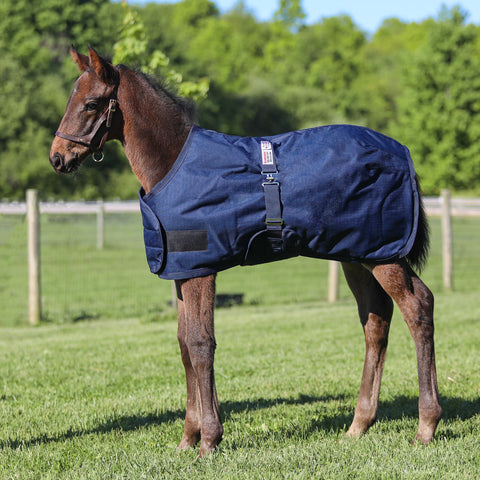
Finally, a Foal Blanket That Grows With Them — And Actually Stays On
The StormShield® Euro Bellyband 220g Foal Turnout Blanket gives newborns and young horses waterproof, windproof protection from 30–50°F — with an expandable closure that adjusts as they grow and a bellyband design that doesn't slip off during their inevitable pasture antics.
Foal Blankets That Don't Fit, Slip, or Last — Sound Familiar?
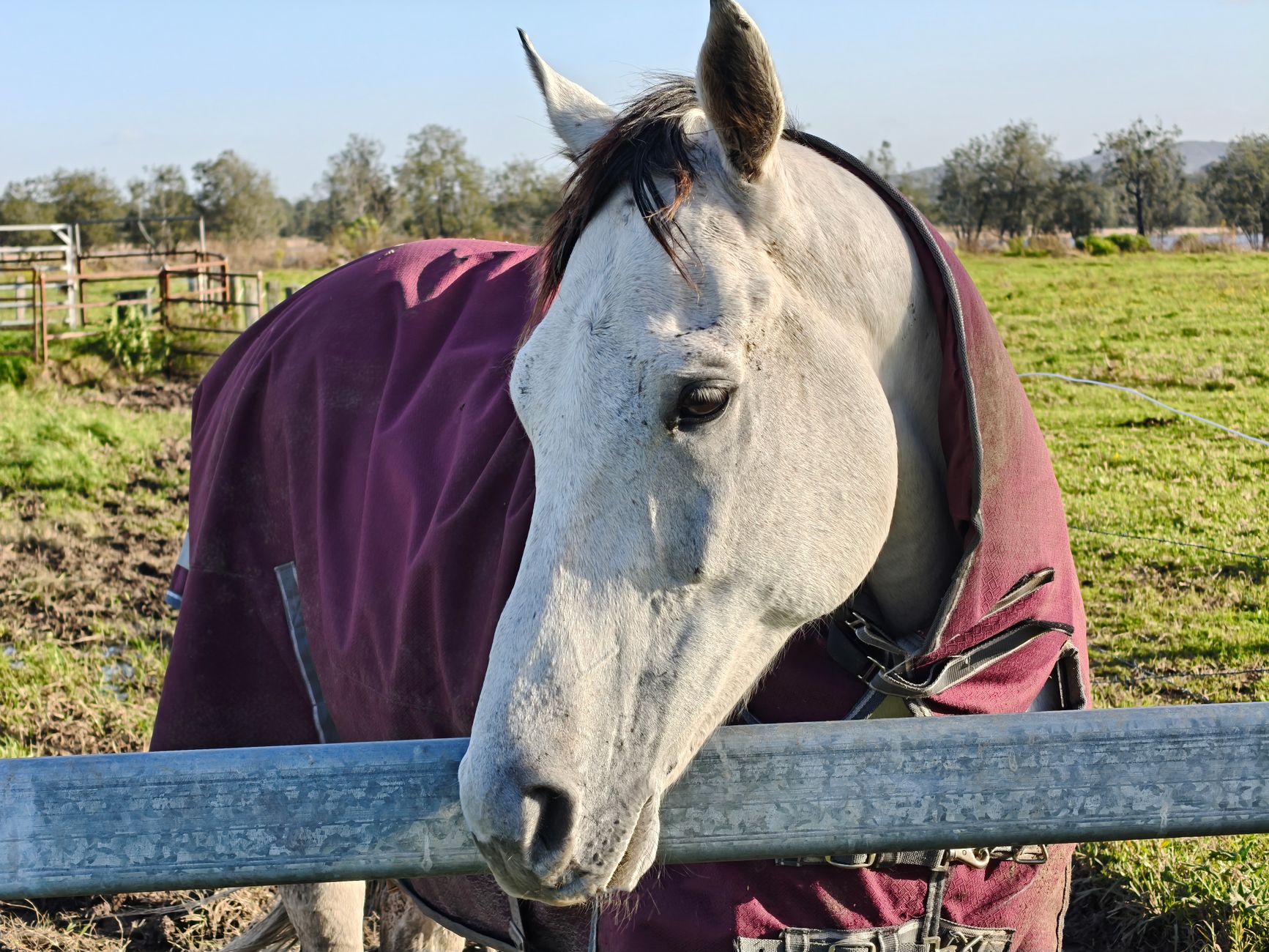
You're out at first light on a March morning, temperature sitting at 38°F with a drizzle coming sideways across the paddock. Your six-week-old foal is standing at the fence, coat fluffed up like a baby chick, shivering despite the blanket you put on last night. You walk over and find it: the blanket has slid halfway around the foal's barrel, the surcingle is twisted, and the neck opening has shifted so far back it's doing nothing for the chest. You've been here before — this is not a one-off. This is what blanketing foals looks like when the gear isn't built for them. The blanket you bought was marketed as a foal blanket. It came in foal sizes. It looked right on the shelf. But somewhere between sundown and 3am, physics won and your foal is standing there cold and damp, looking at you like you've let them down.
The problem runs deeper than an inconvenient morning reset. Foals cannot regulate their body temperature the way adult horses do — their thermoregulation system is still developing in those first weeks and months, and a wet, shivering foal is not just uncomfortable. Chilling burns calories that should be going toward growth, can depress the immune system at exactly the age when it is most vulnerable, and creates stress that compounds into slower weight gain and reduced resilience. A blanket that is riding sideways or has slipped off entirely is not just useless — it is a false sense of security while the actual problem goes unaddressed. You checked the weather, you made the call, you blanketed. But the blanket failed, and your foal paid for it in shivering and in calories spent warming back up instead of growing.
Add to that the practical reality of fast growth. A foal that fit a 48-inch blanket at six weeks may be pushing out of it by twelve weeks. Buckles that were snug are suddenly gapping. The chest closure won't close cleanly, or worse, it closes but leaves pressure points across the shoulders. You have already bought two or three sizes in the same season, washing and storing each one after only weeks of use. Meanwhile the foal is rolling, galloping flat-out across the paddock, spinning at the gate — and every one of those maneuvers is an opportunity for an ill-fitted blanket to migrate into a dangerous position. Leg straps can bind. A shifted blanket can spook a young horse mid-stride. A foal tangled in loose hardware is a vet call waiting to happen. The blanket you thought was solving the problem has become a hazard management problem on top of the temperature management problem.
The workarounds get expensive and frustrating fast. You have tried securing blankets with extra belly wraps. You have tried buying up a size to buy time. You have tried styles marketed as adjustable that turned out to mean one velcro tab at the chest that adds maybe two centimeters of range. You have talked to other people at the barn and heard the same story told back in different variations: foal blanketing is a headache, the gear slips, nothing stays put on an animal that moves this much and grows this fast. You've done everything right on the management side — checking temps, blanketing on schedule, going out in the dark to verify — and the equipment keeps being the weak link.
Every Slip, Every Shiver, Every Dollar Spent on a Blanket That Didn't Work
When a foal blanket doesn't stay put, the ripple effects hit fast and spread wide. You're making extra trips to the barn at odd hours to check and reposition. You're cutting your schedule around weather windows. Your barn manager is calling because the blanket is wrapped around a hindleg and the foal has panicked at the gate. The other horses in the paddock can't be turned out safely because an unsettled foal turns an entire herd dynamic sideways. What started as a simple decision — keep the baby warm — has cascaded into a daily management problem with real costs in time, stress, and barn disruption. And because foals move fast and blankets shift faster, you can never fully trust the setup without physically checking it, which means you never fully rest.
There is a quieter cost too, one that doesn't show up on a vet bill. The anxiety of watching a young horse shiver, knowing you put something on to prevent exactly that, is genuinely exhausting. Foals are vulnerable and you know it. You're trying to give this animal the best possible start, and gear that fails — in front of you or while you're away — chips away at your confidence in the whole setup. You second-guess your choices. You stay up calculating whether the temperature will drop another five degrees overnight and whether the blanket is still where you left it. That mental load is real, it accumulates across a whole foaling season, and it is entirely the product of equipment that was not built for the job.
On the financial side, the math on bad foal blankets is genuinely punishing. Two or three sizes in a single season, $60–$90 each at typical retail, adds up to $200 or more on gear that did not solve the problem. Factor in the extra bedding you are burning through when a damp foal comes in from the paddock and needs to dry off in the stall, the vet check you schedule because a shivering foal warrants a once-over, the time your labor hours spent on extra barn checks across a twelve-week foaling window — and the actual cost of getting the wrong blanket is far higher than the price tag suggests. Getting the right equipment at the start is not a premium expense. It is the cheaper option when you account for everything a failing blanket costs you.
- ✗Blankets that slide sideways or slip back overnight, leaving foals exposed by morning
- ✗Buying two or three sizes in a single season as the foal rapidly outgrows standard fit
- ✗Chest closures that gap, bind, or won't adjust to a fast-changing frame
- ✗False security — a blanket that looks on but isn't protecting against cold and wet

The StormShield® Euro Bellyband Foal Blanket: Built for How Foals Actually Live
The StormShield® Euro Bellyband 220g Foal Turnout Blanket was designed around two non-negotiable realities of early foal life: they grow fast, and they don't hold still. At $99.99, it delivers waterproof, windproof, breathable medium-weight protection calibrated for 30–50°F — the exact temperature window where young horses most need help — without the fit failures that make lesser blankets a liability. This is not a scaled-down adult blanket. It is a foal blanket engineered for the specific dimensions, growth curves, and activity levels of horses in their first months.
The mechanism that makes it work starts with the hook-and-loop front closure, which expands as the foal grows — giving you real adjustment range across multiple size increments without a hardware change or a new blanket purchase. The euro cut is proportioned for a young horse's narrower shoulders and shorter back, with the bellyband configuration replacing the loose surcingles and leg straps responsible for the majority of repositioning problems. That bellyband wraps under the barrel and holds position: through rolling, running, spinning at the gate, and every other motion in a foal's repertoire. The 220g fill delivers genuine insulation for genuine cold without overheating a horse that is built to move all day. And the shell is breathable — so moisture vapor from the horse's body moves out while rain and wind are blocked, which is the combination that keeps a foal dry on both sides of the equation.
The practical cascade from a blanket that stays on and works properly is significant. Fewer barn checks at odd hours. Consistent coverage through weather changes you can't control. A foal that comes in from the paddock warm and dry rather than damp and depleted. Less stall time spent drying out, which means less stress and more turnout — where foals need to be for healthy physical and social development. Because the closure adjusts for growth, you get a full season of real use rather than a few weeks before the blanket is outgrown and the cycle restarts. The economics flip: one blanket that works is cheaper than three that don't.
Behind the StormShield® line is Schneiders Saddlery, founded in 1948 in Chagrin Falls, Ohio — 78 years of outfitting working horses and the people who care for them. Schneiders stands behind its private-label gear with a full satisfaction guarantee. As a retailer that ships to all 50 states, the team behind this blanket is reachable when you have questions about fit, sizing, or care. This is not a generic import with a return label — it is gear from a company that has been answering horse people's practical questions for nearly eight decades, with a 4.8-star rating built on doing exactly that.
Expandable Hook-and-Loop Closure
Adjusts as the foal grows — get a full season of proper fit without buying up a size every few weeks.
Waterproof & Windproof Shell
Full weather protection keeps foals warm and dry through rain, sleet, and biting spring wind.
Euro Bellyband Design That Stays Put
Wraps under the barrel and holds position through rolling, running, and the full chaos of foal turnout.
220g Medium-Weight Fill
Calibrated for 30–50°F — real insulation for genuine cold without overheating an active young horse.
What Riders Are Saying
"
My Quarter Horse filly was born in late February — cold, wet, miserable spring in central Kentucky. I put the StormShield® Euro Bellyband on her at three weeks and it actually stayed where I put it. She galloped the fence line every morning, rolled three times a day minimum, and that bellyband never migrated. By eight weeks I'd let out the chest closure twice. We made it to mid-May in one blanket. That's never happened before. She came in warm and dry every single check, and I stopped losing sleep over the 3am temperature drops.
""
I breed Warmbloods and foal blanketing has always been a nightmare — big-bodied babies that grow three inches in a month and trash blankets by week four. I bought two StormShield® Euro Bellybands this past spring for my TWO March foals and honestly I'm a convert. The expandable closure is the piece I didn't know I needed. Neither foal outgrew their blanket before the weather broke. The waterproofing held through several genuine downpours and both foals stayed dry. At this price point I expected to be disappointed. I wasn't.
""
We run a small Quarter Horse operation in the Nebraska Sandhills — wind is the issue here more than rain, and foal blankets that shift become dangerous fast when you've got thirty-mile-an-hour gusts turning a scared foal into a loose cannon. The bellyband design on this one doesn't move. Put it on, check it in the morning, it's exactly where it was. My vet commented on how well-conditioned my March colt looked at his two-month checkup — coat quality, weight gain, temperament. A blanket that works is the whole picture when you've got a baby in cold weather.
"How We Stack Up
| Feature | Schneiders StormShield® Euro Bellyband 220g | Weatherbeeta Foal Blanket | Rambo Newborn Blanket |
|---|---|---|---|
| Waterproof shell | ✅ | ✅ | ✅ |
| Windproof protection | ✅ | ✅ | ✅ |
| Breathable lining | ✅ | ⚠️ | ✅ |
| Expandable chest closure | ✅ | ❌ | ⚠️ |
| Euro bellyband design | ✅ | ❌ | ❌ |
| 220g medium-weight fill | ✅ | ⚠️ | ✅ |
| Growth-adjustable fit system | ✅ | ❌ | ❌ |
| Satisfaction guarantee | ✅ | ⚠️ | ⚠️ |
| US-based customer support | ✅ | ❌ | ❌ |
| Ships to all 50 states | ✅ | ⚠️ | ⚠️ |
What Makes the Euro Bellyband Different From Standard Foal Blankets
Most foal blankets are scaled-down versions of adult designs, which means they inherit the same fit problems — just smaller. The StormShield® Euro Bellyband takes a different approach: the euro cut is specifically proportioned for a young horse's narrower shoulders and shorter back, with the bellyband configuration replacing the loose leg straps and sliding surcingles that cause the majority of foal blanket repositioning issues. The hook-and-loop chest closure is not a single velcro tab — it is an expandable system that gives you real adjustment range as a foal moves through the rapid growth of their first months. You are not buying the same dimension twice; you are buying a system that accommodates change without requiring a replacement purchase every four weeks.
Breathability matters on a foal blanket more than people expect. A young horse that gets too warm under a non-breathable shell will sweat, and a wet horse under a waterproof barrier is worse off than an unblanketed one. The StormShield® shell is waterproof and windproof but breathable, which means moisture vapor from the horse's body moves out while rain and wind are blocked at the surface. The result is a foal that is dry on the outside from weather and dry underneath from heat regulation — which is the actual goal of a turnout blanket, and one that requires both halves of the equation working correctly at the same time.
- ✓Waterproof, windproof, and breathable shell for complete weather protection
- ✓Expandable hook-and-loop front closure adjusts with foal growth
- ✓Euro-cut bellyband design for secure, no-slip fit through active turnout
- ✓220g fill rated for 30–50°F temperature range
- ✓Schneiders private-label quality, backed by 78 years and a satisfaction guarantee
What You Get