Leather That Lasts: Deep Conditioning Without the Grease
After 78 years fitting riders and their horses, we know what works. Ultra® Leather Conditioner penetrates deep into the fiber where drying actually happens — without transferring to your breeches, your gloves, or your white show saddle pad.

Your Leather Is Aging Faster Than It Should
It usually starts small. You run your hand down the seat of your saddle and feel something you didn't notice before — a slight stiffness, a faint roughness along the flap where the leather folds every time you post. Maybe there's a hairline crack developing near the D-ring, or the skirt has taken on that chalky, washed-out color that tells you the oils are leaving and not coming back on their own. You tell yourself you'll deal with it after the show, after the trail ride, after the clinic. And in the meantime, your tack keeps drying out, one humid August afternoon and one cold January morning at a time, quietly losing the suppleness that makes good leather good.
The problem runs deeper than the surface. Leather is not just a material — it's a protein matrix, preserved in a state of suspended flexibility by the fats and oils that remain in the fiber structure. The moment it leaves the hide, it begins a slow process of losing those fats to the environment. Barn conditions accelerate this: temperature swings from freezing mornings to hot afternoons stress the collagen fibers with repeated expansion and contraction. Sweat deposits salt crystals that draw moisture out from the inside. Even conscientious cleaning, however necessary, strips some natural oils in the process. A saddle that gets ridden hard five days a week and wiped down regularly can still be losing ground if conditioning isn't part of the routine — because cleaning and conditioning are not the same thing, and most riders are doing one without the other.
The daily grind is specific. The bridle comes off after a hard workout, gets a quick wipe with a damp cloth, and goes back on the hook still faintly damp with sweat. The saddle gets a pass with a glycerin bar on Sunday afternoons when there's time. The girth — the piece that absorbs the most sweat and flexes the most — gets almost nothing. Boots get conditioned for a week after they're new and then forgotten. This maintenance rhythm works well enough to keep tack looking presentable across the aisle, but it doesn't replace what sweat and weather and daily friction are pulling out of the leather fibers underneath. The result is equipment that looks acceptable from ten feet away and reveals its true condition the moment you run a thumb along the billet, press into the panel, or open a fold in the flap that hasn't been opened in a while.
Riders who try to address this often end up more frustrated than before. You buy the conditioner at the feed store that promises to restore leather and it does something — but it leaves your saddle slick for two days and transfers onto everything your thigh touches. You try the beeswax product your trainer recommends: smells great, protects the surface, but doesn't do much for leather that's already started to stiffen where it matters. You pick up the spray conditioner that's fast and convenient, but it evaporates before it can penetrate and you're back where you started. You end up with three half-used bottles in the tack room and leather that's still slowly losing the battle, because none of these products solved the real problem: finding something that penetrates deeply, conditions thoroughly, and doesn't create new problems in the process.
Cracked Leather Doesn't Fail on Your Schedule
Leather under stress fails at inconvenient moments because that's what stressed leather does. The billet strap that's been quietly cracking near the buckle hole doesn't announce its departure — it gives out the morning of your first recognized show, or at the trailhead three miles from the trailer, or during a jumping lesson when a crack becomes a snap and you land harder than you planned. Dry leather doesn't just look bad: it becomes structurally compromised. Cracks are not cosmetic. They are fractures in the collagen fiber bundles, and once they progress, no amount of after-the-fact conditioning will close them. You can slow the deterioration of leather that's still intact. You cannot reverse damage that's already set. The window for intervention is always earlier than it looks.
Beyond the safety concern is the quieter frustration of watching expensive tack depreciate faster than it should. A well-made saddle, maintained properly, can outlast the horse you bought it for. Neglected, it becomes a liability — something you're riding on with a background anxiety about what gives out first, or something you're paying a saddler to patch and re-stitch, spending money on repair instead of on the next nice piece of equipment you actually want. Riders who have been through it know the specific regret of holding a saddle that cost real money and seeing a crack running from the pommel channel because they waited too long to condition. That saddle is not coming back to full value. It's a restored saddle, with a history of neglect baked into it.
The workarounds are expensive in time and money both. Neatsfoot oil conditions but darkens leather permanently and can soften thread over time — a real concern on any stitched piece. Mink oil is popular but leaves surfaces tacky and can promote mold in humid barn environments. Commercial restorers work on the surface finish but don't address what's happening in the deeper fiber layers where the actual drying occurs. And none of them solve the problem that stops most riders from conditioning consistently in the first place: the mess. Greasy hands, greasy breeches, the saddle that needs to sit for half a day before you can ride in it without ruining a pair of white show breeches. Riders stop conditioning because it's inconvenient. And that's precisely when leather starts losing ground it will never recover.
- ✗Leather cracking at stress points — billets, flaps, cantle — well before its time
- ✗Greasy conditioner residue transferring to breeches, gloves, and saddle pads
- ✗Expensive saddles depreciating faster than they should from preventable drying
- ✗Conditioners that coat the surface instead of penetrating to where it counts

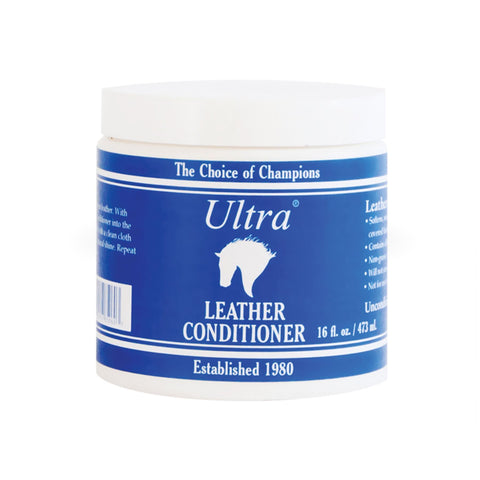
Ultra® Leather Conditioner: Deep Conditioning, Zero Grease
Ultra® Leather Conditioner was built around the problem that makes riders stop conditioning their tack: the mess. Most conditioners work by depositing oil or wax on the leather surface. This protects and looks good right after application, but it transfers to everything you touch, leaves saddle leather feeling slick underfoot, and means you're waiting hours before you can ride without staining your breeches. Ultra uses a non-greasy formula that penetrates into the fiber structure rather than sitting on top — doing its work where leather actually needs it and leaving the surface feeling conditioned, not coated. The result is a product you'll actually use consistently, which is the single most important factor in leather longevity.
The mechanism is rooted in leather's basic structure. Leather is a collagen matrix — protein fibers that remain permanently supple when they contain the right balance of fats and moisture, and permanently rigid when they don't. Once those fibers dry out and cross-link in a contracted state, surface treatment can't reverse the damage. Ultra's formula is designed to move through the grain layer and reach the corium — the dense inner layer where most of the structural integrity lives and where dry leather loses flexibility first. This is where a serious conditioning product needs to work. The payoff is leather that's soft not just to the touch but through the full thickness, producing the kind of quiet, consistent contact under saddle that you only get from genuinely supple leather.
What riders notice first is what doesn't happen: no transfer to breeches, no slick feel on the seat, no waiting period before riding. What they notice after a few applications is what does happen: panels with more give, flaps that fold without stiffness, bridle leather that's taken on a deeper color as the conditioned fibers reflect light differently. New leather breaks in faster because the fiber structure is already flexible before the riding starts. Old leather that looked like a lost cause often finds a level of suppleness it hasn't had in years. The formula is safe for all leather types — smooth, rough-out, full-grain, and corrected-grain — and won't damage stitching or hardware.
Schneiders has been sourcing and testing leather care products since 1948. We carry Ultra under our own label because we use it ourselves, in our own barn, on our own tack, in the Ohio climate that gives leather everything it can handle — humid summers that saturate, cold dry winters that desiccate, and the kind of mud-and-sweat sessions that happen when you're actually riding. The 4.8-star rating from customers across all 50 states reflects what we already knew when we put our name on it. If Ultra doesn't work for your leather, we make it right. That has been the policy since 1948 and it isn't changing.
Non-Greasy Formula
Absorbs into the leather fiber without leaving a tacky or oily surface — safe to ride immediately after application without worrying about transfer.
Won't Transfer to Clothing
No residue on breeches, gloves, or saddle pads. Condition your tack the morning of a show without second-guessing it.
Accelerates Break-In on New Leather
Speeds the break-in process on new saddles, bridles, and boots by softening the fiber structure from the inside out — not just the surface.
Restores Dry and Aged Leather
Brings real flexibility back to stiff, dried-out leather by penetrating to the corium layer — addressing the structural drying, not just the surface appearance.
What Riders Are Saying
"
My 15-year-old Pessoa close contact was looking like it was headed for the trash heap — stiff panels, cracking skirt, that chalky washed-out color that tells you the oils have left and aren't coming back. I applied Ultra Leather Conditioner twice over two weeks and honestly could not believe the turnaround. The leather softened right up, the color came back deep and even, and the surface stopped shedding flakes onto my quarter sheet. My mare Rosie seemed genuinely more comfortable once the panels were supple again. I'm a hunter/jumper trainer with eleven horses in the barn and this is now non-negotiable in our weekly tack cleaning rotation.
""
Trail riding in the Ozarks means my tack takes a serious beating — sweat, creek crossings, dust, and UV all summer long. My Tucker saddle was aging ten years for every one. Every conditioner I tried at the feed store left a film so greasy my hands slipped on the reins. Ultra is completely different. I worked it in on a dry afternoon and it absorbed in twenty minutes with almost no residue. My Quarter Horse Buck and I logged forty miles last month and that saddle looks better than it did when I bought it. At $29.99 this is the best tack investment I've made all year.
""
I ride dressage and I'm particular about tack — my Stubben bridle cost more than my first car payment and I treat it accordingly. I was skeptical of any conditioner marketed as non-greasy because in my experience that just means it doesn't work. Ultra surprised me completely. It soaked in without any tacky feeling, the leather stayed supple through a full week of twice-daily rides in August heat, and most importantly it did not transfer to my white gloves. That last point alone is worth the price. Genuinely impressed, and I don't impress easily when it comes to leather care.
"How We Stack Up
| Feature | Schneiders Ultra® Leather Conditioner | Leather New | Effax Leather Balsam |
|---|---|---|---|
| Non-greasy formula | ✅ | ❌ | ⚠️ |
| Won't transfer to breeches or gloves | ✅ | ❌ | ⚠️ |
| Ride-ready immediately after application | ✅ | ❌ | ❌ |
| Penetrates to corium layer | ✅ | ⚠️ | ✅ |
| Safe for all leather types | ✅ | ✅ | ✅ |
| Accelerates new leather break-in | ✅ | ⚠️ | ✅ |
| Restores dried and aged leather | ✅ | ✅ | ✅ |
| Won't darken light-colored leather | ✅ | ❌ | ⚠️ |
| Silicone-free formula | ✅ | ❌ | ✅ |
| Backed by family-owned satisfaction guarantee | ✅ | ❌ | ❌ |
What 78 Years of Selling Tack Has Taught Us About Leather
Schneiders opened its doors in Chagrin Falls, Ohio in 1948, and leather care has been part of every conversation with customers since day one. Ohio is not a gentle environment for tack — humidity comes in waves all summer, winters are dry and cold, and anyone keeping horses here knows the particular misery of a saddle that's soaked through in August and board-stiff by February. Over seven decades we've tried everything, recommended products we later stopped carrying, and heard directly from riders what holds up in real barn conditions versus what looks promising on a label. Ultra® Leather Conditioner is what we landed on after all of that accumulated trial and error, which is why we put our own name on it rather than just stocking it.
The non-greasy formula solves the biggest practical obstacle to consistent leather care: the mess that makes riders skip conditioning sessions. A conditioner you actually use on a regular schedule is worth ten times more than a better-performing product that lives in the tack room because it's too much trouble to apply before a ride. Ultra absorbs in about twenty minutes after application with minimal residue, can be used before riding without concern about what it does to your grip or your breeches, and works on every type of leather in a typical barn — saddles, bridles, boots, halters, harness, and driving gear. At $29.99, it's one of the most cost-effective ways to protect equipment that cost considerably more than that to replace.
- ✓Non-greasy, non-transfer formula — safe for white breeches and competition gloves
- ✓Penetrates to the corium layer for structural flexibility, not surface shine alone
- ✓Accelerates break-in on new saddles, bridles, boots, and harness
- ✓Safe for smooth, rough-out, full-grain, and corrected-grain leather — won't damage stitching
- ✓Backed by Schneiders' 78-year satisfaction guarantee, ships free over $99 to all 50 states
What You Get