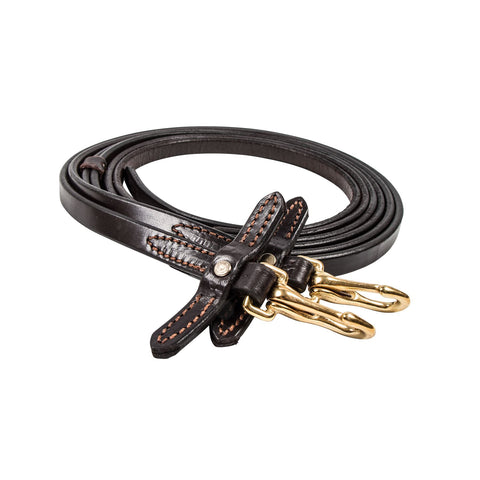
The Training Reins That Think Like a Trainer
Handcrafted in the USA by Amish leather artisans and designed with legendary trainer Gene LaCroix, these split reins deliver the feel, balance, and communication that serious Western riders demand — right out of the box.

Why Most Training Reins Fail You at the Worst Possible Moment
Picture the scene: you're thirty minutes into a productive schooling session with a horse that's finally starting to understand the lateral yield you've been working on for three weeks. Your timing is perfect, your seat is quiet, you lift the rein with the lightest possible ask — and nothing happens. Not because the horse didn't feel it, but because the reins in your hands swallowed the signal somewhere between your fingers and the bit. Stiff, board-flat leather that telegraphs pressure but never nuance. The horse didn't fail you. The equipment did.
Training split reins are not decorative gear. They are the single most important piece of communication hardware between your intention and your horse's understanding, and yet most riders are working with leather that was tanned and treated to look good at the point of sale and never asked to do anything more demanding than that. The problem isn't immediately visible. Budget reins often look fine, feel okay in the tack shop, and hold up for light pleasure riding without complaint. But they have no feel — no drape, no weight consistency from one end to the other, no capacity to transmit a three-ounce cue without amplifying it into a pound of pressure. A horse that's sensitive or still in training reads that noise as contradiction, and the confusion compounds over weeks and months into resistance you'll spend a year trying to undo.
Here's what a daily training session actually looks like when your reins aren't doing their job: You ask for a soft one-rein stop and get a head toss instead of a give. You try to float the rein for a moment of softness and it falls dead rather than maintaining contact because the leather has no consistent weight or balance. You shorten up for collection work and the stiff leather twists in your hands, changing the angle of the bit contact in ways neither you nor your horse can predict. You're fighting the gear at the same time you're trying to build the horse's confidence, and both battles drain time, patience, and momentum from every ride. Multiply that by five rides a week, forty weeks a year, and you start to see what substandard reins actually cost a training program.
Most riders try to solve the problem by breaking in budget leather the hard way — months of conditioning oil, wrapping around fence posts, running through hands in the living room. Others buy up to a heavier rein hoping mass compensates for poor balance, then discover their horse braces against the added weight instead of relaxing into it. Some switch to synthetic materials entirely, trade the feel problem for a grip problem, and end up right back where they started. The core issue is that a rein built without input from someone who actually trains horses for a living will never solve the problems that actual trainers face — because nobody building it knew what those problems were.
Bad Reins Don't Just Slow Your Training — They Undo It
When your equipment creates noise in the communication line between you and your horse, the ripple effects move in every direction at once. The horse that braces because the rein signal is inconsistent learns to brace. That's not a bad ride — that's a trained response to a stimulus you provided, and it will be there waiting for you on your next ride, and the one after that. Every session where confusing gear teaches a horse to brace rather than soften is a session you'll have to spend three future sessions unwinding. The math only gets worse the further into a training sequence you go, because a horse that doesn't trust the rein won't trust the half-halt, won't trust the collection ask, won't trust the stop. You're not just losing ground — you're building ground you'll have to fight back across.
There's a reason experienced trainers are particular about their leather to a degree that looks obsessive from the outside. They've watched horses go sour, watched young riders lose confidence, watched partnership unravel — all because the equipment in the middle didn't carry the message accurately. And the emotional toll compounds the technical one. There's nothing more discouraging than working hard, riding correctly, doing everything your trainer tells you, and watching the horse respond as if you're doing something wrong. Riders at every level second-guess themselves when they can't feel the connection they're working toward. Beginners quit. Intermediate riders plateau. Competitive riders start blaming the horse.
On the financial side, substandard reins are one of the most expensive false economies in the tack room. Cheap leather that needs constant conditioning, breaks early, or stretches unevenly gets replaced again and again. Meanwhile, the training setbacks caused by unreliable equipment can add weeks or months to a horse's development timeline — and professional training time is typically billed at $35 to $75 per ride. A pair of $25 reins that costs you even four extra training sessions has already cost you more than a quality pair of LaCroix split reins. The savings were never real. They were just deferred.
- ✗Stiff leather that swallows subtle cues and forces over-asking
- ✗Uneven weight and drape that creates inconsistent bit contact
- ✗Snaps that fail under pressure or corrode with regular outdoor use
- ✗Break-in periods so long the horse is trained around the gear, not with it

Designed by a Trainer, Built by Artisans, Tested by Horses That Don't Lie
Gene LaCroix didn't sit in a boardroom and approve a product spec. He worked with craftsmen on what a training rein needs to do at every stage of a horse's education — how it needs to drape, where the weight needs to sit, how the snap placement affects bit contact, how the stops need to be positioned to educate a rider's hand without correcting it. The Victor Supreme Gene LaCroix Training Split Reins are the result of that conversation: equipment that starts from what a horse actually feels rather than what looks good hanging on a wall at a trade show.
The mechanism is Amish-crafted American leather selected and finished to drape naturally from the first use. That drape matters because a rein that hangs correctly maintains gentle, consistent contact through transitions — no dead spots, no sudden grabs, no amplified pressure. The solid brass snaps at the bit end won't corrode, won't pop under a shaking head or a spook, and won't introduce a rattle or click that becomes a distraction. And the leather itself is tanned to break in progressively — it gets softer and more supple with every ride, so the rein you have in six months communicates even more clearly than the one you rode in today.
The cascade of benefits that follows is exactly what trainers mean when they talk about good tools getting out of the way. When the rein delivers your ask accurately, your horse has the chance to answer correctly — and a horse that gets to answer correctly builds confidence. That confidence opens the door to the next training concept, and the one after that. Instead of spending rides fighting equipment noise, you're spending them building the relationship and the vocabulary that makes a horse genuinely light and responsive. The stops keep your hands honest. The weight keeps your contact steady. The leather keeps getting better. Everything compounds in the right direction for a change.
Behind these reins is 78 years of Schneiders Saddlery standing behind American-made leather at every price point. We've been the store where serious horse people shop since 1948 — not because we chase trends, but because we've never stopped caring what works in an actual arena, on an actual horse, in an actual training session. If these reins don't perform the way we've described, we make it right. That's not a policy — it's how a family-owned business earns a 4.8-star rating across fifty states over three generations.
USA Amish Handcrafted Leather
Selected and finished by Amish leather artisans for consistent weight, drape, and a break-in curve that improves with every ride.
Solid Brass Snaps
Corrosion-resistant solid brass at the bit end — no rattling, no popping under pressure, no corroded hardware embarrassing you at the show pen.
Gene LaCroix Trainer Design
Engineered in collaboration with a leading Western trainer, with stop placement and leather weight calibrated for how training horses actually behave.
Schneiders 78-Year Guarantee
Family-owned since 1948, shipping to all 50 states, and standing behind every product with the kind of customer service a third-generation business earns.
What Riders Are Saying
"
I run a reining barn in central Texas and I've put these reins on every horse from green three-year-olds to our open futurity horses. My big gray NRHA prospect used to brace through bridle transitions — I chalked it up to his breeding. Two weeks into working him with the LaCroix split reins and that brace is gone. The leather weight and balance are dialed in so precisely that he's picking up the signal before I even complete the ask. Worth every dollar at twice the price.
""
Trail riding is where equipment really gets stress-tested. These reins went through six back-country miles in the Ozarks, two water crossings, and a surprise thunderstorm — and they came out of the bag the next morning feeling broken in rather than beaten up. The snaps are rock solid; my mare has a habit of shaking her head when she's impatient at the trailer and I've never once worried about a snap letting go. The leather just keeps getting better and more supple the more I use them.
""
I coach youth Western riders at a 4-H level and these are the reins I put in kids' hands when they're ready to step off a snaffle. The stops are positioned exactly right to remind young riders where their hands belong without being punishing, and the leather is forgiving enough for a beginner's grip. Three of my students competed at state fair this year using these exact reins. Two of them placed. The quality you'd expect from a big-box store brand at $250 — for $84.99. Schneiders came through again.
"How We Stack Up
| Feature | Schneiders Victor Supreme LaCroix | Professionals Choice | Circle Y |
|---|---|---|---|
| USA Handcrafted Leather | ✅ | ❌ | ⚠️ |
| Amish Artisan Construction | ✅ | ❌ | ❌ |
| Trainer-Collaborated Design | ✅ | ⚠️ | ❌ |
| Solid Brass Snaps | ✅ | ⚠️ | ✅ |
| Progressive Break-In Leather | ✅ | ❌ | ⚠️ |
| Trainer-Specified Stop Placement | ✅ | ❌ | ❌ |
| Under $90 Price Point | ✅ | ❌ | ❌ |
| 78-Year Brand Guarantee | ✅ | ❌ | ❌ |
| Nationwide Free Shipping Threshold | ✅ | ⚠️ | ⚠️ |
| 4.8-Star Customer Rating | ✅ | ⚠️ | ⚠️ |
Every Spec Here Was Argued Over by People Who Actually Train Horses
The stop placement on the Victor Supreme LaCroix reins isn't arbitrary. Gene LaCroix insisted on stops positioned to educate a rider's hands to the correct position for Western training work — not so far up the rein that a beginner can ignore them, and not so close to the bit that an experienced rider finds them restrictive. The leather width and taper was tested through multiple prototypes to achieve the drape that transmits a two-finger cue without amplification. These are not details you'd notice looking at a photograph. They're details you notice thirty minutes into a difficult training session when everything is finally working.
The Amish craftsmen who build these reins work with the same attention to stitch consistency and edge finishing that made American-made leather the global standard before mass production moved offshore. The result is a rein that looks as good as it rides — but more importantly, a rein where the craftsmanship serves the function rather than covering for shortcuts underneath. At $84.99, the Victor Supreme LaCroix split reins land in a category where most manufacturers are cutting corners on either leather selection or hardware. These cut no corners. Schneiders built its reputation on exactly this kind of value: gear that competes with products selling for twice the price because the sourcing and the craft are taken seriously from the first step.
- ✓Handcrafted in the USA by Amish leather artisans
- ✓Solid brass snaps — corrosion-resistant, rattle-free
- ✓Trainer-specified stop placement for consistent hand position
- ✓Progressive break-in — softer and more responsive with every ride
- ✓Designed in collaboration with leading Western trainer Gene LaCroix
What You Get