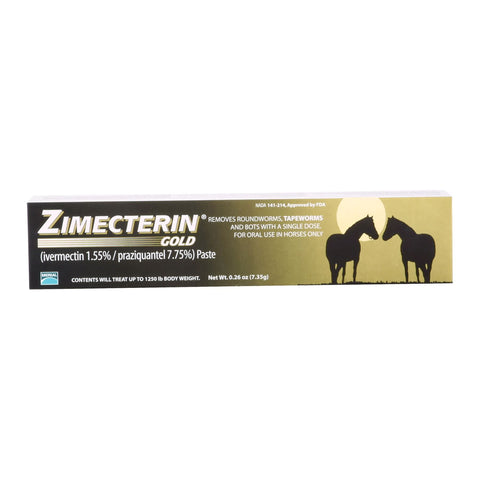
Stop Parasites Before They Rob Your Horse of Everything
Zimecterin Gold combines ivermectin and praziquantel to knock out 47 species and stages of equine parasites — including tapeworms and benzimidazole-resistant small strongyles that other dewormers simply miss.

Your Horse Looks Fine. That's Exactly the Problem.
It starts so quietly you almost miss it. Your horse finishes his hay a little slower than usual. His energy on the trail feels slightly flat — not lame, not obviously sick, just a shade off. You put it down to the season changing, or a hard week of work, or maybe you just need to tweak his feed. You do all of that. Nothing changes. The subtle wrongness stays, and because it never crosses the threshold into an obvious symptom, you keep waiting for it to resolve on its own.
What you're watching is internal parasite load doing what it does best: operating below the level of visibility while steadily eroding your horse's condition. Internal parasites — large and small strongyles, ascarids, pinworms, bots, and especially tapeworms — don't announce themselves. They colonize the gut lining, compete for nutrients, trigger low-grade inflammation, and disrupt normal motility long before you see anything in the manure or on the body weight scale. By the time a horse looks noticeably poor, the damage has been building for months. Tapeworms in particular are notorious for this. They concentrate at the ileocecal junction, cause recurrent spasmodic colic, and are invisible on standard fecal egg counts — so a clean test result gives you false confidence while the problem compounds.
Think about what a meaningful parasite burden actually costs a horse day to day. Every calorie your horse eats that goes to fueling parasite populations is a calorie that isn't going to muscle, bone density, immune function, or coat quality. Senior horses and young horses under four are especially vulnerable — seniors because their immune response is already declining, youngsters because roundworms (ascarids) hit hardest before the horse builds natural resistance. A breeding stallion carrying a tapeworm load isn't performing at his genetic potential. A competition horse with a subclinical strongyle burden simply will not recover between hard work sessions the way a clean horse does. And benzimidazole-resistant small strongyles — the kind that ivermectin-only products can't fully clear — have become the norm on most properties, not the exception.
The frustrating part is how often horse owners do everything right and still come up short. They rotate dewormers on schedule. They pick up manure. They limit pasture density. They get fecal egg counts done. And yet the barn vet still finds tapeworm antibody titers, still sees horses cycling through low-grade colic events, still recommends adding a product that specifically addresses what the standard rotation misses. The rotation approach made sense before resistance patterns shifted. Today, a dewormer that combines two active ingredients targeting different parasite mechanisms isn't a premium option — it's the baseline for comprehensive parasite control.
A Low Parasite Burden Isn't Low Enough When It's Costing You Performance and Peace of Mind
Here is what a persistent parasite problem actually ripples into over a competition or breeding season. Your horse's gut health drives everything — nutrient absorption, hindgut fermentation, immune signaling, even mood and trainability. A horse whose gut is managing chronic low-grade inflammation from parasite activity is a horse that is working against himself every single ride. He may be sound, he may be willing, but his recovery window is longer, his stamina ceiling is lower, and his stress tolerance is thinner. You push him into a hard conditioning block and he just doesn't snap back the way the program expects. You wonder if you're overtraining. You pull back. The real cause never gets addressed.
The emotional weight of this is real and underappreciated. You bought this horse to ride, to compete, to build something together. Watching him be perpetually slightly off — not sick enough to justify a full vet workup, not well enough to feel confident pushing the program — is genuinely demoralizing. Horse ownership is expensive and time-intensive under ideal conditions. When the horse you've invested in isn't thriving, that gap between what you hoped for and what you're experiencing hits hard. You second-guess your feeding program, your forage quality, your training methods. You spend money on supplements chasing a problem that has a much simpler root cause.
Run the numbers on what workarounds actually cost. An equine vet call to investigate unexplained weight loss or recurring colic: $150 to $400 before diagnostics. A fecal egg count panel with tapeworm ELISA: another $80 to $120. Colic management, even mild cases resolved with banamine and hand-walking, costs you time, stress, and often a vet call. Compare that to two targeted treatments per year with a dual-action dewormer that covers the full parasite spectrum. Zimecterin Gold at $18.89 a tube is not an added expense — it is the cheaper option once you account for everything you're spending to manage the consequences of incomplete parasite control.
- ✗Unexplained weight loss despite solid feed and forage
- ✗Recurring low-grade colic with no obvious dietary cause
- ✗Dull coat and poor topline that don't respond to supplementation
- ✗Clean fecal egg count results while tapeworm damage continues undetected

Zimecterin Gold Covers What Single-Ingredient Dewormers Leave Behind
Zimecterin Gold is a dual-action paste dewormer that combines two proven active ingredients in a single dose: ivermectin at 1.87% concentration and praziquantel at 14.03%. That combination matters because no single active ingredient covers the complete range of equine parasites your horse is actually exposed to. Ivermectin handles the heavy lifting — large strongyles, small strongyles, pinworms, ascarids, hairworms, stomach worms, lungworms, intestinal threadworms, and all three species of bot fly larvae. Praziquantel takes care of the one class of parasites ivermectin cannot touch: tapeworms. Together, they control 47 species and stages of equine parasites, which is more than any other dewormer on the market today.
The mechanism is straightforward and that's part of why it works so reliably. Ivermectin binds to glutamate-gated chloride channels in invertebrate nerve and muscle cells, causing paralysis and death in susceptible parasites without affecting mammalian physiology at therapeutic doses. Praziquantel disrupts calcium ion transport across the tegument of cestodes — tapeworms — causing muscular contraction, paralysis, and disintegration of the worm. Critically, Zimecterin Gold is specifically approved to control benzimidazole-resistant small strongyles, the encysted larval forms that have developed resistance to older drug classes across most of the U.S. horse population. That approval is not marketing language — it is an FDA-reviewed efficacy claim backed by controlled studies.
What that comprehensive coverage translates to in practical terms: a horse whose gut is no longer competing with 47 potential parasite species absorbs feed more efficiently, maintains condition more easily, experiences fewer colic episodes, and recovers faster between training sessions. Owners who switch to a rotation that includes Zimecterin Gold typically report visible improvements in body condition and coat quality within four to six weeks of the first treatment — not because the product is doing anything miraculous, but because removing a significant metabolic burden lets the horse's own physiology do what it's supposed to do. The dosing is simple: the weight-graduated paste syringe delivers an accurate dose for horses and ponies up to 1250 lbs, and the apple-flavored formulation means even difficult-to-dose horses accept it without a fight.
At Schneider Saddlery, we've been helping horse owners make sound decisions about equine health products since 1948. We're a third-generation family business based in Chagrin Falls, Ohio, and we've earned a 4.8-star rating from the horse community by carrying products we'd use on our own animals. When we stock Zimecterin Gold, it's because the efficacy data is solid, the price point is fair at $18.89, and our customers have been telling us for years that it delivers results the less comprehensive options don't. Every purchase is backed by our satisfaction guarantee — if it doesn't work for your horse, we make it right.
Dual Active Ingredients
Ivermectin + praziquantel in one dose — covers the full parasite spectrum including tapeworms that ivermectin alone cannot control.
47 Species and Stages Controlled
More approved parasite species and stages than any other equine dewormer on the market, including bot fly larvae and encysted small strongyles.
Resistance-Busting Formula
Specifically approved for benzimidazole-resistant small strongyles — the emerging parasite threat that fenbendazole and oxibendazole can no longer reliably clear.
Simple, Accurate Dosing
Weight-graduated paste syringe doses horses and ponies up to 1250 lbs. Apple-flavored formula accepted even by head-shy and difficult-to-treat horses.
What Riders Are Saying
"
My 14-year-old Quarter Horse, Diesel, had been dropping weight for two years despite a solid feed program. My vet suspected tapeworms, which my old paste wasn't touching. Three weeks after switching to Zimecterin Gold, his topline started filling back in and his coat looked better than it had in years. One tube handled what months of the other stuff never could. This is the only dewormer in my barn cabinet now.
""
I run three barrel horses and rotate dewormers religiously, but my vet fecal egg counts kept coming back high for small strongyles. Switched my whole rotation to include Zimecterin Gold twice a year and the counts dropped dramatically. My sorrel mare had been intermittently colicky — that stopped too. When you're hauling horses to 30 jackpots a season, you cannot afford a sick horse. This product earns its keep every single time.
""
Our barn manager has been using Zimecterin Gold on our hunter/jumper string for three seasons. We have 11 horses ranging from a 4-year-old OTTB to a 20-year-old schoolmaster, and all of them tolerate it easily — even the picky ones. The paste consistency is smooth, it stays in place when you dose, and we've had zero GI upsets. Our vet's annual wellness exams consistently show clean fecal results. Worth every penny for the peace of mind alone.
"How We Stack Up
| Feature | Schneiders Zimecterin Gold | Quest Plus | Equimax |
|---|---|---|---|
| Tapeworm control | ✅ | ✅ | ✅ |
| Ivermectin active ingredient | ✅ | ❌ | ✅ |
| Praziquantel active ingredient | ✅ | ✅ | ✅ |
| Benzimidazole-resistant strongyle control | ✅ | ✅ | ⚠️ |
| All 3 bot fly larvae species | ✅ | ✅ | ✅ |
| 47+ species/stages FDA approved | ✅ | ❌ | ❌ |
| Safe for breeding stallions | ✅ | ⚠️ | ✅ |
| Safe for foals over 4 weeks | ✅ | ❌ | ✅ |
| Apple-flavored formula | ✅ | ❌ | ⚠️ |
| Doses ponies up to 1250 lbs | ✅ | ✅ | ✅ |
What's Inside the Syringe and Why Each Ingredient Earns Its Place
Ivermectin has been the gold standard in equine parasite control since its introduction because its mode of action is fundamentally different from benzimidazole and pyrimidine compounds, which means parasites that have developed resistance to those older classes remain fully susceptible to ivermectin. At 1.87% concentration, the ivermectin in Zimecterin Gold delivers the ingredient at label strength for adult parasite control. Praziquantel at 14.03% addresses the class of parasites ivermectin does not cover — tapeworms — and is FDA approved for effective tapeworm control in a single dose. For guidance on how tapeworm burden and rotational deworming apply to your individual horse and region, work with your veterinarian.
- ✓Controls 47 species and stages of equine parasites — most of any dewormer
- ✓Dual-action formula: ivermectin 1.87% + praziquantel 14.03%
- ✓FDA approved for benzimidazole-resistant small strongyle control
- ✓Eliminates all three species of bot fly larvae
- ✓Weight-graduated syringe doses horses and ponies up to 1,250 lbs
What You Get