
Natural-Source Vitamin E Meets a Documented Omega Oil Blend
Equine Omega Vitamin E combines D-alpha tocopherol with mechanically expelled organic soybean oil and deep-water, wild-caught fish oil.

When Vitamin E Is Only Part of the Feeding Plan
That uncertainty follows you into the barn aisle. Vitamin E supplements come as powders, pellets, water-dispersible liquids, and oil-based formulas, with serving amounts that vary widely. Some provide vitamin E alone. Others combine it with fats or omega fatty acids, but the label may not identify EPA, DHA, calories, or the amount delivered per daily serving. Comparing containers by size does not solve the problem because ounces, milliliters, scoops, and daily doses do not tell the same story.
The real cost is more than the price of another tub. It is the time spent managing separate products, the risk of overlooking how one supplement changes the overall ration, and the worry that your horse’s feeding program is becoming harder to evaluate. Vitamin E is fat-soluble, so this is not a nutrient to add casually or increase without professional input. You need a clearly labeled formula that lets you and your veterinarian see the vitamin E source, daily amount, fatty-acid profile, and calorie contribution together. Before choosing a product, the first question is not which label makes the biggest promise—it is which label gives you the usable facts needed to make a horse-first decision.
Separate Supplements Can Make the Full Ration Harder to Read
Many vitamin E products are intentionally single-nutrient formulas, which may be appropriate when your veterinarian wants to adjust vitamin E without adding other nutrients. But that approach can become cumbersome when your horse’s ration also calls for supplemental fat or omega fatty acids. You may end up opening several containers, measuring several servings, and trying to determine whether the combined ration supplies EPA, DHA, omega-3, omega-6, and added calories. When those values are not published, they must remain unknown—not filled in with assumptions about what an oil or powder probably contains.
That mismatch can create a frustrating cycle. You buy a product based on container size, then discover the serving is smaller or larger than expected. You add an omega oil, only to realize its vitamin E contribution differs from the first supplement. You search for feeding guidance online, but recommendations vary according to your horse’s pasture access, workload, existing ration, health history, and laboratory results. More products do not automatically create a clearer plan; sometimes they simply produce more labels to reconcile.
The trap is choosing by a broad front-label phrase instead of the complete product facts. “Natural vitamin E,” “omega oil,” and “antioxidant support” may describe a formula, but they do not tell you the full daily dose or nutrient profile. Without those specifics and your veterinarian’s guidance, you are left managing complexity rather than confidently supporting your horse.
- ✗Comparing vitamin E sources across different supplement formats
- ✗Accounting for omega fatty acids alongside vitamin E
- ✗Understanding how an oil supplement contributes calories
- ✗Coordinating targeted nutritional support with a veterinarian
Bring Vitamin E, Omega Fatty Acids, and Added Calories Onto One Label
Each published 4-ounce serving supplies 10,000 IU of total vitamin E, 11.2 grams of omega-3 isomers, 47.6 grams of omega-6 isomers, and 20.6 grams of omega-9 isomers. The label also identifies 1.5 grams of EPA and 1 gram of DHA, with an omega-6-to-3 ratio of 4.25:1. At 1,031 calories per serving, this is a concentrated fat-based supplement whose calorie contribution should be considered when balancing your horse’s complete diet.
For your horse, the oil format means the vitamin E, marine-derived EPA and DHA, and other fatty acids are delivered together rather than measured from several separate containers. The formula is designed to support horses that need targeted vitamin E nutrition, including horses receiving veterinary care for neurological or neuromuscular concerns. It is not a substitute for diagnosis, treatment, blood testing, or a veterinarian-designed feeding plan. Because needs vary, especially when higher vitamin E amounts are being considered, the product directions specifically recommend consulting your veterinarian before use.
For you, the advantage is clarity. One label provides the vitamin E source, daily IU amount, omega profile, EPA, DHA, fat, and calories, while the 128-ounce container is listed as a 30-day supply at the published serving. That gives you concrete numbers to discuss with your veterinarian and compare against the rest of the ration. Equine Omega Vitamin E offers a clearly documented option for horse owners who want more than standalone vitamin E and need to account for omega fatty acids and calories at the same time. Backed by equine expertise and Trusted since 1948.
Natural-Source Vitamin E
Uses D-alpha tocopherol as its vitamin E source.
Combined Oil Formula
Blends mechanically expelled organic soybean oil with human-grade, deep-water, wild-caught fish oil.
Published Fatty-Acid Profile
Identifies total omega isomers as well as EPA and DHA in the product information.
Fat-Based Feeding Format
Delivers vitamin E and omega fatty acids together in an oil-based supplement that also provides calories.
What to Review Before Adding This Oil Supplement
- D-alpha tocopherol as the vitamin E source
- Mechanically expelled organic soybean oil
- Deep-water, wild-caught fish oil
- Published EPA and DHA amounts
- Published total omega isomer profile
- Declared calorie contribution
- Veterinary guidance for your horse’s individual needs
Compare Vitamin E and Omega Oil Formulas
A neutral comparison of published product facts at each manufacturer’s stated reference amount. “Not listed” means the cited product page did not publish that value; no absent specification has been inferred.
| Feature | Schneiders Equine Omega Vitamin E | Equinety Ultimate OEC | Equi-lete Super E Oil |
|---|---|---|---|
| Product form | Fat-based liquid supplement | Flaxseed-based liquid oil supplement | Liquid oil supplement |
| Published reference amount | 4 oz serving | 2 oz (60 mL) daily serving | 2 oz guaranteed-analysis amount; feeding directions vary by use |
| Published vitamin E source | D-alpha tocopherol | D-alpha tocopherols | D-alpha tocopherol |
| Vitamin E at reference amount | 10,000 IU | 1,000 IU | 500 IU |
| Total omega-3 at reference amount | 11.2 g | 23 g | 3.984 g |
| Total omega-6 at reference amount | 47.6 g | 4.2 g | 28.462 g |
| EPA at reference amount | 1.5 g | 990 mg | Not listed |
| DHA at reference amount | 1.0 g | 660 mg | Not listed |
| Published oil ingredients | Mechanically expelled organic soybean oil and deep-water wild-caught fish oil | Flaxseed oil and anchovy fish oil | Organic soybean oil |
| Calories at reference amount | 1,031 kcal | Not listed | Not listed |
| Published package or supply | 128 oz; listed as a 30-day supply | 64 fl oz; listed as a 30-day supply | Available in 1-gallon and 5-gallon sizes |
See More of What the Oil Adds to the Ration
- ✓D-alpha tocopherol vitamin E source
- ✓Mechanically expelled organic soybean oil
- ✓Human-grade, deep-water, wild-caught fish oil
- ✓Published EPA and DHA content
- ✓No chemical processing or hydrogenated fats
Inside the Soybean Oil, Fish Oil, and Tocopherol Blend
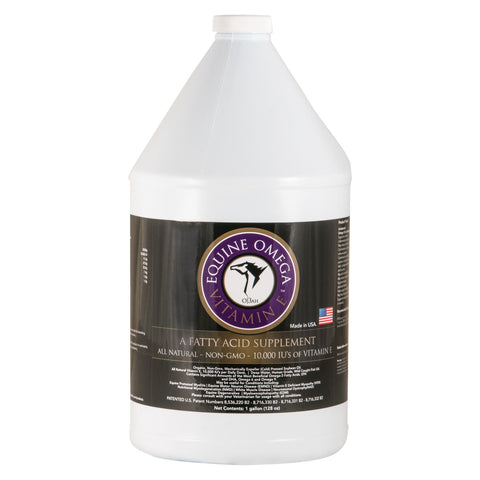
One Oil-Based Formula With More of the Ration Visible
This Schneiders supplement combines natural-source vitamin E with soybean and fish oils while publishing key fatty-acid and calorie information for informed feeding discussions.
Review the Formula With Your Veterinarian
Explore Equine Omega Vitamin E and use its published ingredient and nutrient information when discussing your horse’s feeding plan with your veterinarian.