
Nutritional Support for Metabolic Concerns, Sore Feet, and Pasture Management
See how Heiro Insulin Resistance Supplement fits into an equine feeding and management routine.

When Foot Soreness Makes Every Turnout Decision Harder
If your horse has elevated insulin, a history of founder, chronic foot soreness, or sensitivity to pasture changes, that uncertainty can become part of every barn day. A cresty neck, an easy-keeper build, or a previous laminitis episode may raise concern, but those signs alone cannot diagnose insulin dysregulation. You need veterinary testing and a management plan built for your horse—not guesswork based on appearance or a single difficult morning.
The practical cost reaches far beyond one missed ride. You may be maintaining a dry lot, testing hay, soaking forage, checking digital pulses, arranging frequent farrier visits, and watching every change in stride. Turnout with the herd may need to be limited while you and your veterinarian assess diet, body condition, hoof health, and insulin response. Even ordinary seasonal changes—lush spring growth, stressed summer grass, or frosty fall pasture—can turn the paddock gate into a daily decision instead of a simple routine.
You want your horse comfortable, moving willingly, and participating safely in turnout. Getting there requires a coordinated plan, because metabolic and hoof concerns are rarely solved by changing only one part of your horse’s care.

Metabolic and Hoof Concerns Demand More Than Feed-Room Guesswork
That expectation creates confusion because metabolic-support formulas are not interchangeable. Some center on magnesium and chromium. Others list amino acids, polyphenols, herbs, probiotics, hoof nutrients, or vitamin E. Serving sizes, concentrations, package yields, and purchase requirements also differ. A familiar ingredient name does not establish that two products provide the same formula or serve the same role. Published veterinary guidance is equally clear that diet remains central to managing equine metabolic syndrome, and a supplement should not be treated as a substitute for controlled forage, appropriate weight management, farriery, or follow-up testing.
When those distinctions are overlooked, your horse can end up paying for an overly simple plan. A comfortable week may be mistaken for permission to return immediately to unrestricted grass. A new tub may be added without checking how its vitamins and minerals overlap with a ration balancer or other supplements. Foot soreness may be watched for several days instead of prompting a timely veterinary call. Meanwhile, you’re left studying labels in the feed room, wondering which numbers matter and whether the routine is actually appropriate for your horse.
That is the trap: expecting one scoop to carry the full burden of metabolic management. Your horse needs a plan in which every piece has a defined purpose. Until the supplement’s ingredients, directions, and limitations are clear, adding another product can create more questions instead of the confidence you need at the paddock gate.
- ✗Chronic sore feet can complicate daily movement and turnout decisions.
- ✗Elevated insulin levels may be associated with laminar injury and foot pain.
- ✗A history of founder can make pasture access an ongoing concern.
- ✗Seasonal factors can add uncertainty for horses prone to laminar injury and soreness.
A Veterinarian-Developed Herbal Formula for Equine Nutritional Support
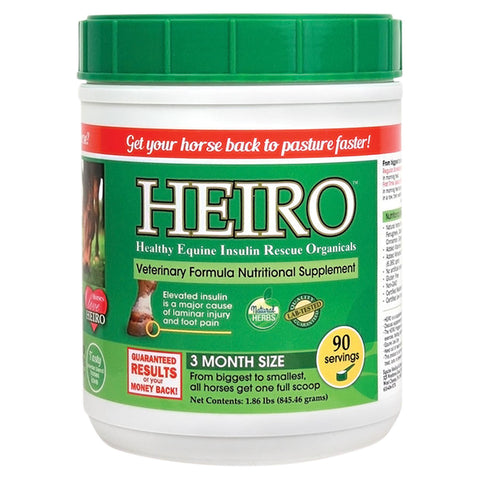
The regular schedule is straightforward: mix one enclosed scoop into your horse’s morning feed once daily. The listed directions provide a separate schedule when your horse is foot sore—one scoop in the morning and one in the evening for 10 consecutive days, followed by a return to the regular schedule. Because foot soreness can signal a serious problem, that label direction should accompany, not delay, a conversation with your veterinarian. The product is offered in 30-day and 90-day options, with the 0.62-pound container identified as a 30-day supply.
HEIRO is also listed as containing no artificial colors or preservatives and as certified low in sugar, starch, and fructan. The product page states that it is certified melamine-, pesticide-, lead-, and drug-free and made in the USA. For your horse, the practical benefit is a measured daily routine that can be incorporated into a carefully controlled feeding program without pretending that supplementation replaces forage analysis, pasture decisions, diagnostic testing, exercise planning, or skilled hoof care.
For you, that clarity means knowing what is in the published formula, how it is fed, and where it belongs in the larger plan. You can bring the ingredient list and nutrient declarations to your veterinarian, review possible overlaps with your horse’s existing ration, and monitor progress using objective veterinary and farrier guidance. It is a horse-first approach to nutritional support: a defined formula, a repeatable routine, and realistic expectations. Backed by equine expertise and offered by a family-owned company trusted since 1948.
Targeted Equine Support
A veterinarian-developed nutritional formula for horses with elevated insulin levels — used as part of a broader management plan built with your veterinarian.
Named Herbal Blend
Contains fenugreek, ocean kelp, blue-green spirulina algae, cinnamon, ginger, willow, peppermint, milk thistle, and alfalfa.
Added Nutritional Ingredients
The published formula includes natural, soluble vitamin E and magnesium oxide.
Straightforward Feeding Routine
The enclosed scoop is mixed into feed according to the regular or foot-sore directions on the label.
What to Review Before Adding HEIRO to Feed
- Confirm that the formula suits your horse’s veterinarian-guided plan.
- Review the complete proprietary herbal blend.
- Check the added vitamin E and magnesium oxide against the current ration.
- Follow the enclosed-scoop directions on the label.
- Keep the bottle tightly closed.
- Use only for equines and keep out of reach of children.
- Consult your veterinarian for a pregnant, nursing, or medicated horse.
Compare Metabolic Support Formulas Side by Side
This comparison reflects published product and label information available on the cited pages. The formulas serve different nutritional purposes, so review ingredient amounts, existing feed and supplements, and your horse’s veterinary plan before choosing.
| Feature | Schneiders HEIRO Insulin Resistance Supplement | KPP InsulinWise® | AniMed REMISSION |
|---|---|---|---|
| Published formula approach | Proprietary blend of nine named USDA Certified Organic herbs with added natural vitamin E and magnesium oxide | Published active ingredients include amino acids plus the polyphenols resveratrol and quercetin | Magnesium oxide-based formula listing amino acids, flaxseed meal, rice bran, yeast ingredients, vitamins, minerals, and probiotics |
| Labeled daily serving | Regular schedule: 1 enclosed scoop once daily in morning feed | 1 scoop (28 g) daily; may be split into two 14 g feedings | 1 oz daily per 1,000 lb body weight; maintenance serving is 1/2 oz daily per 1,000 lb |
| Published vitamin E declaration | Natural/soluble vitamin E: 128,190 IU/lb | Not listed among the published active or inactive ingredients in the cited catalog page | 70 IU per ounce |
| Published magnesium declaration | Magnesium oxide: 6,360 ppm | Not listed among the published active or inactive ingredients in the cited catalog page | Magnesium: 6,000 mg per ounce |
| Named herbal blend | Fenugreek, ocean kelp, blue-green spirulina algae, cinnamon, ginger, willow, peppermint, milk thistle, and alfalfa | Not listed in the cited active or inactive ingredient statements | Not listed in the cited ingredient statement |
| Published probiotic declaration | Not listed on the cited product page | Not listed on the cited catalog page | 175 million CFU total lactic acid bacteria per ounce |
| Published package or supply options | 0.62-lb 30-day supply and a 90-day option | 2-lb bucket containing 32 scoops or 5-lb bucket containing 80 scoops | FarmVet listing offers REMISSION by package size; serving duration depends on body weight and whether the full or maintenance serving is used |
| Purchase channel noted by source | Available through Schneider Saddlery as a retail supplement | Manufacturer states that it is sold through licensed veterinarians only | Available through the cited equine retail listing |
A Published Formula You Can Review Ingredient by Ingredient
- ✓Developed by a veterinarian
- ✓Made with USDA Certified Organic herbs
- ✓No artificial colors or preservatives
- ✓Certified low in sugar, starch, and fructan
- ✓Made in the USA
Choose the Available Supply and Use the Enclosed Scoop
Defined Ingredients for a Defined Role
HEIRO provides equine nutritional support through a veterinarian-developed blend of organic herbs, added natural vitamin E, and magnesium oxide, with clear label directions for incorporating it into feed.
Bring a Clearly Listed Formula Into Your Horse’s Care Plan
Review Heiro Insulin Resistance Supplement, its named herbal ingredients, added vitamin E and magnesium oxide, and label directions with your veterinarian.