
Total Roughout Grip Meets Close-Contact Western Work Design
Meet the Schneiders® Running W II Roughout Western Work Saddle, designed for training rides and ranch work.

When Your Work Saddle Does Not Deliver the Grip or Connection You Want
Every serious Western rider knows that a saddle is more than a place to sit. It shapes how connected you feel through transitions, circles, lateral work, and long stretches outside the arena. A smooth seat may not provide the grip you want during active schooling or ranch work. A bulky build can make your cues feel farther away. Extra weight may also become noticeable when you are saddling more than once a day, moving tack between horses, or loading your trailer before sunrise.
The cost is not limited to one inconvenient ride. When a saddle does not suit the job, you may spend your time adjusting your position instead of concentrating on your horse. You may hesitate to use it for everyday work, leaving an expensive piece of tack sitting on the rack. Then the search begins again: another listing, another collection of vaguely described tree shapes, and another attempt to compare saddles whose published specifications do not answer the same basic questions.
You need clear information about tree construction, bar style, gullet width, skirt dimensions, weight, hardware, and warranty before deciding whether a saddle belongs on your fitting list. Without those details, “work saddle” is only a category label—not enough to tell you how the saddle is built or whether its design matches your priorities.

A Smooth Seat, Bulky Feel, or Unclear Build Can Distract From the Work
Terms such as “work,” “training,” “trail,” and “all-around” describe intended use, but they do not replace measurable specifications. Two saddles with similar silhouettes can differ substantially in weight, skirt length, tree construction, bar designation, seat surface, and rigging. Even familiar phrases such as full horse bars or Quarter Horse bars are starting points rather than a final fit verdict. If a listing leaves out the gullet, skirt, or warranty, you cannot safely fill in the blank from the category name or assume that one maker’s terminology matches another’s.
That uncertainty can create a frustrating cycle. You compare one saddle with a published weight but no gullet measurement, then another with several tree options but a different seat treatment. You carry a heavy saddle to the mounting area only to decide it is more than you want to handle every day. Or you choose a smooth surface for its finished appearance, then realize you would prefer more grip during colt starting, schooling, or ranch work. Each mismatch costs time, return effort, and another disruption to your horse’s routine.
The trap is believing that you must choose between useful working features, manageable weight, and a clearly documented build. You do not need louder promises or a generic claim that one saddle fits everything. You need a practical set of published specifications, followed by a careful fit check for your horse and an honest assessment of how you ride.
- ✗A smooth seat may not provide the grip you prefer during active training rides or ranch work.
- ✗A bulky saddle can create more distance between your seat and leg cues and your horse.
- ✗A heavier build can be less convenient to carry, lift onto your horse, or load for a ride.
- ✗Missing construction details can make it harder to decide whether a saddle belongs on your fitting list.

A Lightweight Roughout Saddle Built for Stability and Direct Feel
Its published measurements make the first stage of comparison straightforward. The saddle has a 7-inch gullet and a 28-by-14-inch skirt, and it is offered in 14-, 15-, 16-, and 17-inch seat sizes. The listed weight is 21.5 pounds, making it notably manageable for carrying from the tack room, lifting onto your horse, or loading for a day away from home. Stainless-steel, heavy-duty hardware is specified for working use, and the injected-molded plastic tree carries a five-year warranty.
For your horse, the full horse bars are designed to accommodate most modern conformations, while the close-contact construction is intended to reduce the feeling of unnecessary distance between you and your horse. That does not replace an individual saddle-fit evaluation: your horse’s topline, withers, shoulder movement, back length, pad, and condition still matter. What this saddle offers is a clearly defined starting point, with the gullet, bar style, and skirt dimensions available before you decide whether to try the fit.
For you, the payoff is a work saddle built around everyday practicality rather than unnecessary ornament. You get the grip of a total roughout surface, pre-turned fenders, a published 21.5-pound weight, durable stainless-steel hardware, and four seat-size choices in one focused design. It is a value-conscious option for riders who want a saddle for regular training or ranch work and prefer to compare real specifications before making a decision. Backed by a five-year tree warranty and equine expertise from a family-owned business trusted since 1948, the Running W II is built to earn its place in your working tack lineup.
Secure Roughout Surface
The total roughout design adds texture for grip and stability during training rides and ranch work.
Close-Contact Feel
Pre-turned fenders support a closer feel through your seat and leg while you ride.
Lightweight Tree Construction
The injected-molded plastic tree keeps the saddle lightweight for everyday handling.
Working-Grade Hardware
Heavy-duty stainless-steel hardware complements the saddle’s practical work-focused design.
Is the Running W II Built Around Your Riding Priorities?
- You want a total roughout saddle for added grip.
- You ride for training or ranch work.
- You prefer a close-contact feel.
- You value pre-turned fenders.
- You are considering full horse bars.
- You want a lightweight injected-molded plastic tree.
- You prefer heavy-duty stainless-steel hardware.
Compare the Published Saddle Specifications
These three Western saddles serve different working, training, or trail priorities. The table compares only specifications stated on the cited product pages; omitted details are marked “not listed” rather than inferred.
| Feature | Schneiders Schneiders® Running W II Roughout Western Work Saddle | Dakota Saddlery Roughout Training Saddle | Cashel Roughout Trail Saddle |
|---|---|---|---|
| Published intended use | Training rides or ranch work | Training | Trail riding |
| Seat sizes listed | 14", 15", 16", 17" | 14", 15", 16", 17" | 15", 16", 17" |
| Roughout treatment | Total roughout design with roughout leather seat | Full roughout with black suede seat | Roughout jockeys and fenders |
| Tree construction | Injected-molded plastic tree | Double fiberglass-covered tree | Fiberglass-covered AXIS tree |
| Published bar or tree-fit description | Full horse bars | Quarterhorse bars | AXIS Quarter Horse or Wide tree; standard, wide, and extra-wide gullet options listed |
| Published gullet width | 7" | Not listed | 6.5" standard, 7" wide, or 7.5" extra wide |
| Published weight | 21.5 lb | Approximately 35 lb | Approximately 24.5 lb |
| Published skirt dimensions | 28" x 14" | Not listed | 25", 26", or 27" long, depending on seat size; width or drop not listed |
| Published hardware or rigging | Stainless-steel heavy-duty hardware; rigging position not listed | Stainless-steel in-skirt rigging in 7/8 position | In-skirt rigging in 7/8 position; hardware material not listed |
| Published tree warranty | 5 years | 5 years | Not listed on cited product page |
Published Construction Details Make This Saddle Easier to Evaluate
- ✓Total roughout design with a secure roughout leather seat
- ✓Full horse bars designed for modern conformations
- ✓Close-contact feel supported by pre-turned fenders
- ✓Lightweight injected-molded plastic tree
- ✓Heavy-duty stainless-steel hardware
What the Running W II Brings to Training and Ranch Work
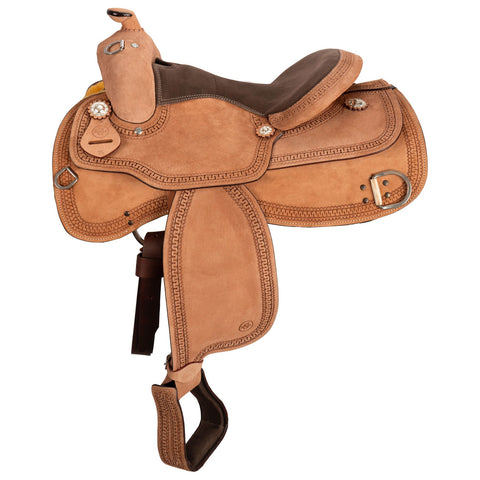
A Focused Western Work Saddle With Grip, Close Contact, and a Lightweight Build
The Running W II combines a total roughout surface, pre-turned fenders, full horse bars, stainless-steel hardware, and an injected-molded plastic tree in a saddle designed for training rides and ranch work.
Put Roughout Grip and Close Contact Into Your Working Tack Lineup
Explore the Schneiders® Running W II Roughout Western Work Saddle and choose from the available Light Oil seat options.