
FDA-Approved Ulcer Prevention — Before the Haul, Not After the Signs
UlcerGard® (omeprazole) is the only non-prescription formula proven to prevent Equine Gastric Ulcer Syndrome in healthy horses. Each syringe holds four marked daily doses for horses weighing 600 to 1,200 lbs.

Your Horse Can't Tell You When Something Hurts
Every attentive rider knows how unsettling that uncertainty can be. Decreased appetite, recurrent colic, intermittent loose stools, a dull coat, poor body condition, and slipping performance can be associated with gastric ulcers, but those signs can also point to other conditions. Even when your horse looks generally healthy, travel, stall confinement, training, racing, showing, and competition can introduce changes in routine that deserve thoughtful gastric-health planning.
The cost is not limited to an entry fee or a missed ride. You may spend the weekend watching every manure pile, checking the water bucket, and questioning each change in expression instead of focusing on your horse’s comfort and the work you prepared to do together. If the signs continue, guessing can also delay the veterinary evaluation needed to identify whether ulcers—or another health problem—are responsible.
That is what makes prevention a separate decision from treatment. UlcerGard® is intended only to prevent gastric ulcers in healthy horses; it is not a substitute for diagnosing a horse that is already showing concerning signs. The challenge is recognizing when your horse is entering a stressful period and putting a prevention plan in place before discomfort becomes the question hanging over every ride.

Every Stress Event Is a Risk — and Your Horse's Stomach Never Stops Producing Acid
- ✗A long haul to the show you've been pointing at all season
- ✗Three days in a stall at a venue your horse has never seen
- ✗A training block that steps up faster than his routine does
- ✗Rehab confinement after an injury

UlcerGard® — The Only OTC Formula With a Proven Prevention Claim
FDA Approved for Prevention
The only non-prescription formula proven to prevent Equine Gastric Ulcer Syndrome, and it's FDA approved.
4 Doses Per Tube
Each syringe covers four days for horses 600–1,200 lbs, making it economical across a full show weekend or trail trip.
Easy to Administer
Cinnamon-flavored paste applied to the back of the tongue or cheek pouch — no mixing, no supplements to hide in feed.
Stress-Event Ready
Made for the stressful conditions the label names — trailering, showing, training, racing, and injury rehabilitation.
Is UlcerGard® Right for Your Horse?
What Riders Are Saying
"I use it for trailering and camping on all my horses, one is ulcer prone and so far no more ulcers"
"Shipped quickly when I needed it."
"This works and is a must have at the shows."
How UlcerGard® Fits Among Equine Omeprazole Products
These FDA-approved omeprazole pastes have different labeled purposes. UlcerGard® is an over-the-counter preventive for healthy horses, while GastroGard® and Gastrobim® are prescription products labeled for treating diagnosed gastric ulcers and preventing recurrence. Consult your veterinarian when your horse shows possible clinical signs.
| Feature | Schneiders UlcerGard® (omeprazole) | GastroGard® (omeprazole) Oral Paste | Gastrobim® (omeprazole) Oral Paste |
|---|---|---|---|
| FDA regulatory status | FDA-approved animal drug under NADA 141-227 | FDA-approved animal drug | FDA-approved generic animal drug under ANADA 200-842 |
| How dispensed | Over the counter | Prescription required | Prescription required |
| Labeled indication | Prevention of gastric ulcers in healthy horses | Treatment of gastric ulcers and prevention of recurrence in horses and foals at least 4 weeks old | Treatment of gastric ulcers and prevention of recurrence in horses and foals at least 4 weeks old |
| Active ingredient and dosage form | Omeprazole oral paste | Omeprazole oral paste | Omeprazole oral paste |
| Labeled treatment regimen for existing ulcers | Not labeled for treatment; consult a veterinarian when clinical signs are present | 4 mg/kg orally once daily for 4 weeks | 4 mg/kg orally once daily for 4 weeks |
| Labeled regimen for preventing ulcer recurrence after treatment | Not listed as an indication | 2 mg/kg orally once daily for at least 4 additional weeks | 2 mg/kg orally once daily for at least 4 additional weeks |
| Labeled primary-prevention dosing | At least 1 mg/kg once daily; one marked dose for horses 600–1,200 lb and two marked doses for horses over 1,200 lb | Primary prevention in healthy, ulcer-free horses is not listed as an indication | Primary prevention in healthy, ulcer-free horses is not listed as an indication |
| Published age or weight boundary | For horses at least 600 lb; consult a veterinarian below 600 lb, and effectiveness in foals and weanlings has not been evaluated | For horses and foals at least 4 weeks old | For horses and foals at least 4 weeks old |
What Makes UlcerGard® Different From Feed-Through Ulcer Supplements
The patented paste formulation guarantees stability and consistency dose to dose — you get the same effective amount in the first squeeze and the last. It's suitable for use in breeding stallions and is recommended for horses exposed to any of the stressors that drive ulcer formation: trailering, competition, intensive training, racing, or injury rehabilitation.
Note: Safety in pregnant mares has not been determined. If your horse already shows clinical signs of ulcers, consult your veterinarian — treatment may require prescription-strength omeprazole before switching to a prevention protocol.
- ✓FDA-Approved for ulcer prevention — the only non-prescription formula with a clinically proven prevention claim
- ✓Omeprazole (proton pump inhibitor) reduces acid production at the source, not just a buffer or coating
- ✓Patented paste formulation guarantees stability and dose-to-dose consistency
- ✓Cinnamon-flavored syringe — easy administration on the tongue or in the cheek pouch
- ✓4 daily doses per tube for horses 600–1,200 lbs; horses over 1,200 lbs require 2 doses per day
FDA-Approved Prevention, Ready When Your Horse Needs It
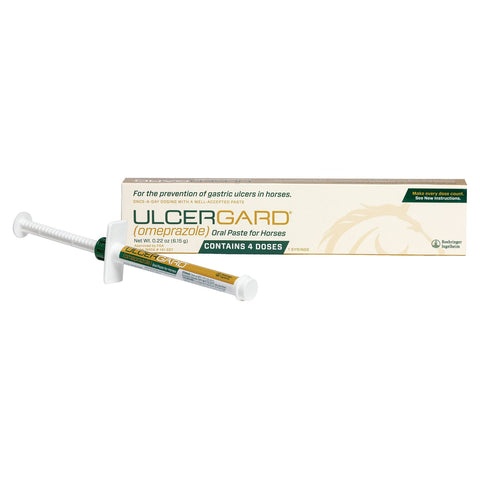
If your horse faces stress events, UlcerGard® is the one preventive that's actually been proven to work.
It carries the only FDA-approved prevention claim available over the counter — not treatment, not management, prevention. Keep a tube in your trailer and your show kit, and your horse's gut has real protection even when the schedule is demanding.
Protect Your Horse Before the Next Haul
UlcerGard® (Omeprazole) is $270.99, with free shipping on orders $99+. Each tube holds four daily doses for a horse weighing 600 to 1,200 lbs, so plan your prevention window before the trailer is hitched. If your horse is already showing decreased appetite, recurrent colic, loose stools, a poor hair coat, or a drop in condition, call your veterinarian for diagnosis and treatment — UlcerGard® is labeled for prevention in healthy horses.